Sindhi Grammar: Zamir and Its Types
Sindhi grammar zamir types matter because zamir words let us avoid repeating the same name again and again in every sentence. A zamir is a pronoun: a word that stands in place of an ism, such as a person, place or thing already mentioned. Instead of writing Ali went, Ali sat and Ali read in three sentences, we can write Ali went, he sat and he read, using a zamir for the second and third mention. This guide explains the main types of zamir in Sindhi, including personal, demonstrative and relative pronouns, with illustrative examples in Roman transliteration. You will learn how each type works, how to choose the right form, and which mistakes students make most often in writing.
What Is a Zamir and Why Do We Need It
A zamir replaces an ism so that speech and writing stay smooth and natural. Without zamir words, even a short paragraph would sound repetitive and clumsy, because every sentence would have to repeat full names and nouns. With zamir words, a writer can introduce a person or thing once, then refer back to it briefly in the sentences that follow. That is why zamir is one of the first grammar topics taught after ism, fail and harf: it builds directly on knowing what an ism is, and it makes longer writing possible without constant repetition.
The key rule is that a zamir must point clearly to something the reader already knows. If you write He is reading, the reader must be able to tell who he refers to, either from an earlier sentence or from the situation. A vague zamir confuses the reader just as much as a missing word does. Good writers therefore introduce the ism first, then use the zamir, and they switch back to the full name whenever a new person enters the story. Practise this by rewriting a short paragraph: replace repeated names with zamir words, then read it aloud to check that every reference is still clear.
Personal Zamir: Talking About People
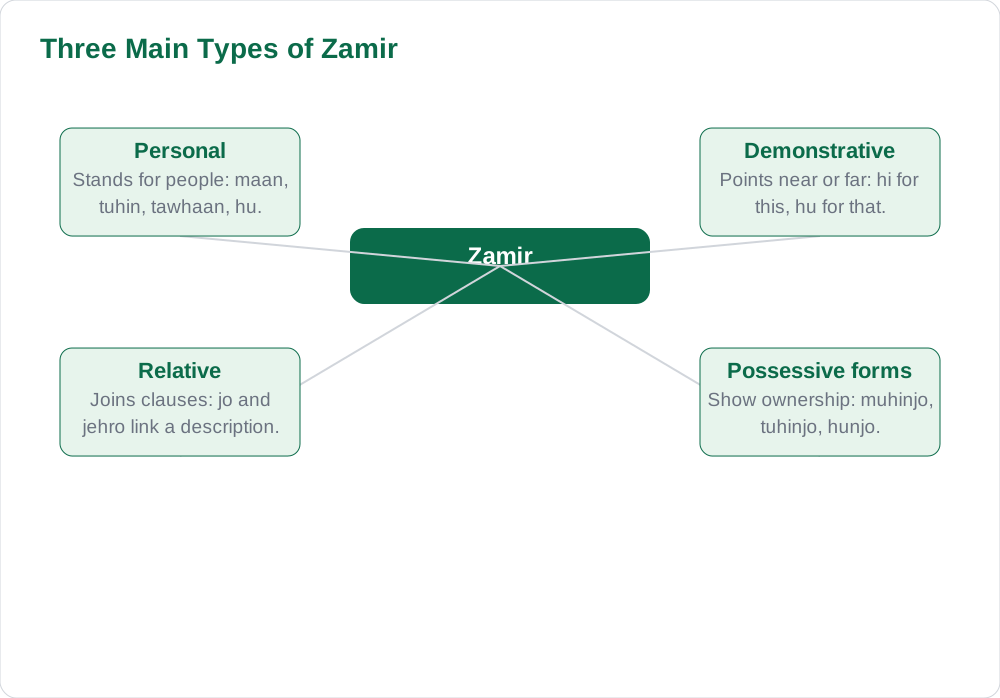
Personal zamir words refer to people in the first, second or third person. First-person forms include maan (I) and asaan (we), used when the speaker talks about himself or herself or a group including the speaker. Second-person forms include tuhin (you, singular familiar) and tawhaan (you, respectful or plural), used when speaking directly to someone. Third-person forms include hu (he or she, near or general) and uh (that one), used when talking about someone who is not part of the conversation. Choosing between tuhin and tawhaan also shows respect, so students should notice how adults address elders and teachers.
Personal zamir forms change with case and number, so the same person may appear as maan, muhinjo (my) or mukhe (to me) depending on the sentence. For example, the illustrative sentences Maan kitab parhi tho (I am reading a book) and Ustad mukhe sabak dino (The teacher gave me the lesson) both refer to the speaker, but the form changes because the role in the sentence changes. The best way to learn these forms is to practise one person at a time: write five sentences using maan, then five using asaan, then five using tawhaan, and compare the forms. For more solved material, visit the solved notes and book list pages.
- First person: maan (I), asaan (we)
- Second person: tuhin (you, familiar), tawhaan (you, respectful)
- Third person: hu (he or she), uh (that person)
- Possessive: muhinjo (my), tuhinjo (your), hunjo (his or her)
Demonstrative Zamir: Pointing to Near and Far
Demonstrative zamir words point to something, showing whether it is near the speaker or farther away. Sindhi uses hi (this) for things that are near and hu or uh for things that are farther away, although the exact form depends on gender, number and case in the full sentence. For example, the illustrative sentence Hi kitab muhinji aahe (This book is mine) points to a book close at hand, while Hu kitab ustad ji aahe (That book is the teacher's) points to one farther away. Learning this near and far contrast helps students describe objects, choose items in a shop, and follow directions accurately.
A common confusion is mixing demonstrative zamir with demonstrative sifat, which is a describing word used before an ism. In Hi kitab suthi aahe (This book is good), hi points to the book and works with the ism kitab. The test is simple: if the word stands alone in place of the ism, it is a zamir; if it stands before the ism and describes which one, it is closer to a sifat. Students should practise pairs of sentences, one with the word alone and one with the word before an ism, and explain the difference. This small distinction earns marks in grammar exercises and improves clarity in everyday writing.
Relative Zamir: Joining Two Ideas Together
Relative zamir words join two clauses by referring back to a person or thing already mentioned. The most important Sindhi relative word is jehro or jo (who, which, that), used in sentences where one part describes another. For example, the illustrative sentence Chhokro jehro mehnat kare tho, so kamyab thindo (The boy who works hard will succeed) uses jehro to link the description of hard work to the boy. Without the relative zamir, the sentence would split into two short, disconnected statements, and the link between effort and success would feel weaker.
Relative zamir sentences need care with word order and agreement, because the relative clause sits inside the main sentence. A useful method is to build the sentence in two steps: first write the main statement, then add the describing clause with jo or jehro. For example, start with Kitab suthi aahe (The book is good), then expand it to Kitab jo maan parhi, so suthi aahe (The book which I read is good). Read the full sentence aloud and check that the relative word still points to the right ism. If the sentence sounds tangled, split it again and rebuild it slowly. This patient method prevents the long, confusing sentences that lose marks.
Common Zamir Mistakes and How to Fix Them
The most common zamir mistake is a unclear reference: the reader cannot tell who he or she means because two people were mentioned. For example, if Ali and Ahmed are both in a paragraph and the next sentence says Hu aayo (He came), the reader cannot know which boy came. The fix is simple: repeat the name when a new person appears, or rewrite the sentence so only one person is possible. Another frequent mistake is mixing respectful and familiar forms, such as using tuhin for a teacher, which sounds rude in Sindhi. Always use tawhaan for elders, teachers and strangers, and keep tuhin for close friends and younger children.
A third mistake is changing the zamir halfway through a paragraph without reason, jumping from maan to asaan or from hu to uh. Consistency matters: once you choose a form for a person, keep it unless the person or distance genuinely changes. Before submitting written work, read it once just for zamir words: circle each one, draw an arrow to the ism it replaces, and check that every arrow is clear. This five-minute check catches most errors and is one of the fastest ways to raise the quality of Sindhi composition. More practice ideas are available on the blog and the [home page](/) of this site.
AI Help: Muse AI
Muse AI is Meta's personal AI assistant, and it can help you practise zamir by turning a paragraph full of repeated names into a smoother version using pronouns. For this topic, ask it to explain personal, demonstrative and relative zamir with new examples, then label the zamir words in its sentences yourself.
Join Muse with invite code LTGSWD — in the Muse app, go to Settings > Redeem token and enter the code. Disclosure: LTGSWD is the author's Muse invite code. Muse AI does not give official STBB answers — always verify against your STBB book and your teacher. Remember to verify against your Sindh Textbook Board book before using any explanation in classwork or exams.
5 key points you must know
- A zamir stands in place of an ism so writing avoids repeating the same name.
- Personal zamir covers first, second and third person, including respectful tawhaan.
- Demonstrative zamir points near with hi and farther away with hu or uh.
- Relative zamir words like jo and jehro join a description to the main sentence.
- Every zamir must point clearly to one ism, or the reader will be confused.
Frequently asked questions
What is the difference between ism and zamir?
An ism names a person, place or thing directly, such as Ali or kitab. A zamir replaces that ism after it has been introduced, such as hu for Ali. You introduce the ism first so the reader knows who you mean, then use the zamir in later sentences to avoid repetition. If the zamir could point to two different people, repeat the name instead.
When should I use tuhin and when tawhaan?
Use tuhin for close friends, younger children and people you know very well. Use tawhaan for teachers, elders, strangers and anyone you should address respectfully, and also when speaking to more than one person. Using tuhin for a teacher sounds disrespectful in Sindhi, so this choice is about manners as well as grammar.
What is a demonstrative zamir with an example?
A demonstrative zamir points to something near or far. Hi means this and points to something close, as in Hi kitab muhinji aahe (This book is mine). Hu or uh means that and points to something farther away, as in Hu kitab ustad ji aahe (That book is the teacher's). The contrast between near and far is the key idea to remember.
How does a relative zamir work in a sentence?
A relative zamir joins a describing clause to a main sentence. In Chhokro jehro mehnat kare tho, so kamyab thindo, jehro links the description of hard work to the boy. Build such sentences in two steps: write the main statement first, then add the clause with jo or jehro, and read the result aloud to check the word order.
Why is my zamir marked wrong even when the word is correct?
Often the word itself is right but the reference is unclear. If two people appear in a paragraph and you write hu, the examiner cannot tell which person you mean. Fix it by repeating the name when a new person enters, keeping one form consistently for each person, and circling each zamir to check it points to exactly one ism before you submit your work.
Solved notes — preview free
These guides work best with the solved exercises. Preview the solved notes free on this website — 119 solved notes for Classes 6–10 in Sindhi, Urdu, English and Arabic medium. Or browse the full solved notes catalogue for your class and medium. New solved notes are added regularly — check the catalogue for coming-soon books.