Sindhi Grammar: Wahid and Jama Rules

Sindhi grammar wahid and jama rules decide whether a word refers to one thing or to more than one, and getting them right changes the whole sentence. Wahid means singular, one person, place or thing, while jama means plural, more than one. In Sindhi, changing a noun from wahid to jama often changes its ending, and the verb, sifat and zamir in the sentence must change to match. This guide explains the most common singular-to-plural patterns, the irregular forms students meet most, and the agreement checks that keep sentences correct. All Sindhi examples are illustrative, given in Roman transliteration, so you can practise the patterns without memorising whole lists blindly.
Wahid and Jama: The Basic Idea
Wahid refers to one item, such as hik kitab (one book) or hik chhokro (one boy). Jama refers to more than one, such as be kitaba (two books) or ghanan chhokra (many boys). The change from wahid to jama is not just about the noun itself: in a correct sentence, the verb and any describing words must also agree with the new number. For example, the illustrative pair Chhokro parhi tho (The boy is reading) and Chhokra parhin tha (The boys are reading) shows the noun, the verb form and the overall pattern changing together. Students who change only the noun often produce sentences that sound wrong to a Sindhi reader.
Number also interacts with gender, because muzakkar and muannas nouns may form their plurals differently. That is why grammar lessons teach wahid and jama alongside gender: the two systems work together in every sentence. A practical starting habit is to learn each new ism in a pair, wahid and jama together, rather than learning the singular alone and guessing the plural later. Write the pair in your notebook, add one example sentence for each form, and revise the pairs weekly. This small habit prevents a large number of agreement errors in composition and translation exercises.
Common Patterns for Making Jama
Many Sindhi nouns form their jama by changing or adding an ending, and recognising the pattern makes new words easier. One common pattern changes a final vowel, so a noun ending in a certain sound takes a different ending in the plural. Another pattern adds a plural marker to the stem, keeping the base word recognisable. A third pattern changes an internal vowel or uses a form borrowed from Arabic or Persian patterns, which students meet in more formal vocabulary. Rather than memorising a rule for every word, learn the pattern groups with three examples each, and then sort new words into the group they resemble.
Counting words also help signal jama: be (two), teen (three) and ghanan (many) almost always appear with plural nouns, and they give the reader an early clue about number. When you read, underline the noun and its number word together, and notice the verb form that follows. When you write, decide the number before you choose the verb: if the subject is jama, the verb must be jama too. Teachers often mark number agreement first because it is easy to check and because it affects the whole sentence. Keep a list of pattern groups in the back of your notebook and add each new plural you meet to the group. For more material, see the book list and solved notes.
- Pattern 1: final vowel change in the noun ending
- Pattern 2: plural marker added to the noun stem
- Pattern 3: internal vowel change or borrowed plural form
- Number words like be, teen and ghanan signal a plural noun
Irregular Plurals and Words That Stay the Same
Not every noun follows a neat pattern, and irregular plurals are where students need extra care. Some nouns have a plural form that looks quite different from the singular, often because the word came from Arabic or Persian with its own plural system. Others are collective or uncountable, such as pani (water) or khorak (food), and they do not take a normal plural because they name a substance rather than countable items. A third group stays the same in form for singular and plural, and only the verb or number word shows whether one or many is meant. These exceptions cannot be guessed reliably, so they must be learned as pairs.
The best approach to irregular forms is to collect them deliberately instead of hoping to absorb them by chance. Keep a separate page titled irregular plurals, and write each pair with a short example sentence in both forms. Revise that page more often than the regular patterns, because irregular forms are forgotten fastest. In exams, if you are unsure of a plural, choose a different noun you know well rather than guessing a form that may be wrong. Examiners reward correct, confident vocabulary more than risky guesses, and a safe word used correctly always beats an impressive word used incorrectly.
Agreement: Making the Whole Sentence Match
Agreement means that the noun, sifat, zamir and fail in a sentence all match in number, and often in gender as well. If the subject is jama, the verb must be jama, the sifat describing it must be jama, and any zamir referring back to it must be plural too. For example, the illustrative sentence Sutha chhokra parhin tha (The good boys are reading) keeps sifat, noun and verb all plural. Change one part back to singular and the sentence breaks: a careful reader notices the mismatch immediately, even if the meaning is still understandable. Agreement is therefore a matter of correctness, not just style.
A reliable revision check is to read each sentence and ask, one by one, whether the subject is wahid or jama, and then whether every related word matches that answer. Circle the subject, draw lines to the sifat, verb and zamir that belong to it, and check each line for agreement. This check takes only a minute per paragraph, but it catches errors that spellcheckers and quick rereads miss. Students who do this check before submitting work consistently score higher on grammar, because number agreement is one of the first things a marker notices. Practise the check on old compositions as well as new ones. More tips are on the blog and the [home page](/).
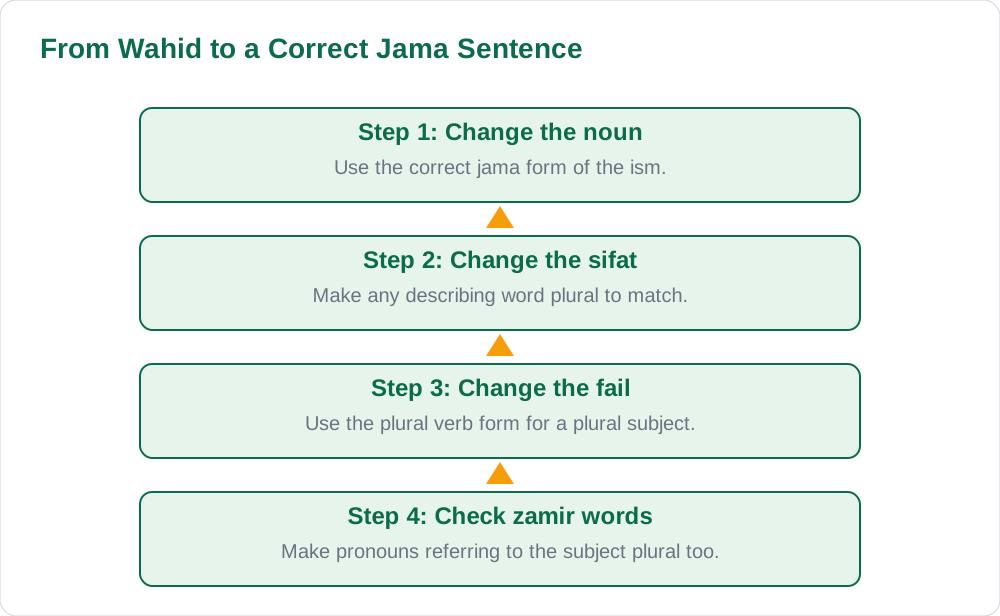
Practice Plan for Wahid and Jama Mastery
A short daily practice plan works better than one long cramming session for wahid and jama. Each day, choose ten nouns from your lesson, write their jama forms, and then write one sentence using each plural correctly. On the second day, return to the same ten words without looking, and write new sentences with them. On the third day, mix those words with ten new ones, so that older forms stay fresh while new ones are added. This spaced repetition mirrors how memory actually works, and it turns plural patterns from a list to be memorised into a skill you can use under exam pressure.
Pair work also helps: one student says a wahid sentence and the partner must convert the whole sentence to jama, changing noun, sifat and verb together. The first student checks every change, and the pair swaps roles after five sentences. This game exposes the common mistake of changing only the noun, because the partner must catch it to score a point. Keep a record of words your class finds hardest, and revise those words most often. Within a few weeks, most students find that plural agreement becomes a habit rather than a calculation, and their writing gains a noticeable smoothness and confidence.
AI Help: Muse AI
Muse AI is Meta's personal AI assistant, and it can help you practise wahid and jama by converting your singular sentences into plural ones for comparison. For this topic, ask it to explain common plural patterns with new examples, then try forming the plurals yourself before checking its answers.
Join Muse with invite code LTGSWD — in the Muse app, go to Settings > Redeem token and enter the code. Disclosure: LTGSWD is the author's Muse invite code. Muse AI does not give official STBB answers — always verify against your STBB book and your teacher. Remember to verify against your Sindh Textbook Board book before using any explanation in classwork or exams.
5 key points you must know
- Wahid means one item and jama means more than one item.
- Changing a noun to jama usually requires changing its verb and sifat too.
- Common plural patterns include ending changes, added markers and internal vowel changes.
- Irregular and uncountable nouns must be learned as pairs, not guessed.
- Check every sentence for number agreement before submitting written work.
Frequently asked questions
What is the difference between wahid and jama?
Wahid means singular, one person, place or thing, such as hik kitab. Jama means plural, more than one, such as be kitaba. The difference matters because the verb, sifat and zamir in the sentence must match the number of the subject. A sentence with a plural subject but a singular verb sounds wrong to a Sindhi reader.
How do I know the plural form of a new Sindhi word?
First, look for the pattern group the word belongs to, such as an ending change or an added plural marker. Then check whether the word is irregular or uncountable, in which case the plural must be learned as a pair. Learn each new noun with its plural in your notebook, and use number words like be or ghanan as clues when you read.
Why does my verb change when the noun becomes plural?
Because Sindhi verbs agree with their subjects in number. A singular subject takes a singular verb form, and a plural subject takes a plural verb form. In Chhokro parhi tho and Chhokra parhin tha, both the noun and the verb change. Changing only the noun leaves a mismatch that markers notice immediately.
Are there Sindhi nouns with no normal plural?
Yes, uncountable nouns naming substances, such as pani (water), do not take a normal plural because they are not counted as separate items. Some nouns also keep the same form for singular and plural, with only the verb or number word showing the difference. Learn these words individually and use quantity words like thoro or ghanan with them instead of a plural ending.
What is the fastest way to improve plural agreement?
Practise ten nouns a day in wahid and jama pairs, write a sentence for each plural, and revise the same words over three days. Then use the circle-and-check method: circle the subject in each sentence and check that its sifat, verb and zamir all match in number. Pair work, where a partner converts your singular sentences to plural, also catches the habit of changing only the noun.
Solved notes — preview free
These guides work best with the solved exercises. Preview the solved notes free on this website — 119 solved notes for Classes 6–10 in Sindhi, Urdu, English and Arabic medium. Or browse the full solved notes catalogue for your class and medium. New solved notes are added regularly — check the catalogue for coming-soon books.