Sindhi Grammar: Tashkeel-e-Alfaaz (Word Formation)

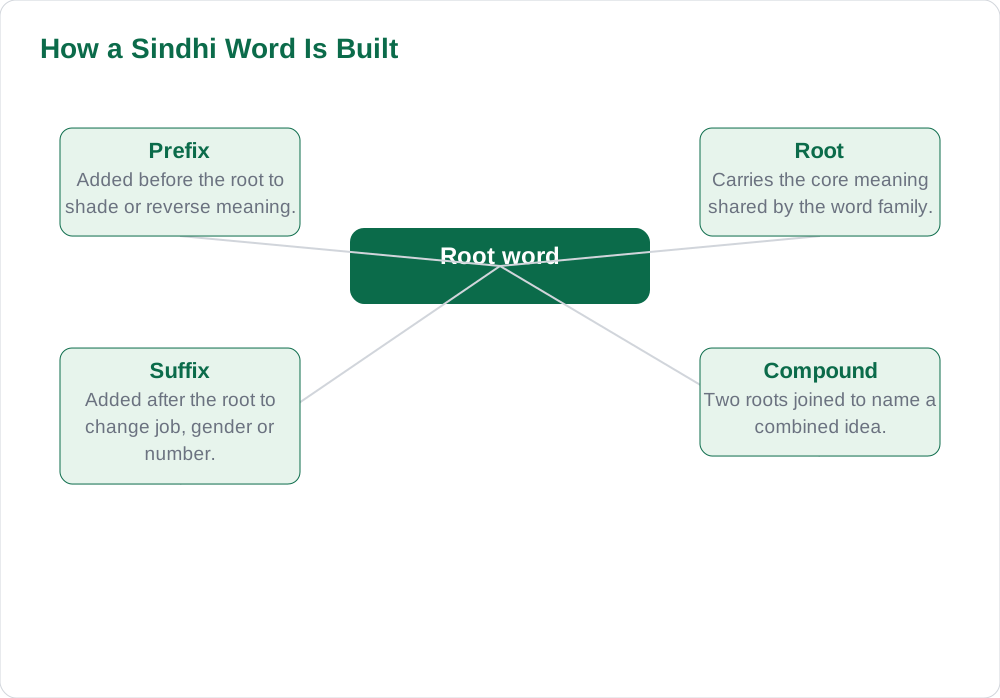
Sindhi grammar tashkeel-e-alfaaz is the study of how words are formed, and it explains why so many Sindhi words look like families sharing a common root. A root word carries the core meaning, a prefix is added at the beginning to change or refine that meaning, and a suffix is added at the end to change the word's job or shade of meaning. Once students recognise roots, prefixes and suffixes, they can guess the meaning of unfamiliar words, spell new words more accurately, and build their vocabulary far faster than by memorising isolated words. This guide explains word formation with illustrative Sindhi examples in Roman transliteration and practical exercises for the classroom.
Root Words: The Core of a Word Family
A root word is the smallest meaningful part of a word, carrying its core idea. For example, the root parh relates to reading, and it appears in parhan (to read), parhae (teaching, as a verb form) and parhaee (study or reading, as a noun idea) in illustrative usage. Recognising the root lets a student see that these words are related, even when their endings differ. Root words are the anchor of vocabulary learning: instead of memorising ten separate words, a student can learn one root and understand the family that grows from it, which saves time and builds confidence with unfamiliar texts.
Roots also help with spelling, because the root usually keeps its shape while prefixes and suffixes change around it. When a student is unsure how to spell a long word, breaking it into root plus affixes often reveals the correct spelling of each part. Practise by choosing five common roots from your lessons, such as likh for writing, parh for reading, and kha for eating, and listing every word you know that contains each root. Compare lists with classmates, and notice how many words share a root. This root-first habit turns vocabulary revision from random memorisation into organised family learning.
Prefixes: Meaning Added at the Beginning
A prefix is a small part added before a root to change or refine its meaning. In Sindhi, prefixes borrowed from Persian and Arabic are common, such as be- for without or lack of, as in be-waqoof used illustratively for a lack of sense, and na- for not, as in na-mumkin (impossible). Other prefixes add ideas like again, together, or against, depending on the root they join. A prefix does not usually change the word's class on its own; it shades the meaning, often turning a positive idea negative or adding a sense of absence, repetition or opposition.
Students should learn prefixes as meaning units, not as random letters. When you meet an unfamiliar word, check whether it begins with a known prefix, remove that prefix mentally, and see whether the remaining root is familiar. If the root is familiar, the prefix will often explain the new meaning: be- plus a quality often means without that quality, and na- plus a possibility often means not possible. Keep a prefix table with three examples for each prefix, and add new examples as you meet them. This guessing skill is especially useful in reading comprehension, where unfamiliar words appear in context and must be understood quickly. For more material, see the book list and solved notes.
- Be-: often means without or lacking, as in be-waqoof
- Na-: often means not, as in na-mumkin (impossible)
- Prefixes shade meaning; they rarely change word class alone
- Strip a known prefix to reveal a familiar root underneath
Suffixes: Meaning and Job Added at the End
A suffix is a part added after a root, and it can change both meaning and grammatical job. For example, adding a suffix to a verb root can turn an action into a person who does it, a place where it happens, or an abstract idea. Illustrative patterns include forming a doer word from an action root, or forming an abstract noun from a quality word, such as turning a description of goodness into the idea of goodness itself. Suffixes also mark gender, number and tense in Sindhi, so the same root with different suffixes can appear as a verb, a noun or a describing word in different sentences.
Because suffixes do so much work, they are a common source of spelling and agreement errors. A student who adds the wrong suffix may produce a word that looks close to correct but belongs to the wrong class or gender. The remedy is to learn suffixes in pairs with their function: this suffix makes a person, that suffix makes a place, this suffix makes an abstract idea. Practise by taking five roots and adding a different suffix to each, then writing a sentence that shows the new word's job. If the sentence does not work, the suffix choice is probably wrong, and the exercise itself teaches the correction.
Compound Words: Two Roots Joined Together
Compound words join two roots or two full words into one new word with a combined meaning. Sindhi, like many languages, builds compounds for everyday ideas, such as joining a word for school with a word for book, or a word for day with a word for time, to name a familiar object or occasion. The meaning of a compound is often close to the sum of its parts, but sometimes it becomes a fixed expression with a special meaning that cannot be guessed from the parts alone. Students should therefore treat compounds as vocabulary to learn, while still using the parts as a first clue to meaning.
Compounds also teach spelling discipline, because the two parts keep their own shapes when joined, and a missing or doubled letter changes the word. When writing a compound, write each part separately first, check its spelling, and then join them carefully. When reading a compound, split it into its parts and ask what each part contributes to the whole meaning. This split-and-join exercise is excellent pair work: one student says a compound, the partner splits it and explains both parts, and the pair checks whether the combined meaning matches the dictionary meaning. More guidance is available on the blog and the [home page](/).
Using Word Formation to Guess Unknown Words
Word formation is most valuable when you meet a word you have never seen before in a reading passage. Instead of stopping or guessing wildly, break the word into prefix, root and suffix, recall the meaning of each part, and combine them into a sensible guess. Then check your guess against the sentence: does it fit the subject, the verb and the overall topic? If it fits, you have probably understood the word well enough to continue reading. If it does not fit, try a different split, because some words can be divided in more than one way, and only one division matches the context.
This guessing method should be practised deliberately, not only used in emergencies. Each week, choose five unfamiliar words from your reading, break each one into parts, write your guessed meaning, and then check it with a dictionary or teacher. Record how often your guess was close, and which prefixes or suffixes helped most. Over time, your guesses will become more accurate, and your reading speed will rise, because you will stop at fewer words. Word formation thus connects grammar to real reading skill, and it is one of the most practical topics in the whole Sindhi grammar course.
AI Help: Muse AI
Muse AI is Meta's personal AI assistant, and it can help you practise tashkeel-e-alfaaz by breaking unfamiliar Sindhi words into roots, prefixes and suffixes. For this topic, ask it to explain word formation with new examples, then try splitting words yourself before checking its answers.
Join Muse with invite code LTGSWD — in the Muse app, go to Settings > Redeem token and enter the code. Disclosure: LTGSWD is the author's Muse invite code. Muse AI does not give official STBB answers — always verify against your STBB book and your teacher. Remember to verify against your Sindh Textbook Board book before using any explanation in classwork or exams.
5 key points you must know
- A root word carries the core meaning shared by a whole word family.
- A prefix is added before a root to shade, reverse or refine meaning.
- A suffix is added after a root and can change meaning and word class.
- Compound words join two roots or words into one combined meaning.
- Breaking a word into parts is the best way to guess an unknown word.
Frequently asked questions
What is tashkeel-e-alfaaz in Sindhi grammar?
Tashkeel-e-alfaaz is word formation: how new words are built from roots, prefixes, suffixes and compounds. A root carries the core meaning, a prefix adds meaning at the beginning, and a suffix adds meaning or changes the word's job at the end. Learning word formation helps students guess unfamiliar words, spell correctly and grow vocabulary faster.
What is the difference between a prefix and a suffix?
A prefix comes before the root, such as be- or na- at the start of a word, and it usually shades or reverses the meaning. A suffix comes after the root, and it can change the word's job, such as turning an action into a person or an abstract idea, as well as marking gender, number or tense. Position is the simplest way to tell them apart.
How does knowing a root help with vocabulary?
One root appears in many related words, so learning the root unlocks the whole family. For example, the root parh relates to reading and appears in several reading words. Instead of memorising each word separately, you learn the root once and recognise its family members in new texts, which makes revision organised rather than random.
Can I always guess a word from its parts?
Not always, but parts give a strong first guess that you can check against the sentence. Split the word into prefix, root and suffix, combine their meanings, and ask whether the result fits the subject and topic. If it fits, continue reading; if it does not fit, try a different split or check a dictionary. Compounds with special fixed meanings are the main exception.
How should I revise prefixes and suffixes for exams?
Keep a table with each prefix or suffix, its meaning or function, and three example words. Revise one group at a time, covering the examples and recalling them from memory. Then practise with five unfamiliar words each week, breaking them into parts and guessing their meanings before checking. This combination of table revision and guessing practice builds lasting skill.
Solved notes — preview free
These guides work best with the solved exercises. Preview the solved notes free on this website — 119 solved notes for Classes 6–10 in Sindhi, Urdu, English and Arabic medium. Or browse the full solved notes catalogue for your class and medium. New solved notes are added regularly — check the catalogue for coming-soon books.