Sindhi Grammar: Sifat and Adverbs in Sentences
Sindhi grammar sifat adverbs are the words that add colour and precision to a sentence, telling us what kind of thing something is and how an action is done. A sifat is a describing word that tells us more about an ism, such as whether a book is new, big or interesting. An adverb, often called a fail jo sifat in simple terms, tells us more about a fail, such as whether someone reads slowly, carefully or every day. Without these words, sentences are correct but flat: The boy reads becomes a picture only when we know which boy and how he reads. This guide explains sifat and adverbs separately, shows where each one sits in a sentence, and gives illustrative Sindhi examples in Roman transliteration for practice.
What Is a Sifat in Sindhi Grammar
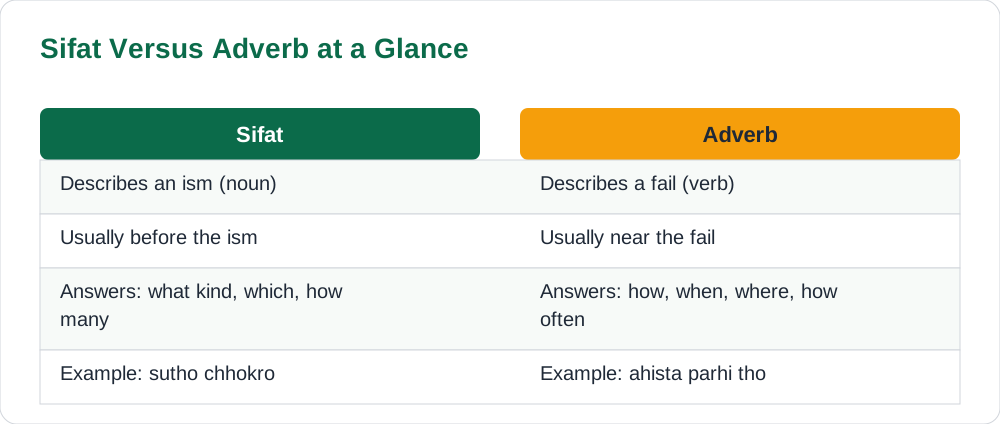
A sifat is a word that describes an ism, giving information about its quality, size, colour, number or condition. In the illustrative sentence Sutho chhokro school wanji tho (The good boy is going to school), sutho is the sifat because it describes chhokro. Other common sifat words include wado (big), nandho (small), lal (red), navo (new) and purano (old). A sifat usually comes before the ism it describes in Sindhi, which makes it easy to spot once you look for the describing word just before a noun. Students should practise by adding one sifat to a plain noun and noticing how much clearer the picture becomes.
Sifat words also agree with the ism they describe in gender and number, and this agreement is where many students lose marks. A sifat used with a muzakkar ism may look different from the same sifat used with a muannas ism, and the plural form may change again. The rule is simple to state but needs practice: always check the ism first, then choose the sifat form that matches it. When you write, underline each sifat and its ism together, and ask whether they match. This pairing habit, repeated daily with five new sentences, builds agreement into your writing so that it becomes automatic rather than a last-minute worry.
Types of Sifat Students Should Know
Sifat words fall into useful groups that help students choose the right description. Quality sifat words describe character or condition, such as sutho (good), kharab (bad) and bahadur (brave). Quantity sifat words tell how many or how much, such as ghanan (many), thora (few) and sab (all). Colour and size sifat words describe appearance, such as lal (red), sawo (green), wado (big) and nandho (small). Number sifat words give an exact count or order, such as pehriyon (first), be (two) and teen (three). Knowing these groups helps you find a precise word instead of repeating sutho for everything.
Demonstrative and possessive words sometimes act like sifat when they stand before an ism, such as hi kitab (this book) or muhinji kitab (my book). In those cases the word points to or claims the ism rather than describing its quality, but it still sits in the sifat position. Students do not need to argue about the label in every case; what matters is recognising that the word belongs with the ism and agrees with it. A practical exercise is to take ten isms from your classroom, write two different sifat words for each, and sort them into quality, quantity, colour, size and number groups. For more reading, see the book list and solved notes.
- Quality: sutho, kharab, bahadur, mehnati
- Quantity: ghanan, thora, sab, kuch
- Colour and size: lal, sawo, wado, nandho
- Number: pehriyon, be, teen, chauthon
What Is an Adverb and How Does It Differ
An adverb describes a fail, not an ism, and it answers questions like how, when, where and how often an action happens. In the illustrative sentence Chhokro ahista parhi tho (The boy is reading slowly), ahista is the adverb because it tells us how the boy reads. In Chhokri roz school wanji thi (The girl goes to school every day), roz is an adverb of time, telling us how often she goes. In Ustad bahar betho aahe (The teacher is sitting outside), bahar is an adverb of place. The test is reliable: if the word describes the action, it is an adverb; if it describes a noun, it is a sifat.
Confusion arises because some words can act as sifat in one sentence and adverb in another. For example, ahista can describe a slow boy in one sentence and slow reading in another, and only the job in that sentence decides the label. Students should therefore ask two questions for every describing word: what does it describe, and is that thing an ism or a fail? Answering those questions correctly is more important than memorising long lists. Practise with pairs of sentences that use the same describing word in both roles, and explain the difference in your own words to a classmate.
Where Sifat and Adverbs Sit in a Sentence
Position helps the reader understand a sentence quickly, so placing sifat and adverbs correctly matters. A sifat normally comes before the ism it describes, as in navo kitab (new book) or suthi chhokri (good girl). An adverb is more flexible: it often comes before the fail, as in ahista parhi tho, or at the start of the sentence for emphasis, as in Roz, chhokri school wanji thi. Adverbs of place often come after the object or before the fail, depending on what the writer wants to stress. Reading sentences aloud is the best test: a well-placed describing word sounds smooth, while a misplaced one sounds awkward.
Word order mistakes usually come from translating directly from another language or from piling too many describing words into one sentence. Keep it simple: one sifat before the ism and one adverb near the fail is enough for most school sentences. If you want a second description, put it in a new sentence or join it with a conjunction. For example, instead of writing a long chain of adjectives, write Kitab navo aahe (The book is new) and then add So sutho bhi aahe (It is also good). Short, well-placed descriptions impress examiners far more than long, tangled ones. More guidance is available on the blog and the [home page](/).
Practice That Builds Describing Skills
Describing skills grow fastest when students practise with real objects and actions around them. Start with five objects in your classroom: write the ism, add a sifat for colour or size, and then write a full sentence using it. Next, choose five actions you do every day, add an adverb for how or when, and write a sentence for each. For example, Maan ahista likhan tho (I am writing slowly) practises an adverb, while Maan navo qalam kharidyo (I bought a new pen) practises a sifat. Doing both exercises in one session teaches the contrast far better than memorising definitions alone.
A second useful exercise is editing: take a plain paragraph of five sentences and add exactly one sifat and one adverb to each sentence, without changing the facts. Then read the edited paragraph aloud and ask whether every addition helps or whether some additions feel forced. Good description adds information the reader needs; extra description that repeats what is already known only makes the paragraph heavy. Ask your teacher to mark one edited paragraph each week, focusing only on sifat and adverb choice and position. Within a month, your descriptions will become sharper, and your composition marks will usually rise with them.
AI Help: Muse AI
Muse AI is Meta's personal AI assistant, and it can help you practise sifat and adverbs by giving you plain sentences to improve with describing words. For this topic, ask it to explain the difference between a sifat and an adverb with new examples, then try adding your own sifat or adverb to each sentence before checking its suggestions.
Join Muse with invite code LTGSWD — in the Muse app, go to Settings > Redeem token and enter the code. Disclosure: LTGSWD is the author's Muse invite code. Muse AI does not give official STBB answers — always verify against your STBB book and your teacher. Remember to verify against your Sindh Textbook Board book before using any explanation in classwork or exams.
5 key points you must know
- A sifat describes an ism, telling what kind, which one, how many or what colour it is.
- An adverb describes a fail, telling how, when, where or how often an action happens.
- Sifat usually comes before its ism and agrees with it in gender and number.
- Adverbs sit near the fail and are more flexible in position than sifat words.
- One well-chosen description beats a long chain of vague describing words.
Frequently asked questions
How do I tell a sifat from an adverb quickly?
Ask what the word describes. If it describes an ism, such as a boy, book or girl, it is a sifat. If it describes a fail, such as reading, writing or going, it is an adverb. In Sutho chhokro, sutho describes the boy, so it is a sifat. In Ahista parhi tho, ahista describes the reading, so it is an adverb. This question works for almost every school sentence.
Does a sifat change with the ism it describes?
Yes, a sifat usually agrees with its ism in gender and number. That means the same describing idea may take a different form with a muzakkar ism, a muannas ism, or a plural ism. Always check the ism first, then choose the matching sifat form, and underline the pair when you revise so mismatches stand out.
What are the main kinds of adverb in Sindhi?
The main kinds are manner, time, place and frequency. Manner tells how an action is done, such as ahista (slowly). Time tells when, such as aj (today). Place tells where, such as bahar (outside). Frequency tells how often, such as roz (every day). Naming the kind helps you place the adverb and check that it answers the right question.
Can the same word be both a sifat and an adverb?
Yes, some describing words can do both jobs in different sentences. The label depends on the job in that sentence, not on the word alone. If the word describes a noun, call it a sifat; if it describes a verb, call it an adverb. Practise with sentence pairs that use the same word in both roles to make this distinction clear.
How many describing words should I use in one sentence?
For school writing, one sifat before the ism and one adverb near the fail is usually enough. Adding more descriptions can help if each one adds new information, but a long chain of adjectives makes sentences heavy and hard to read. If a sentence feels crowded, split it into two sentences or move the extra description into the next sentence.
Solved notes — preview free
These guides work best with the solved exercises. Preview the solved notes free on this website — 119 solved notes for Classes 6–10 in Sindhi, Urdu, English and Arabic medium. Or browse the full solved notes catalogue for your class and medium. New solved notes are added regularly — check the catalogue for coming-soon books.