Sindhi Grammar: Muzakkar and Muannas
Sindhi grammar muzakkar and muannas rules tell us whether a noun is treated as masculine or feminine, and that choice affects verbs, sifat words and zamir words throughout the sentence. Muzakkar means masculine gender and muannas means feminine gender in Sindhi grammar. For people and animals, gender often follows natural sex, but for things and ideas, gender is grammatical: a book, a table or a feeling is muzakkar or muannas by convention, not by nature. This guide explains how to identify gender, how agreement works, and which common words break the patterns students expect in everyday classroom writing. All Sindhi examples are illustrative, given in Roman transliteration for easy practice.
Muzakkar and Muannas: What Gender Means in Grammar
In Sindhi grammar, every ism belongs to one of two genders: muzakkar (masculine) or muannas (feminine). For living beings, the gender usually matches the being itself: chhokro (boy) is muzakkar and chhokri (girl) is muannas. For non-living things, gender is a property of the word, learned with the word itself: kitab (book) is muannas in Sindhi usage, while qalam (pen) is muzakkar. There is no physical reason why one object is masculine and another feminine; the language simply assigns each noun a gender, and speakers must learn the assignment along with the meaning.
Gender matters because it controls agreement across the sentence. A muzakkar subject takes a muzakkar verb form and muzakkar sifat forms, while a muannas subject takes muannas forms. For example, the illustrative pair Chhokro sutho aahe (The boy is good) and Chhokri suthi aahe (The girl is good) shows the sifat changing from sutho to suthi to match the subject. Students who ignore gender produce sentences that are understandable but clearly incorrect, and examiners mark gender agreement closely. Learn each new noun with its gender, just as you learn its plural, and gender errors will fall sharply.
Clues That Hint at Gender
Although gender must ultimately be learned word by word, several clues help students guess correctly more often. Nouns ending in certain vowels are more likely to be muannas, while nouns ending in other sounds are more likely to be muzakkar, and these tendencies cover a large share of everyday vocabulary. Words borrowed from Arabic or Persian often keep the gender they had in the source language, which creates another pattern for formal words. Words naming male people and male animals are muzakkar, and words naming female people and female animals are muannas, which is the most reliable clue of all for living beings.
Clues are tendencies, not guarantees, and that is why they must be used with a dictionary or teacher check, not as a substitute for learning. A student who relies only on endings will still meet exceptions, especially among common household words and abstract ideas. A practical method is to note the clue beside each new word in your notebook, such as ending pattern or source language, and then confirm the gender with your teacher. Over time, the clues become a useful first guess, and the confirmed list in your notebook becomes the reliable record. For more solved material, see the solved notes and the book list.
- People and animals: gender usually follows natural sex
- Word endings: certain final vowels lean muzakkar or muannas
- Borrowed words: Arabic and Persian words often keep source gender
- Always confirm: clues guide a guess, they do not replace learning
Agreement: Gender Across the Sentence
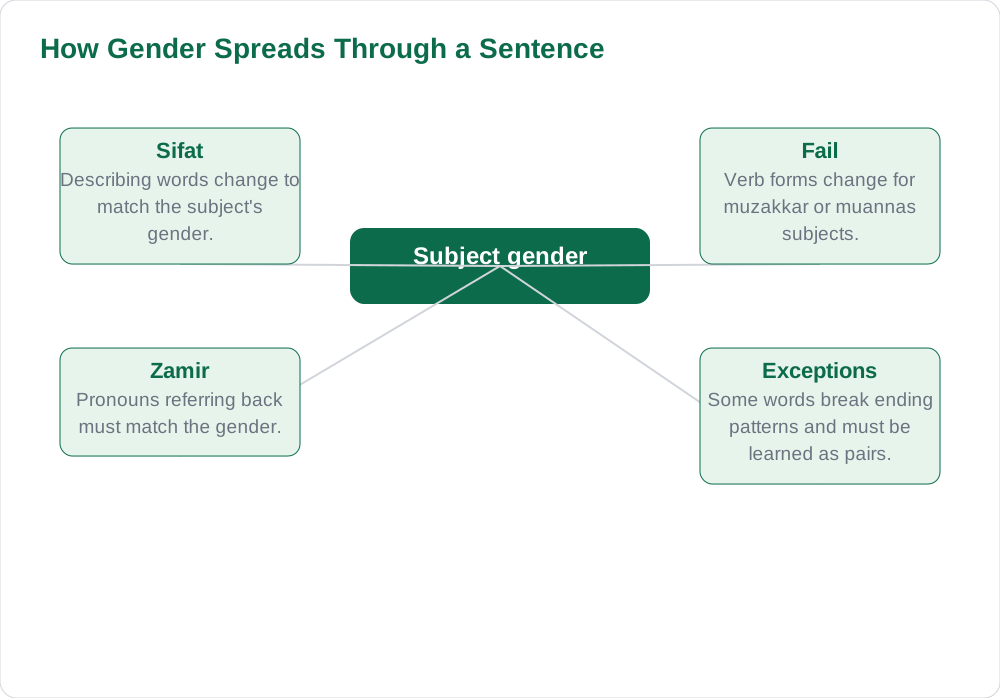
Gender agreement works like number agreement: once the subject's gender is known, the sifat, fail and zamir that belong to it must match. In the illustrative sentence Suthi kitab mez te aahe (The good book is on the table), the sifat suthi and the verb form match the muannas noun kitab. If the subject were a muzakkar noun, the sifat and verb forms would change accordingly. Zamir words referring back to the subject must also match: a muannas subject is referred to with muannas pronoun forms in later sentences, and the same holds for muzakkar subjects. Agreement is checked as a whole, not word by word in isolation.
A common error is to match the verb to the nearest noun instead of to the real subject. For example, in a sentence where a harf phrase sits between the subject and the verb, the verb must still agree with the subject, not with the noun inside the harf phrase. To avoid this, find the subject first, cover the middle of the sentence with your finger, and then choose the verb form. Then uncover the sentence and check the sifat and zamir as well. This subject-first method is simple, but it prevents a large share of gender errors in longer sentences, where the nearest noun is often a trap.
Words That Break the Rules Students Expect
Every language has words that surprise learners, and Sindhi gender has its share. Some words look muzakkar by their ending but are treated as muannas, and some look muannas but are treated as muzakkar. Some words naming professions or roles have both a muzakkar and a muannas form, such as ustad and ustani, and students must learn the pair rather than using one form for both. Other words, especially abstract ideas like mohabbat (love) or himmat (courage), have a fixed gender that cannot be guessed from meaning, because ideas have no natural sex at all.
The right response to rule-breakers is to collect them, not to argue with them. Keep a page in your notebook titled gender surprises, and write each surprising word with its gender and one example sentence. Revise that page before tests, because examiners often choose exactly these words to test whether students have learned real usage rather than just rules. When you meet a new word whose gender surprises you, add it to the page the same day, while the surprise is fresh. Over a term, this page becomes a personal dictionary of the hardest words, and it is far more valuable than a generic rule list. More guidance is on the blog and the [home page](/).
Daily Practice for Gender Confidence
Gender confidence comes from daily contact with nouns in full sentences, not from reading a rule once. Each day, take ten nouns from your lesson, write muzakkar or muannas beside each one, and write a sentence for each noun that includes a sifat and a verb. The sentence forces you to use the gender, which is the only way to test whether you really know it. If you only write the label without a sentence, you may recognise the gender on a list but still fail to use it correctly in writing, which is where marks are actually earned.
A second exercise is gender swapping: take a correct sentence with a muzakkar subject, replace the subject with a muannas noun of similar meaning, and change every agreeing word to match. For example, change a sentence about a boy to a sentence about a girl, changing sifat, verb and zamir as needed. This exercise makes agreement visible, because every word that must change stands out. Ask a partner to check your swapped sentence, and keep a list of the words you most often forget to change. With steady practice, gender agreement becomes a habit, and your Sindhi writing will read as natural and correct.
AI Help: Muse AI
Muse AI is Meta's personal AI assistant, and it can help you practise muzakkar and muannas by checking the gender of nouns in your sentences. For this topic, ask it to explain gender agreement with new examples, then try labelling nouns yourself before checking its answers.
Join Muse with invite code LTGSWD — in the Muse app, go to Settings > Redeem token and enter the code. Disclosure: LTGSWD is the author's Muse invite code. Muse AI does not give official STBB answers — always verify against your STBB book and your teacher. Remember to verify against your Sindh Textbook Board book before using any explanation in classwork or exams.
5 key points you must know
- Muzakkar means masculine gender and muannas means feminine gender in Sindhi grammar.
- For things and ideas, gender is grammatical convention, not natural sex.
- Word endings and source language give useful clues but never guarantee gender.
- Sifat, fail and zamir must all agree with the subject's gender.
- Collect surprising words in a personal list and revise them before tests.
Frequently asked questions
How do I know if a Sindhi noun is muzakkar or muannas?
For people and animals, gender usually follows natural sex. For things and ideas, gender is a property of the word that must be learned with the word itself. Word endings and source language give useful clues, but the reliable method is to learn each noun with its gender in your notebook and confirm doubtful words with your teacher or dictionary.
Why does gender change the verb in a sentence?
Because Sindhi verbs agree with their subjects in gender as well as number. A muzakkar subject takes a muzakkar verb form and a muannas subject takes a muannas form. If the verb does not match the subject, the sentence sounds incorrect even when the meaning is clear, so markers check gender agreement closely.
Do sifat words change for gender too?
Yes, sifat words describing a noun usually change to match that noun's gender. For example, sutho is used with a muzakkar noun and suthi with a muannas noun in the illustrative pair about a good boy and a good girl. Always check the noun first, then choose the sifat form that matches it.
What should I do with a word whose gender surprises me?
Write it on a special page for gender surprises, with its correct gender and one example sentence. Revise that page before tests, because examiners often choose surprising words. Do not try to force the word to follow the pattern you expected; learn its real usage and use it confidently from then on.
Can one profession word have both genders?
Yes, many role words have a muzakkar form and a muannas form, such as ustad and ustani. Learn the pair together and use the form that matches the person described. Using the muzakkar form for a female teacher, or the reverse, is a gender agreement error even when the rest of the sentence is correct.
Solved notes — preview free
These guides work best with the solved exercises. Preview the solved notes free on this website — 119 solved notes for Classes 6–10 in Sindhi, Urdu, English and Arabic medium. Or browse the full solved notes catalogue for your class and medium. New solved notes are added regularly — check the catalogue for coming-soon books.