Sindhi Grammar: Murakkab Jumle Made Easy
Sindhi grammar murakkab jumle are sentences made by joining two or more simpler sentences into one longer, connected sentence. Murakkab means compound or joined, and these sentences let writers show relationships between ideas: adding information, showing contrast, offering a choice, or explaining a cause. Students often write only short simple sentences because longer ones feel risky, but murakkab jumle, used carefully, make writing sound mature and connected. This guide explains the main conjunctions for joining sentences, shows how to choose the right one, and warns against the run-on sentences that lose marks for classwork, homework and exams in Sindhi. All Sindhi examples are illustrative, given in Roman transliteration for practice.
What Is a Murakkab Jumla
A murakkab jumla joins two clauses, each of which could often stand alone, into a single sentence with a conjunction or a relative word. For example, the illustrative sentence Ali parhi tho ain Ahmed likhi tho (Ali is reading and Ahmed is writing) joins two simple sentences with ain (and). The result is one sentence with two subjects and two verbs, but the reader can still see both ideas clearly. Murakkab jumle are different from simple jumle, which carry one idea, and they are the natural next step once simple sentences feel comfortable.
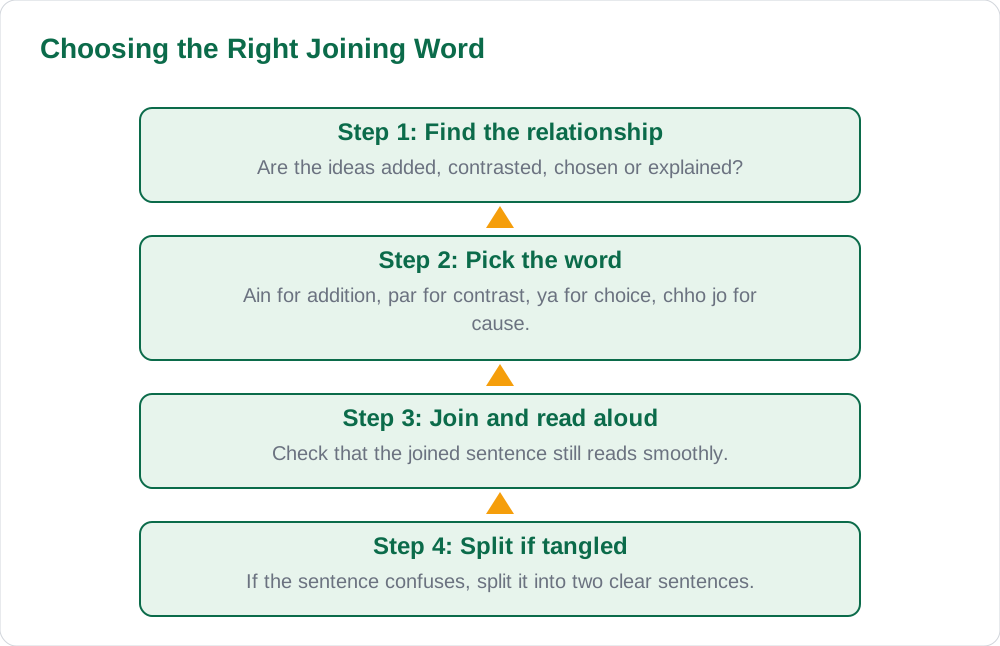
The purpose of joining is not to make sentences longer for its own sake, but to show how ideas relate. Joining with ain shows addition, joining with par shows contrast, joining with ya shows choice, and joining with jo or jehro adds a description. A writer who joins sentences thoughtfully guides the reader through the logic of a paragraph, while a writer who joins randomly only creates confusion. Before joining two sentences, always ask what relationship exists between them, and choose the joining word that names that relationship exactly. For more solved material, see the solved notes and the book list.
Conjunctions for Adding and Contrasting
The most used joining words are ain (and) for adding and par (but) for contrasting. Ain joins ideas that belong together: Ali school wanji tho ain sabak parhi tho (Ali goes to school and studies his lesson). Par joins ideas that pull in different directions: Ali mehnat kare tho par kamyab na thiyo (Ali works hard but did not succeed). The difference matters, because swapping ain and par changes the logic of the sentence even when both parts are correct. Students should practise pairs of sentences where only the conjunction changes, and explain how the meaning changes with each choice.
Other useful conjunctions include ya (or) for choice, je (if) for condition, and chho jo (because) for cause. Each one answers a different question: ya asks which option, je asks under what condition, and chho jo asks why. A paragraph that uses only ain sounds flat, because every relationship is presented as addition, even when contrast or cause is meant. Varying conjunctions, but only where the meaning genuinely calls for variety, is a mark of mature writing. Keep a list of conjunctions with one example sentence each, and check your list before writing a long composition. More tips are on the blog and the [home page](/).
- Ain (and): adds a related idea to the first one
- Par (but): shows contrast or an unexpected result
- Ya (or): offers a choice between two ideas
- Chho jo (because): gives the reason for the first idea
Joining With Jo, Jehro and Jadhen
Relative and time words also create murakkab jumle, but they work differently from ain and par. Words like jo and jehro (who, which, that) attach a describing clause to a noun, as in Kitab jo maan parhi, so suthi aahe (The book which I read is good). The describing clause cannot stand alone, so the whole sentence is complex as well as compound in the broad sense of joined. Time words like jadhen (when) attach a clause that says when something happens, as in Jadhen ustad aayo, shagird khara thi waya (When the teacher came, the students stood up). These joining words add detail without adding a second equal idea.
The danger with jo, jehro and jadhen is placing the clause so that it points to the wrong word. In a long sentence, a relative clause should sit as close as possible to the noun it describes, or the reader may attach it to a nearer noun by mistake. A safe method is to build the sentence in two steps: write the main sentence first, then insert the describing clause right after the noun it describes, and read the result aloud. If the sentence still sounds clear, keep it; if it sounds tangled, split it back into two sentences and try again. Clarity always beats length in school writing.
Avoiding Run-On and Tangled Sentences
A run-on sentence joins two ideas without any conjunction or punctuation, leaving the reader to guess where one idea ends and the next begins. For example, writing Ali parhi tho Ahmed likhi tho without ain or a full stop is a run-on, even though both parts are correct on their own. The fix is simple: add a conjunction, add a full stop and start a new sentence, or use a semicolon-like pause if your teacher allows it. Students should check every long sentence in their work for a joining word, and split any sentence that has two subjects and two verbs but no conjunction.
Tangled sentences are the opposite problem: too many clauses joined in a chain, so the reader loses track of the main idea. A sentence with three or four conjunctions usually needs splitting into two sentences, even if it is grammatically correct. A practical limit for school writing is two clauses per sentence in most cases, with an occasional third clause only when the relationship is very clear. After writing, read each sentence aloud in one breath: if you run out of breath or lose the thread, split the sentence. Short, joined sentences that the reader can follow always earn more marks than impressive sentences that confuse.
Practice: From Simple Sentences to Murakkab Jumle
The best practice for murakkab jumle starts with simple sentences you already know. Write five pairs of simple sentences on the same topic, such as your school day or a story you read. Then join each pair once with ain, once with par, and once with ya, and note which joining makes sense and which sounds wrong. This exercise teaches that conjunction choice is a meaning choice, not a decoration: the same two facts can add, contrast or offer a choice depending on the word you choose. Discuss your joined sentences with a partner, and defend each conjunction choice in one sentence.
A second exercise is editing a paragraph: take a paragraph written only in simple sentences, and join two or three pairs where the relationship is genuinely addition, contrast or cause. Leave the other sentences simple, so the paragraph gains variety without becoming tangled. Then read the edited paragraph aloud and ask whether every joined sentence is clearer than the two separate sentences were. If a joined sentence is not clearer, undo it. This editing habit is exactly what good writers do, and it teaches murakkab jumle as a tool for clarity rather than as a trick for length.
AI Help: Muse AI
Muse AI is Meta's personal AI assistant, and it can help you practise murakkab jumle by joining your simple sentences with suitable conjunctions. For this topic, ask it to explain ain, par, ya and chho jo with new examples, then try joining sentence pairs yourself before checking its suggestions.
Join Muse with invite code LTGSWD — in the Muse app, go to Settings > Redeem token and enter the code. Disclosure: LTGSWD is the author's Muse invite code. Muse AI does not give official STBB answers — always verify against your STBB book and your teacher. Remember to verify against your Sindh Textbook Board book before using any explanation in classwork or exams.
5 key points you must know
- A murakkab jumla joins two or more clauses into one connected sentence.
- Ain adds, par contrasts, ya offers a choice, and chho jo gives a reason.
- Jo, jehro and jadhen attach describing or time clauses to a main sentence.
- A run-on sentence joins ideas without a conjunction or full stop.
- Split any joined sentence that sounds tangled when read aloud.
Frequently asked questions
What is a murakkab jumla in simple words?
A murakkab jumla is a joined sentence made from two or more simpler sentences or clauses. For example, Ali parhi tho ain Ahmed likhi tho joins two simple sentences with ain. The joined sentence shows how the ideas relate, such as addition, contrast, choice or cause, instead of leaving them as separate statements.
How do I choose between ain and par?
Use ain when the second idea adds to the first, and par when the second idea contrasts with it or gives an unexpected result. Test by swapping the conjunctions and noticing how the meaning changes. If the second idea is surprising after the first, par is usually right; if it simply continues the first, ain is right.
What is a run-on sentence and how do I fix it?
A run-on sentence joins two complete ideas without a conjunction or punctuation, such as Ali parhi tho Ahmed likhi tho. Fix it by adding a conjunction like ain, or by adding a full stop and starting a new sentence. Check every long sentence for a joining word, and split any sentence with two subjects and verbs but no conjunction.
When should I use jo or jehro instead of ain?
Use jo or jehro when you want to describe a noun with extra information, not when you want to add an equal idea. In Kitab jo maan parhi, so suthi aahe, the clause describes which book is meant. Use ain when the second idea is equal in importance and could stand alone as its own sentence.
How long should a murakkab jumla be in school writing?
Two clauses per sentence is a safe limit for most school writing, with an occasional third clause only when the relationship is very clear. If a sentence has three or four conjunctions, it usually needs splitting. Read the sentence aloud in one breath: if you lose the thread, split it into two clear sentences.
Solved notes — preview free
These guides work best with the solved exercises. Preview the solved notes free on this website — 119 solved notes for Classes 6–10 in Sindhi, Urdu, English and Arabic medium. Or browse the full solved notes catalogue for your class and medium. New solved notes are added regularly — check the catalogue for coming-soon books.