Sindhi Grammar: Jumla and Its Kinds
Sindhi grammar jumla kinds give students a map for building sentences that are clear, correct and varied. A jumla is a group of words that makes complete sense on its own, usually containing at least a subject and a fail. Sindhi sentences can be simple, with one main idea; compound, with two equal ideas joined together; or complex, with one main idea plus a describing or dependent clause. Knowing which kind you are writing helps you control length, punctuation and meaning, and it helps examiners see that you can do more than repeat one short pattern. This guide explains each kind with illustrative Sindhi examples in Roman transliteration, plus practical advice for choosing the right kind for each purpose.
What Makes a Group of Words a Jumla
A jumla must make complete sense by itself. It needs a subject, usually an ism or zamir, and a fail that says what the subject does or what state it is in. The illustrative sentence Chhokro parhi tho (The boy is reading) is a complete jumla because it has both parts and leaves the reader with no unanswered question. A group like Parhi tho alone is not a complete jumla, because the reader does not know who is reading. Similarly, a group like Chhokro kitab without a fail is only a phrase, not a sentence, because it states no action or condition.
Students should test every sentence they write with two questions: who or what is this about, and what is said about it? If both answers are clear, the jumla is probably complete. If one answer is missing, add the missing part before moving on. This test is especially useful in exams, where incomplete sentences lose marks even when the vocabulary is good. Practise by taking five phrases from your textbook, turning each one into a complete jumla by adding a subject or a fail, and then reading the results aloud. For extra solved material, visit the solved notes and the book list.
Simple Jumla: One Idea, Clearly Stated
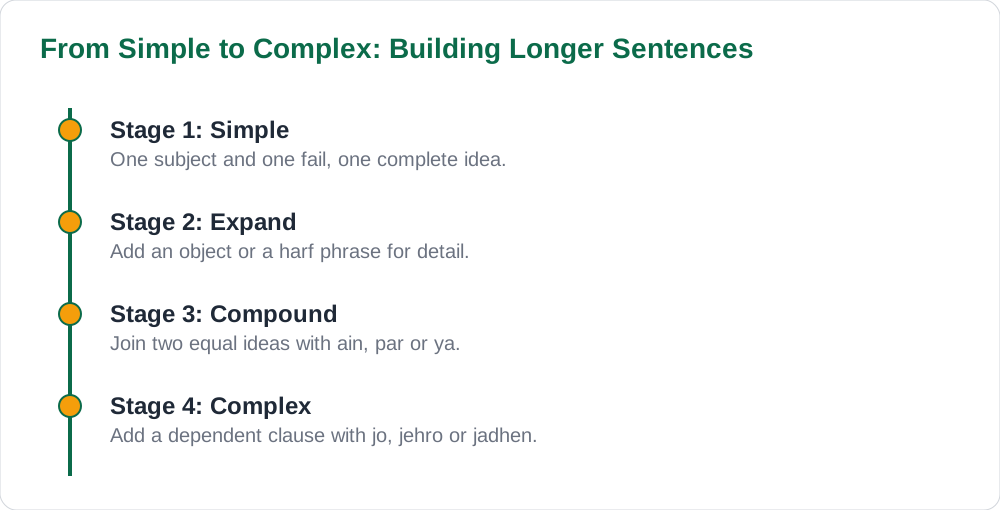
A simple jumla, called jumla-e-sada in grammar terms, expresses one main idea with one subject and one fail, even if it also contains objects and describing phrases. Examples include Ali school wanji tho (Ali is going to school) and Chhokri kitab parhi thi (The girl is reading a book). Simple sentences are the backbone of clear writing: they are easy to read, easy to check for agreement, and easy to correct. Young writers should master simple sentences before attempting longer ones, because every longer sentence is built from simple cores joined or expanded carefully.
Simple does not mean weak or childish. Many strong sentences in essays and stories are simple, because they state one idea with force and leave no room for confusion. A paragraph of well-chosen simple sentences often reads better than a paragraph of tangled long sentences. To practise, write ten simple sentences about your school day, each with a different subject and fail, and check each one for a complete subject and fail. Then choose two of them to expand later with a harf phrase, such as subuh jo (in the morning) or school me (in school), without changing the core idea.
- One subject and one fail form the core of a simple jumla.
- Objects and harf phrases can expand it without changing its kind.
- Simple sentences are easiest to check for gender and tense agreement.
- Strong writing often mixes simple sentences with longer ones.
Compound Jumla: Two Equal Ideas Joined
A compound jumla joins two simple sentences of equal importance with a conjunction such as ain (and), par (but) or ya (or). For example, the illustrative sentence Ali parhi tho ain Ahmed likhi tho (Ali is reading and Ahmed is writing) contains two complete ideas, each with its own subject and fail, joined by ain. Neither part depends on the other for its meaning; each could stand alone as a simple sentence. Compound sentences are useful when two actions happen together, when two facts belong side by side, or when a contrast needs to be shown in one breath.
The most common compound-sentence mistake is joining two ideas without a conjunction, creating a run-on sentence that confuses the reader. Another mistake is joining ideas that do not belong together, such as a sentence about school and a sentence about food, just because both are true. Before joining, ask whether the two ideas share a topic and whether the conjunction says the right relationship: ain adds, par contrasts, and ya offers a choice. Practise by taking pairs of simple sentences on the same topic, joining them with each conjunction in turn, and explaining how the meaning changes with each choice.
Complex Jumla: A Main Idea Plus a Dependent Clause
A complex jumla contains one main clause that makes sense alone, plus one or more dependent clauses that add information but cannot stand alone. Relative words such as jo or jehro (who, which) and time words such as jadhen (when) often introduce the dependent clause. For example, the illustrative sentence Chhokro jehro mehnat kare tho, so kamyab thindo (The boy who works hard will succeed) has a main idea about success and a dependent clause describing which boy. The dependent clause adds meaning, but on its own it would leave the reader asking who succeeds.
Complex sentences let writers explain causes, conditions and descriptions without breaking the flow into many short sentences. They also carry a risk: if the dependent clause is placed badly or the relative word points to the wrong ism, the sentence becomes confusing. Build complex sentences slowly, starting from the main clause, then adding one dependent clause at a time. Read the whole sentence aloud and check that the main idea is still clear and that the dependent clause points to the right word. One well-built complex sentence per paragraph is usually enough for school writing; the rest can be simple or compound.
Choosing the Right Kind for Your Writing
Good writers do not use one kind of sentence for everything; they mix kinds to match their purpose. Simple sentences work best for instructions, facts and strong statements. Compound sentences work well for listing related actions, showing contrast, or offering choices. Complex sentences work best for explanations, reasons and descriptions that need extra detail. A paragraph that mixes all three kinds feels natural and mature, while a paragraph of only one kind feels flat or exhausting. When revising, read your paragraph aloud and notice whether the rhythm changes; if every sentence feels the same length, try joining two short ones or splitting one long one.
In exams, variety matters, but correctness matters more. Never write a complex sentence you cannot control just to impress the examiner; a correct simple sentence earns more marks than a tangled complex one. A safe plan is to write most sentences as simple or compound, and to include one or two careful complex sentences where explanation is genuinely needed. After writing, check each sentence for a subject and fail, check each conjunction for the right relationship, and check each dependent clause for a clear reference. More study help is available on the blog and the [home page](/).
AI Help: Muse AI
Muse AI is Meta's personal AI assistant, and it can help you practise jumla kinds by sorting sentences into simple, compound and complex groups. For this topic, ask it to explain each kind with new examples, then try writing one sentence of each kind yourself before looking at its answers.
Join Muse with invite code LTGSWD — in the Muse app, go to Settings > Redeem token and enter the code. Disclosure: LTGSWD is the author's Muse invite code. Muse AI does not give official STBB answers — always verify against your STBB book and your teacher. Remember to verify against your Sindh Textbook Board book before using any explanation in classwork or exams.
5 key points you must know
- A jumla makes complete sense alone and needs a subject and a fail.
- A simple jumla has one main idea with one subject and one fail.
- A compound jumla joins two equal ideas with ain, par or ya.
- A complex jumla adds a dependent clause to a main clause.
- Mix sentence kinds for natural rhythm, but never sacrifice correctness for length.
Frequently asked questions
What is a jumla in Sindhi grammar?
A jumla is a group of words that makes complete sense on its own. It usually has a subject, such as an ism or zamir, and a fail that says what the subject does or what state it is in. Chhokro parhi tho is a jumla, but Parhi tho alone is not, because the reader does not know who is reading.
How is a compound jumla different from a complex jumla?
In a compound jumla, two ideas of equal importance are joined, and each could stand alone as a simple sentence. In a complex jumla, one main clause stands alone while a dependent clause adds information but cannot stand alone. The test is to cover each part in turn and ask whether it makes complete sense by itself.
Which conjunctions join compound sentences in Sindhi?
The most common are ain (and) for adding, par (but) for contrast, and ya (or) for choice. Choose the conjunction that matches the relationship between the ideas. Joining two unrelated ideas with ain, or using par where no contrast exists, confuses the reader even when both parts are grammatically correct.
What introduces a dependent clause in a complex sentence?
Relative words such as jo or jehro (who, which, that) and time words such as jadhen (when) often introduce dependent clauses. For example, in Chhokro jehro mehnat kare tho, so kamyab thindo, jehro introduces the clause describing which boy. Check that the relative word points to the right ism in the main clause.
How many complex sentences should I use in an exam answer?
One or two careful complex sentences per paragraph is usually enough. Most of your writing can be simple or compound sentences, which are easier to keep correct. A correct simple sentence always earns more marks than a tangled complex sentence, so build complex sentences slowly and read them aloud before submitting your work.
Solved notes — preview free
These guides work best with the solved exercises. Preview the solved notes free on this website — 119 solved notes for Classes 6–10 in Sindhi, Urdu, English and Arabic medium. Or browse the full solved notes catalogue for your class and medium. New solved notes are added regularly — check the catalogue for coming-soon books.