Sindhi Grammar: Ism, Fail and Harf Explained
Sindhi grammar ism fail harf is the starting point for every student who wants to read, write and speak Sindhi correctly. Every word in a Sindhi sentence belongs to one of three main classes: ism, which names a person, place, thing or idea; fail, which shows an action or state; and harf, which joins words and shows a relationship between them. Once you can tell these three apart, sentences stop looking like a jumble of words and start looking like a clear pattern. This guide explains each class with illustrative Sindhi examples in Roman transliteration, so you can practise without a dictionary. You will also learn quick tests for identifying each word, common confusions, and how to use all three classes together in your own sentences for classwork and exams.
Why Sindhi Words Fall Into Three Classes
Sindhi, like many languages, groups words by the job they do in a sentence, and the three traditional classes are ism, fail and harf. An ism names something, so it can stand as the subject or object of a sentence. A fail tells us what happens, what someone does, or what state something is in, and it usually changes with tense. A harf does not name or act on its own; instead, it connects an ism to another word and shows direction, place, possession or a similar relationship. Learning these classes first saves time later, because rules about gender, number, case and tense all build on knowing which class a word belongs to.
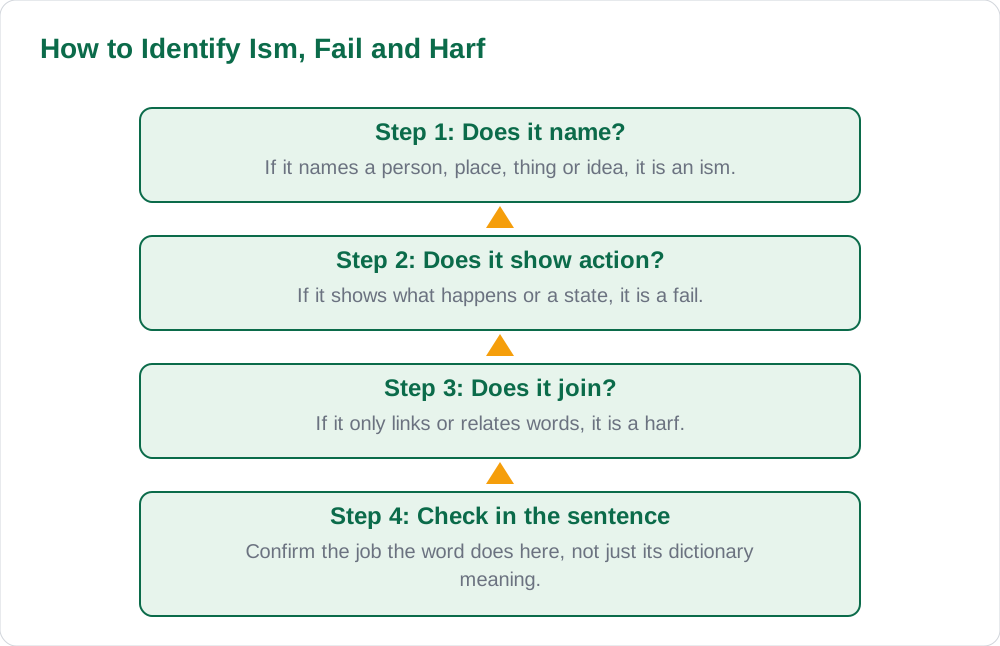
A useful habit is to ask a simple question about each word you meet. If the word answers who or what, it is probably an ism. If it answers what is happening or what was done, it is probably a fail. If it only makes sense beside another word, joining or relating it to the rest of the sentence, it is probably a harf. Try this test on short sentences from your reading book, and underline each word in a different colour. After a few days of practice, you will begin to spot the pattern at a glance, and longer sentences will feel much less confusing. For extra reading material, explore the book list and the solved notes pages.
Ism: Words That Name People, Places and Things
An ism is a naming word. It can name a person, such as chhokro (boy) or ustad (teacher); a place, such as goth (village) or school; a thing, such as kitab (book) or qalam (pen); or an idea, such as mohabbat (love) or sachai (truth). Isms can be common, naming any member of a group, or proper, naming one particular person or place, such as Ali or Hyderabad. In a sentence, an ism often comes first as the subject, or after the fail as the object. Recognising the ism is the first step in understanding who the sentence is about and what it is discussing.
Isms in Sindhi also carry gender and number, which is why later lessons on muzakkar and muannas and wahid and jama matter so much. For example, the illustrative sentence Chhokro kitab parhi tho (The boy is reading a book) contains two isms, chhokro and kitab, and one fail, parhi tho. Change the ism and the sentence changes its meaning completely, while the structure stays the same. When you write, choose your ism carefully, check its spelling, and make sure the rest of the sentence agrees with it. Practise by listing ten isms from your own classroom and sorting them into people, places, things and ideas.
- Person: ustad, shagird, amma, abba
- Place: goth, sheher, school, ghar
- Thing: kitab, qalam, kursi, mez
- Idea: mohabbat, himmat, sachai, khushi
Fail: Words That Show Action and State
A fail is an action word or a state word. It tells the reader what the subject does, did, or will do, or what condition the subject is in. Common illustrative examples include parhan (to read), likhan (to write), khaen (to eat), wanjen (to go) and vehn (to sit). Unlike an ism, a fail changes its form with time: the same action looks different in the past, present and future. That is why verb lessons often come with tables, and why practising one fail in all three tenses is such a useful exercise for building confidence in Sindhi writing.
To find the fail in a sentence, ask what is happening. In the illustrative sentence Shagird sabak likhi tho (The student is writing the lesson), the fail is likhi tho, because it shows the action being done. In Chhokri khushi aahe (The girl is happy), the word aahe works like a state word, telling us about the subject's condition rather than a physical action. Some students confuse an ism and a fail when a word can appear in both roles, so always check the job the word does in that particular sentence, not just its dictionary meaning. Keep a small notebook of new fails with one example sentence each.
Harf: Small Words That Join and Relate
A harf is a small joining or relating word, and it rarely makes full sense standing alone. Common illustrative examples include me (in), te (on), kha (from), saan (with) and lae (for). In the sentence Kitab mez te aahe (The book is on the table), the harf te links kitab and mez and shows where the book is. Remove te and the sentence falls apart, because the relationship between the two isms disappears. Harf words may look unimportant because they are short, but they carry the direction, place, time and possession that make a sentence precise.
Students often skip harf words when reading quickly, and that is where meaning gets lost. Compare two illustrative sentences: Ali ghar me aahe (Ali is in the house) and Ali ghar kha aayo (Ali came from the house). The only change is the harf, yet the meaning changes completely. When you write, pause after each harf and ask whether it says exactly what you mean: in, on, from, with, for and to are not interchangeable. Practise by taking one sentence and swapping only its harf, then explaining how the meaning changes. This single exercise sharpens both reading comprehension and writing accuracy.
Using Ism, Fail and Harf Together in Sentences
A complete Sindhi sentence usually needs at least an ism and a fail, and often a harf as well. Start simple: choose one ism as your subject, one fail as your action, and add an object ism if the action needs one. For example, the illustrative sentence Ustad sabak parhae tho (The teacher is teaching the lesson) has ustad as subject ism, sabak as object ism, and parhae tho as fail. Once that core feels easy, add a harf phrase for extra detail, such as school me (in school) or subuh jo (in the morning), and the sentence becomes richer without becoming confusing.
Build up gradually rather than writing very long sentences at once. Write five short sentences using one new ism, one new fail and one harf each, then read them aloud to check that they sound natural. Ask a classmate or teacher to mark the ism, fail and harf in each sentence, and correct any word you misclassified. Over time, try joining two short sentences with a conjunction, but keep the ism-fail core of each part clear. This steady practice is exactly what examiners reward: clear subjects, correct verbs and precise joining words. You can find more study help on the blog and the [home page](/) of this site.
AI Help: Muse AI
Muse AI is Meta's personal AI assistant, and it can help you practise Sindhi grammar by explaining a word class in simple words or by giving you fresh practice sentences to classify. For this topic, ask it to explain the difference between ism, fail and harf with new examples, then try classifying the words yourself before reading its answers.
Join Muse with invite code LTGSWD — in the Muse app, go to Settings > Redeem token and enter the code. Disclosure: LTGSWD is the author's Muse invite code. Muse AI does not give official STBB answers — always verify against your STBB book and your teacher. Remember to verify against your Sindh Textbook Board book before using any explanation in classwork or exams.
5 key points you must know
- Ism names a person, place, thing or idea and often acts as subject or object.
- Fail shows an action or state and changes form with past, present and future tense.
- Harf joins words and shows relationships such as place, direction, time and possession.
- Classify a word by the job it does in that sentence, not only by its dictionary meaning.
- Practise with short sentences first, then add harf phrases and conjunctions gradually.
Frequently asked questions
What is an ism in Sindhi grammar?
An ism is a naming word. It names a person like ustad, a place like goth, a thing like kitab, or an idea like mohabbat. In a sentence it usually works as the subject or the object. If a word answers the question who or what, it is very likely an ism. Proper isms name one particular person or place, while common isms name any member of a group.
How is a fail different from an ism?
A fail shows action or state, while an ism names something. In the illustrative sentence Chhokro kitab parhi tho, chhokro and kitab are isms and parhi tho is the fail, because it tells us what the boy is doing. A fail also changes with tense, so the same action looks different in the past, present and future, whereas an ism changes mainly for gender and number.
Why are harf words important if they are so small?
Harf words carry relationships that change meaning. In Kitab mez te aahe, te tells us the book is on the table. Change the harf and the meaning changes, even though the isms stay the same. Without harf words, sentences lose place, direction, time and possession, so readers have to guess what the writer meant.
Can one Sindhi word be more than one class?
Yes, sometimes the same word can act as an ism in one sentence and part of a fail phrase in another, depending on its job. That is why grammar teaches you to check the word in context. Always ask what the word is doing in this particular sentence before deciding whether it is an ism, a fail or a harf.
How can I practise ism, fail and harf at home?
Take five short sentences from your reading book, underline each word, and label it as ism, fail or harf. Then write five sentences of your own using one new word from each class. Read them aloud, swap only the harf in one sentence, and notice how the meaning changes. Ask your teacher to check your labels once a week until the pattern feels automatic.
Solved notes — preview free
These guides work best with the solved exercises. Preview the solved notes free on this website — 119 solved notes for Classes 6–10 in Sindhi, Urdu, English and Arabic medium. Or browse the full solved notes catalogue for your class and medium. New solved notes are added regularly — check the catalogue for coming-soon books.