Sindhi Grammar: Imla Mistakes Students Make Most

Sindhi grammar imla mistakes cost students marks even when their ideas are good, because spelling errors distract the reader and sometimes change the meaning of a word. Imla means spelling and orthography: the correct written form of a word, including its letters, dots and joins. Sindhi spelling is challenging because some letters sound similar, some words differ by a single dot, and some borrowed words keep spellings from Arabic or Persian. This guide covers the most common imla mistakes students make, explains why each one happens, and gives proofreading habits that catch errors before work is submitted. All Sindhi examples are illustrative, given in Roman transliteration with the error described in words.
Why Sindhi Imla Feels Difficult
Sindhi uses a script with many letters that share shapes and differ only by dots or small marks, so a single missed dot can turn one word into another. Several letters also sound alike in fast speech, especially for students who speak a different language at home, so they write the letter they hear rather than the letter the word actually uses. Borrowed words add another layer, because Arabic and Persian spellings do not always follow the sound patterns of everyday Sindhi speech. Together, these factors mean that imla cannot be learned by sound alone; it must be learned by eye, through reading and careful copying of correct forms.
The good news is that imla improves quickly once students treat spelling as a skill with patterns, not as a talent they either have or lack. Most errors fall into a small number of groups: similar-sounding letters, similar-looking letters, missing or extra dots, and borrowed-word spellings. If a student learns the pattern behind each group and practises the words in that group together, the error rate falls fast. Teachers can help by marking imla errors by group, not just by circling words, so students see which pattern they need to practise next. For more solved material, see the solved notes and the book list.
Confusing Letter Pairs That Sound Alike
The largest group of imla mistakes comes from letters that sound similar but are written differently. Students often choose the letter that matches their pronunciation, especially when two letters share a sound in their home dialect. For example, pairs of letters for similar s, z, t and h sounds are frequent sources of confusion, and the wrong choice produces a word that looks almost right but is marked wrong. The only reliable cure is to learn each word's correct spelling as a visual picture, not as a sound, and to revise confusing pairs side by side so the difference becomes visible.
A practical exercise is to make minimal-pair cards: write two words that differ by only one letter on opposite sides of a card, with a picture or example sentence for each. Revise five cards a day, saying the word, visualising its letters, and writing it from memory. Another exercise is dictation with a partner: one student reads a list of confusing words slowly, the other writes them, and both check the spellings together, discussing each error by letter, not just by word. Over weeks, the visual memory of correct forms strengthens, and the similar-sound trap loses its power. Students should also read aloud from correct texts daily, because seeing correct spellings repeatedly builds the same visual memory.
- Similar sounds: learn the word as a visual picture, not only by sound
- Similar shapes: check dots and small marks letter by letter
- Minimal pairs: revise words differing by one letter side by side
- Dictation: practise confusing words with a partner weekly
Dots, Joins and Letters That Look Alike
A second group of mistakes involves letters that look alike and differ only by dots or by how they join to neighbours. In handwriting, a dot placed hastily above the wrong letter, or a join written too loosely, can change the word completely. Students writing quickly in exams are especially vulnerable, because speed tempts them to skip dots or to join letters carelessly. The result is a word that the student meant correctly but the marker reads incorrectly, which is frustrating because the knowledge was present but the writing hid it.
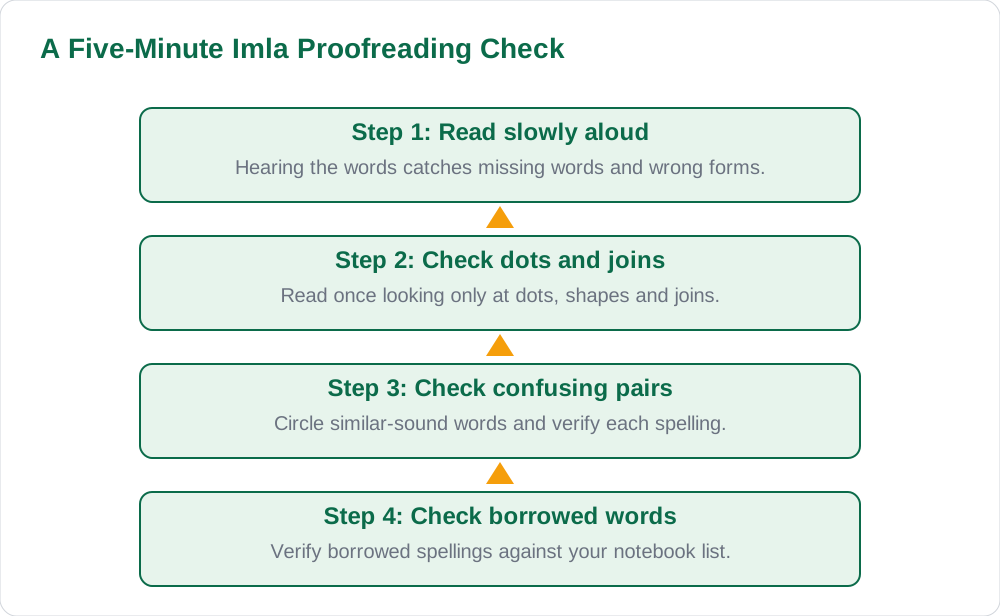
The remedy is slow, deliberate handwriting practice, not just more writing. Set aside ten minutes a day to copy a short paragraph slowly, focusing on dots, joins and letter shapes, and compare your copy letter by letter with the original. In exams, reserve the last five minutes for a dot check: read your work once looking only at dots and joins, not at meaning, and fix any letter that looks doubtful. Writing slightly larger also helps, because small, cramped writing hides dot errors. Teachers often advise students to write clearly rather than quickly, because a readable answer with correct dots earns more than a fast answer full of dot mistakes.
Borrowed Words and Silent Letters
Borrowed words from Arabic, Persian and English often keep spellings that do not match their Sindhi pronunciation, and these words trap even good spellers. A letter that is silent in speech may still be written, or a word may keep a double letter from its source language that Sindhi speech does not emphasise. Students who spell borrowed words purely by sound will therefore miss letters that must be present in writing. The solution is to learn borrowed words as whole written units, with attention to their source spelling, rather than trying to rebuild them from sound each time.
A useful method is to keep a borrowed-words page in your notebook, divided by source language where known, with the correct spelling and one example sentence for each word. Revise that page before tests, because borrowed words are common in formal Sindhi passages and in exam texts. When you meet a new borrowed word, copy it three times slowly, say it aloud, and write it once from memory the next day. If you still miss a letter, copy it three more times and test again the following day. This spaced copying method, though simple, is remarkably effective for words whose spelling cannot be guessed from sound alone. More help is on the blog and the [home page](/).
Building a Personal Imla Improvement Plan
A personal imla plan turns random errors into steady improvement. Start by collecting your last five marked pieces of writing and sorting every spelling error into groups: similar sounds, similar shapes, dots and joins, and borrowed words. Count the errors in each group, and you will usually find that one or two groups account for most of your mistakes. Focus your practice on those groups first, because fixing the largest group gives the biggest improvement for the least effort. Set a simple goal, such as halving errors in your largest group within a month, and track it by counting errors in each new piece of work.
Daily habits support the plan: read a correct Sindhi text for ten minutes, copy a short paragraph slowly, and revise five minimal-pair or borrowed-word cards. Weekly habits add dictation with a partner and a dot-check of one old composition. Monthly, repeat the error count and adjust your focus to the group that is now largest. Students who follow this cycle often report that spelling stops feeling like luck and starts feeling like a system they control. Imla is not about being naturally good at spelling; it is about noticing patterns, practising the right words, and proofreading with a clear checklist every single time.
AI Help: Muse AI
Muse AI is Meta's personal AI assistant, and it can help you practise imla by giving you dictation sentences and spelling quizzes on confusing words. For this topic, ask it to explain common Sindhi spelling patterns with new examples, then try spelling the words yourself before checking its answers.
Join Muse with invite code LTGSWD — in the Muse app, go to Settings > Redeem token and enter the code. Disclosure: LTGSWD is the author's Muse invite code. Muse AI does not give official STBB answers — always verify against your STBB book and your teacher. Remember to verify against your Sindh Textbook Board book before using any explanation in classwork or exams.
5 key points you must know
- Imla means correct spelling, including letters, dots and joins.
- Similar-sounding letters cause the largest group of spelling errors.
- Similar-looking letters and missed dots change words in handwriting.
- Borrowed words keep source spellings that cannot be guessed from sound.
- A five-minute proofreading check catches most errors before submission.
Frequently asked questions
Why do I spell Sindhi words wrong even when I know what I mean?
Because Sindhi spelling depends on visual memory as well as sound. Some letters sound alike, some look alike apart from dots, and borrowed words keep source spellings. Knowing the meaning does not guarantee knowing the letters, so you must also learn each word's written picture through reading, slow copying and dictation practice.
How can I remember which similar-sounding letter is correct?
Use minimal-pair cards: write two words differing by one letter, with a picture or sentence for each, and revise five cards a day by writing each word from memory. Reading correct texts daily also builds visual memory. Over time, the correct letter for each word becomes a picture you recognise, not a sound you guess.
What is the best proofreading check for imla?
Read your work slowly aloud first, then read it once looking only at dots, joins and letter shapes, then circle similar-sound words and borrowed words and verify each spelling. Reserve the last five minutes of exam time for this check. Writing slightly larger also helps, because cramped writing hides dot errors from both writer and marker.
Why are borrowed words harder to spell in Sindhi?
Borrowed words from Arabic, Persian and English often keep spellings from their source language, including silent letters or double letters that Sindhi speech does not emphasise. Spelling them purely by sound therefore misses letters. Learn borrowed words as whole written units, keep a borrowed-words page, and copy each new word slowly three times before testing yourself the next day.
How long does it take to improve Sindhi spelling?
Most students see clear improvement within a month of focused practice, because errors usually cluster in one or two groups. Sort your recent errors by group, practise the largest group daily with cards and dictation, and count errors in each new piece of work to track progress. Spelling improves like any skill: steady, patterned practice beats occasional long sessions.
Solved notes — preview free
These guides work best with the solved exercises. Preview the solved notes free on this website — 119 solved notes for Classes 6–10 in Sindhi, Urdu, English and Arabic medium. Or browse the full solved notes catalogue for your class and medium. New solved notes are added regularly — check the catalogue for coming-soon books.