Sindhi Grammar: Fail and Tense Forms
Sindhi grammar fail tense forms show when an action happens: in the past, in the present, or in the future. The fail is the action word of the sentence, and its form changes with time, with the subject's gender and number, and sometimes with the kind of sentence. Students who master tense can tell a story in order, describe daily routines, and make plans clearly and confidently, while students who mix tenses confuse the reader about when events happened. This guide explains past, present and future forms with illustrative Sindhi verb examples in Roman transliteration, shows how tables help you learn them, and gives practice methods that make tense choice automatic.
What Tense Means for a Fail
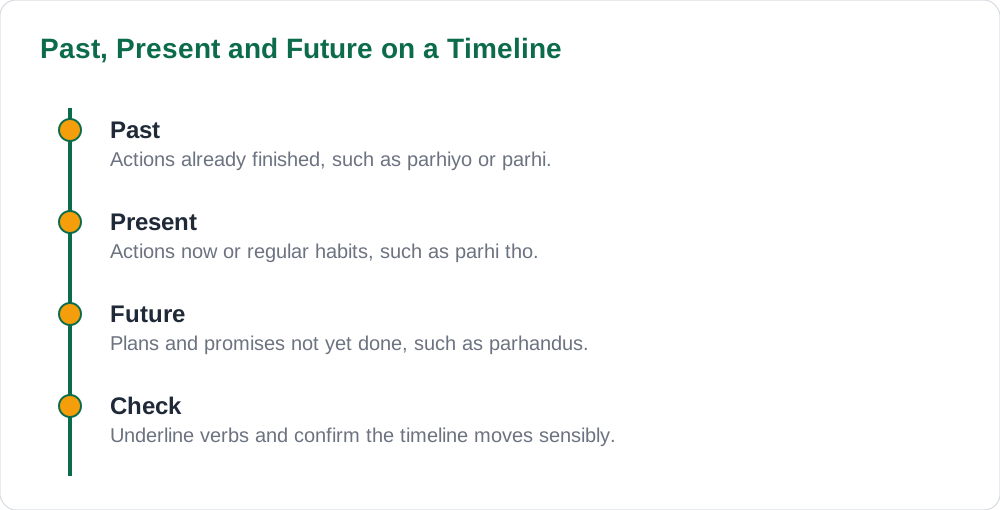
Tense is the part of grammar that places an action in time. Present tense describes actions happening now or happening regularly, such as Maan parhan tho (I am reading) or Maan roz parhan tho (I read every day). Past tense describes actions already finished, such as Maan parhiyo (I read, past). Future tense describes actions not yet done, such as Maan parhandus (I will read). The same fail, parhan (to read), appears in three different forms, and the reader learns the time of the action from the form alone, without needing extra words like yesterday or tomorrow, although those words often help.
Tense also works together with gender and number, so a complete verb form carries several pieces of information at once: what the action is, when it happens, and who is doing it. That is why verb tables are so useful: a table shows one fail across persons, genders, numbers and tenses, so students can see the whole system instead of memorising isolated forms. When you meet a new fail, do not learn only its present form; learn its past and future forms in the same session, and write one sentence for each tense. This triple learning prevents the common problem of knowing a verb in one tense only.
Present Tense: Now and Every Day
Present tense covers two related uses: actions happening right now and actions that happen regularly. The illustrative sentence Chhokro parhi tho (The boy is reading) describes an action in progress at this moment. The sentence Chhokro roz parhi tho (The boy reads every day) uses a similar form but adds roz (every day) to show a habit. Students should notice that the time word changes the meaning from a single moment to a routine, even when the verb form looks similar. Context and time words therefore matter as much as the verb form itself.
A frequent present-tense mistake is using a present form for a finished action, which makes a story sound as if everything is happening now. Another mistake is forgetting agreement: a present verb must still match its subject in gender and number, so a muannas subject and a plural subject need different forms from a muzakkar singular subject. Practise present tense by writing a diary paragraph about today, using only present forms, and then underlining each verb and its subject to check agreement. For more solved material, see the solved notes and the book list.
- Action now: Chhokro parhi tho (The boy is reading)
- Daily habit: Chhokro roz parhi tho (The boy reads every day)
- Always check gender and number agreement in present forms
- Time words like roz, aj and hane clarify present meaning
Past Tense: Actions Already Finished
Past tense describes actions that are complete, and Sindhi past forms often look quite different from present forms. The illustrative sentence Chhokro kitab parhi (The boy read the book) places the action firmly in the past, while Chhokri kitab parhi (The girl read the book) shows how gender can affect the past form. Past tense is the backbone of storytelling: once a story moves into the past, most of its verbs should stay in the past unless a character speaks in the present or a habit is described. Mixing past and present without reason is one of the most noticeable errors in student stories.
To learn past forms, practise with a timeline: write five things you did yesterday, in order, using past verbs only. Then write five things you did last week, and notice whether the same verbs keep the same past forms. Some verbs are regular in the past, following a clear pattern, while others are irregular and must be learned individually. Keep a list of irregular past forms in your notebook, with the present form beside each one, and revise that list weekly. Storytelling practice, even a short paragraph a day, teaches past tense faster than memorising tables alone, because the forms are used for a real purpose.
Future Tense: Plans and Promises
Future tense describes actions that will happen, including plans, promises, predictions and intentions. The illustrative sentence Maan subhane school wendus (I will go to school tomorrow) combines a future verb form with the time word subhane (tomorrow) to make the timing unmistakable. Future forms are also used for offers and requests in polite speech, such as asking whether someone will help. Students should practise future tense by writing plans for tomorrow, next week and next year, because each plan naturally needs a future verb and a time word together.
A common future-tense error is using a present form for a future plan without a time word, leaving the reader unsure whether the action is happening now or later. Always pair a future intention with either a future verb form or a clear time word, and preferably both in school writing. Another error is promising in the future tense but describing the steps in the present tense without signalling the change, which breaks the timeline. Before submitting a paragraph about plans, underline every verb, label its tense, and check that the timeline moves in a sensible order from now to later. More help is available on the blog and the [home page](/).
Using Verb Tables Without Memorising Blindly
Verb tables look intimidating, but they are simply a map of one fail across persons, genders, numbers and tenses. Read a table row by row, not all at once: first learn the three tenses for maan (I), then for tuhin and tawhaan (you), then for hu (he or she), and so on. Say each form aloud as you write it, because hearing the ending helps memory far more than silent copying. After studying a row, cover the table and write the forms from memory, then check and correct only the forms you missed. This cover-and-recall method beats copying the whole table five times.
Tables should also be used for checking, not just for learning. When you write a paragraph, keep the table for your main verbs open beside you, and check each verb form against it before submitting. Over time, you will need the table less and less, because the forms you use most often will become automatic. Do not try to learn ten verbs at once; master one common fail fully, including all three tenses and both genders, before adding the next. Depth with a few verbs builds a pattern sense that transfers to new verbs, while shallow knowledge of many verbs fades quickly under exam pressure.
AI Help: Muse AI
Muse AI is Meta's personal AI assistant, and it can help you practise fail tense forms by giving you verb tables for common Sindhi verbs. For this topic, ask it to show one verb in past, present and future forms with new examples, then try writing your own sentences in each tense before checking its answers.
Join Muse with invite code LTGSWD — in the Muse app, go to Settings > Redeem token and enter the code. Disclosure: LTGSWD is the author's Muse invite code. Muse AI does not give official STBB answers — always verify against your STBB book and your teacher. Remember to verify against your Sindh Textbook Board book before using any explanation in classwork or exams.
5 key points you must know
- Tense places a fail in the past, present or future.
- Present tense covers actions happening now and regular habits.
- Past tense describes finished actions and carries most storytelling.
- Future tense covers plans, promises, predictions and intentions.
- Verb tables work best when studied row by row with cover-and-recall practice.
Frequently asked questions
How do I choose between past, present and future tense?
Ask when the action happens. If it is already finished, use past tense. If it is happening now or happens regularly, use present tense. If it has not happened yet, use future tense. Time words like kal (yesterday), aj (today) and subhane (tomorrow) help, but the verb form itself should also show the tense clearly.
Why does the same verb look different in each tense?
Because Sindhi verb forms change their endings to show time, and they also agree with the subject in gender and number. The base meaning stays the same, but the form carries extra information about when and by whom the action is done. Verb tables show these changes systematically for each person, gender and number.
What is the most common tense mistake in stories?
Mixing past and present without reason is the most common mistake. Once a story moves into the past, most verbs should stay in the past unless a character speaks in the present or a habit is described. Before submitting a story, underline every verb, label its tense, and fix any verb that breaks the timeline without a good reason.
How should I use a verb table for revision?
Study one row at a time, starting with maan, then tuhin and tawhaan, then hu. Say each form aloud, cover the table, write the forms from memory, and correct only the ones you missed. Use the table to check your writing as well, keeping it open beside your paragraph until the most common forms become automatic.
Are some past forms irregular in Sindhi?
Yes, some verbs have past forms that do not follow the regular pattern and must be learned individually. Keep a list of irregular past forms with their present forms beside them, and revise that list weekly. In exams, prefer a verb whose past form you know confidently over a verb whose past form you would have to guess.
Solved notes — preview free
These guides work best with the solved exercises. Preview the solved notes free on this website — 119 solved notes for Classes 6–10 in Sindhi, Urdu, English and Arabic medium. Or browse the full solved notes catalogue for your class and medium. New solved notes are added regularly — check the catalogue for coming-soon books.