From Ethics to Their Own Faith: A Big Change for Minority Pupils
The Sindh minority pupils ethics own faith textbooks change is one of the most meaningful textbook decisions of 2026-27, because it concerns what children learn about their own religion at school. The Sindh School Education and Literacy Department decided in April 2026 to introduce religious textbooks for Hindu pupils in Grades 3-5 in government schools for the academic year 2026-27, with STBB handling distribution. Previously, minority-religion pupils were taught Ethics instead of education related to their own faith. The Education Minister said: We cannot deprive any religious community of its fundamental rights. This article explains what changed, who it covers, how the books are provided, and why the change matters, in a factual and respectful tone.
What changed in 2026-27
The change is straightforward. From the academic year 2026-27, Hindu pupils in Grades 3-5 in government schools in Sindh study religious textbooks of their own faith, rather than the Ethics subject that minority-religion pupils were previously taught instead of education related to their own faith. The decision was taken by the Sindh School Education and Literacy Department in April 2026.
The point of the change is that pupils learn about their own religion from a proper textbook, in school, as part of their ordinary education. It places the religious education of minority pupils on the same footing as that of other pupils: a subject with a textbook, a teacher and a place in the school day, rather than a substitute subject chosen because no textbook existed.
Who the change covers
The change covers Hindu pupils in Grades 3-5 in government schools, for the academic year 2026-27. The grade range matters: it is the early primary years, when children are forming their first organised understanding of faith, values and community. A textbook at this stage gives children accurate material to learn from, instead of leaving religious learning entirely to what they happen to hear outside school.
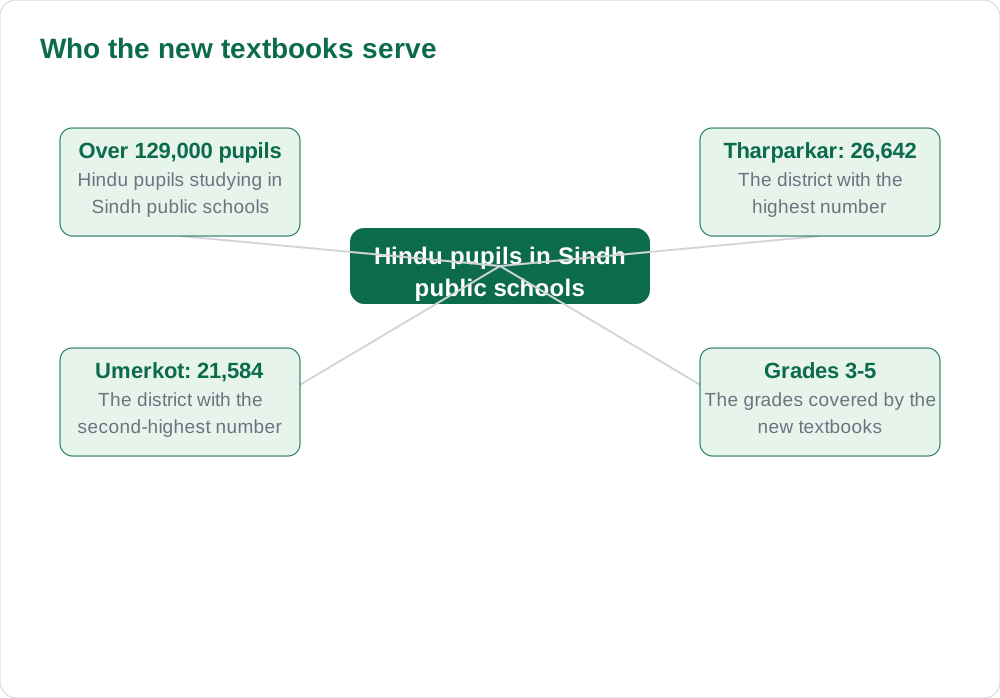
Over 129,000 Hindu pupils study in Sindh public schools. That is the community the decision serves, and it is a reminder that this is not a small administrative adjustment. It is a change that touches a large number of children and their families across the province.
Where the pupils are: Tharparkar and Umerkot
Two districts stand out in the figures. Tharparkar has the highest number of Hindu pupils in public schools, at 26,642, followed by Umerkot with 21,584. These are districts where the change will be felt in a large number of classrooms, and where the new textbooks will reach many children at once.
The district figures also explain why distribution matters as much as the decision itself. A decision in Karachi helps a child in Tharparkar only when the textbook actually reaches that child's school. That is why STBB's role in distribution is part of the story, and why schools and district officials have a practical part to play in making the change real.
From Ethics to their own faith: what it means in class
In class, the change means that a Hindu pupil in Grade 3, 4 or 5 now studies a textbook about their own faith where they previously studied Ethics. The lesson has a textbook to open, passages to read, and ideas to discuss with the teacher and classmates. For the pupil, the difference is simple and personal: school now teaches them about what they believe, rather than giving them a different subject in its place.
For the classroom as a whole, the change is a lesson in respect. Pupils of different faiths learning side by side, each with textbooks for their own faith, see that the school treats every community's beliefs with the same seriousness. That is the practical meaning of the minister's words: no religious community should be deprived of its fundamental rights, and schools should reflect that principle in what they teach.
Who prints and distributes the books
STBB handles distribution of the new religious textbooks. The publication cost for the current year is borne by Prem Sagar Sanstha Karachi, a community organisation, and STBB is to budget for the cost from the next academic year. This arrangement means the books could reach schools in the current year without waiting for a new budget cycle, while the regular funding is put in place for the years that follow.
Pupils and parents who want to know whether the books have reached their school should ask the school, as with any textbook delivery. Teachers can confirm whether the Grade 3-5 religious textbooks have arrived and when they will be handed out. For more background on the decision, see our earlier guide to Hindu religious textbooks for Grades 3-5 in Sindh and the companion article on Sindh Hindu religious textbooks for Grades 3-5.
AI Help: Muse AI
Muse AI is Meta's personal AI assistant, and it can help pupils understand a new subject with respect and curiosity. For example, you can ask it to explain a textbook passage in simple words, or to help you prepare questions to discuss with your teacher. Muse AI does not give official Sindh Textbook Board answers — always verify against your Sindh Textbook Board book and your teacher.
Join Muse with invite code LTGSWD — in the Muse app, go to Settings > Redeem token and enter the code.
Disclosure: LTGSWD is the author's Muse invite code.
5 key points you must know
- Sindh decided in April 2026 to introduce religious textbooks for Hindu pupils in Grades 3-5 in government schools for 2026-27.
- Previously, minority-religion pupils were taught Ethics instead of education related to their own faith.
- Over 129,000 Hindu pupils study in Sindh public schools, including 26,642 in Tharparkar and 21,584 in Umerkot.
- STBB handles distribution; publication cost for the current year is borne by Prem Sagar Sanstha Karachi, and STBB will budget from the next academic year.
- The Education Minister said: We cannot deprive any religious community of its fundamental rights.
Frequently asked questions
What changed for Hindu pupils in Sindh schools in 2026-27?
Religious textbooks for Hindu pupils were introduced in Grades 3-5 in government schools for the academic year 2026-27. Previously, minority-religion pupils were taught Ethics instead of education related to their own faith.
Which grades and schools does the change cover?
The change covers Hindu pupils in Grades 3-5 in government schools in Sindh, for the academic year 2026-27. The decision was taken by the Sindh School Education and Literacy Department in April 2026.
How many Hindu pupils are there in Sindh public schools?
Over 129,000 Hindu pupils study in Sindh public schools. The highest numbers are in Tharparkar (26,642) and Umerkot (21,584).
Who pays for printing the new textbooks?
The publication cost for the current year is borne by Prem Sagar Sanstha Karachi, and STBB is to budget for the cost from the next academic year. STBB handles distribution of the books.
What did the Education Minister say about the change?
The minister said: We cannot deprive any religious community of its fundamental rights. The decision gives minority pupils textbooks for their own faith instead of a substitute subject. See also our guide to free STBB textbooks for how textbook distribution works.
Solved notes — preview free
These guides work best with the solved exercises. Preview the solved notes free on this website — 119 solved notes for Classes 6–10 in Sindhi, Urdu, English and Arabic medium. Or browse the full solved notes catalogue for your class and medium. New solved notes are added regularly — check the catalogue for coming-soon books.