Lighter Bags, Sharper Thinking: Study Habits for Sindh's Creative Turn
In a statement reported around 20 October 2026, Sindh's Education Minister said pupils will be relieved of excessive book burden and guided toward creative thinking, as part of a revised curriculum planned for the next academic year. The revised curriculum's stated focus includes research, scientific thinking and creativity, modern trends in science, technology, mathematics, languages and social sciences, plus religious tolerance, mutual respect, gender studies and environmental protection. That is a direction, not a syllabus in force today, and this article does not pretend otherwise. What it does is translate the direction into daily study habits you can start now, with the books you already have, so that when the revised curriculum arrives, you are already the kind of learner it is designed for. Lighter bags are the minister's promise; sharper thinking is a habit you can build yourself, starting tonight.
What the Minister Actually Said
Before building habits on a statement, it is worth getting the statement right. The minister's words, as reported around 20 October 2026, were that pupils will be relieved of excessive book burden and guided toward creative thinking, within a revised curriculum from the next academic year that emphasises research, scientific thinking and creativity, modern trends across subjects, and values including tolerance, mutual respect, gender studies and environmental protection. Note the tense: this is a plan for the next academic year, not a description of the books in your bag today. Your current textbooks, examinations and syllabus remain what they are, and any habit you build should strengthen your performance in them, not distract you from them.
That distinction protects you from two mistakes. The first is waiting: students who hear that a lighter, more creative curriculum is coming sometimes relax, as though the change will do the learning for them, when in fact the next academic year rewards the students who arrive already curious and already practised in thinking. The second is discarding: students who throw away careful textbook study in the name of creativity usually lose marks in the examinations that still test the textbook, because creative thinking is an addition to knowledge, not a replacement for it. The habits below are designed to sit on top of your current study, making the same books yield more understanding, so that both today's examinations and tomorrow's curriculum find you ready.
From Lighter Bags to Sharper Habits
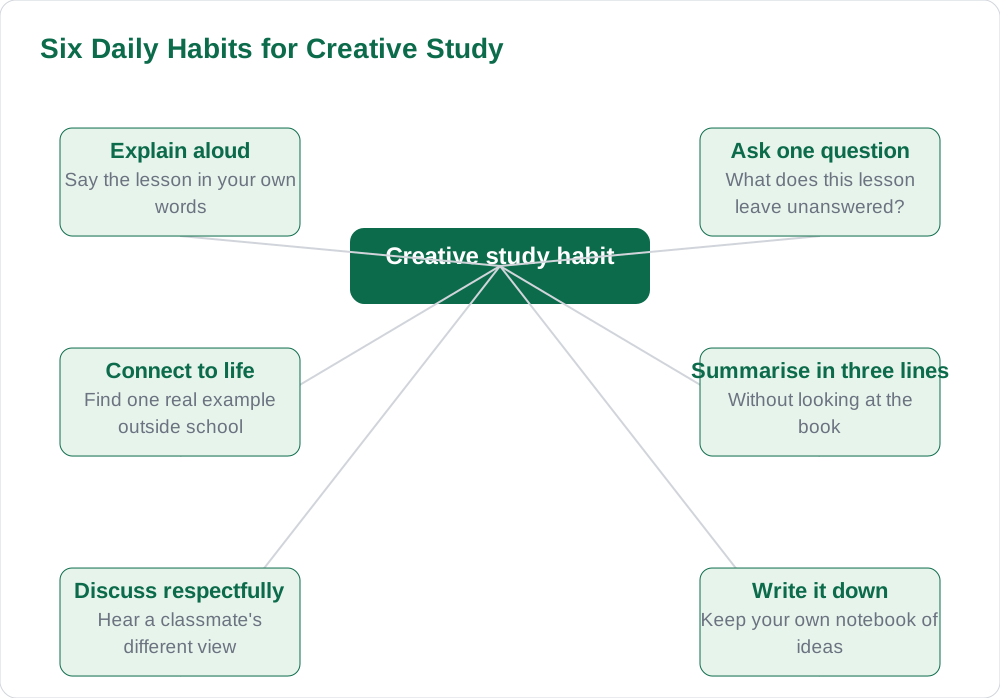
A lighter bag does not automatically mean a lighter mind; it means the weight shifts from carrying many books to using one book well. The core habit is simple: for every lesson you study, do something with it beyond reading it. Explain it aloud in your own words, write a three-line summary without looking, invent one question the lesson raises, or connect it to something you saw outside school. Each of these moves forces your brain to process the material rather than merely pass your eyes over it, and processed material is remembered far longer than read material. Students who study this way often find they need fewer repeated readings, which is exactly the relief from burden the minister described, achieved by method rather than by waiting for policy.
Start small so the habit survives contact with homework and examinations. Choose one lesson a day for the full treatment: read it once, close the book, explain it aloud, and write down one question it leaves you with. Keep a small notebook for those questions and summaries, because a notebook of your own thinking becomes a revision resource no textbook can replace. Over weeks, the notebook grows into evidence of your own creative work, and revision becomes re-reading your own ideas rather than re-reading whole chapters under pressure. The habit costs ten extra minutes per lesson and returns hours of revision time later, which is a trade any student can afford.
Research and Scientific Thinking in Daily Study
Research sounds like a university activity, but at school level it means a simple discipline: do not accept a claim until you have checked it against something. When your textbook states a fact, ask where it comes from and whether another source agrees; when a classmate states a fact, ask how they know; when a social media post states a fact, treat it as unproven until a reliable source confirms it. This is the same verification habit that protects students from fake result announcements, applied to everyday learning, and it is the foundation of scientific thinking. A student who checks claims habitually is harder to mislead in examinations, in admissions and in life, because misinformation depends on unquestioning readers.
Scientific thinking also means testing your own understanding rather than trusting your feeling of understanding. After studying a science or mathematics topic, solve a problem you have not seen before, predict an outcome before reading the answer, or explain why a wrong answer is wrong rather than merely noting the right one. Each test reveals gaps that reading alone hides, and each gap found in practice is a mark saved in the examination. Keep a list of the questions that stumped you and return to them weekly, because a question you struggled with once and then mastered is knowledge you will keep. The solved notes on this site are useful here: use them to check your working after you attempt a problem, not instead of attempting it.
Tolerance, Respect and the World Around You
The revised curriculum's emphasis on tolerance, mutual respect, gender studies and environmental protection is sometimes dismissed as soft content beside mathematics and science, but that dismissal misunderstands what these topics teach. Tolerance and mutual respect are practised, not memorised: they show in how you discuss a classmate's different opinion, how you share credit in group work, and how you speak about people whose background differs from yours. Gender studies, at school level, means noticing who gets heard, who gets opportunities and who carries which burdens, in your classroom, your family and your community, and asking whether that distribution is fair. These are thinking skills, and they are tested in life far more often than in examinations.
Environmental protection offers the most concrete daily practice of all. Notice the water, electricity and paper your school and home use, and find one waste you can reduce this week; notice the plants, animals and open spaces in your neighbourhood, and learn the name of one you did not know. Small observations like these turn a curriculum theme into lived knowledge, and lived knowledge is what you remember and what you act on. When you discuss these topics with classmates, practise the respect the curriculum names: listen fully before replying, disagree with ideas rather than with people, and change your mind openly when a better argument appears. A classroom that practises that discipline is already living the revised curriculum, whatever year it formally arrives.
A Week of Creative Habits You Can Start Now
Here is a week that puts the whole article into practice without overhauling your routine. On Monday, pick one lesson and explain it aloud to a family member or an empty room. On Tuesday, write three questions the lesson raises and try to answer one from another source. On Wednesday, find a real-life example of the lesson's idea and note it in your notebook. On Thursday, summarise a different lesson in three lines without looking, then check what you missed. On Friday, discuss a topic with a classmate and practise listening fully before replying. On Saturday, review your week's notebook and pick the idea you most want to remember. On Sunday, rest, because a rested mind is a creative mind, and the habit must survive the week to matter.
After a month of such weeks, judge the habit by its results, not by its intentions. Are your summaries getting sharper? Are you asking better questions? Are you remembering lessons with fewer re-readings? If yes, keep the habit and extend it to more lessons; if a particular move does not suit you, replace it with another from this article rather than abandoning the whole project. The revised curriculum, when it arrives next academic year, will ask for research, creativity, tolerance and environmental awareness, and you will already have a notebook proving you can do all four. That is the real meaning of a lighter bag: not fewer books to carry, but a stronger mind to carry what matters. For subject support alongside your habits, explore the books section and the blog for study guides.
AI Help: Muse AI
Muse AI is Meta's personal AI assistant, and it can help you practise creative study by turning a lesson into questions, summaries and real-life examples.
For this article's topic, you can ask Muse AI to help you write a three-line summary of a lesson or to suggest a real-life example that connects a textbook idea to the world around you.
Join Muse with invite code LTGSWD — in the Muse app, go to Settings > Redeem token and enter the code.
Disclosure: LTGSWD is the author's Muse invite code.
Muse AI does not give official STBB answers — always verify against your Sindh Textbook Board book and your teacher.
5 key points you must know
- The revised curriculum is planned for the next academic year, not in force today.
- Its stated focus includes research, scientific thinking, creativity and modern trends.
- It also emphasises tolerance, mutual respect, gender studies and environmental protection.
- Creative study means doing something with a lesson: explaining, questioning, summarising, connecting.
- One lesson a day with full treatment builds a habit that survives examinations and homework.
Frequently asked questions
Is the new creative curriculum already in force?
No. The revised curriculum is planned for the next academic year, as stated in the minister's statement reported around 20 October 2026. Your current textbooks and syllabus remain in force.
What will the revised curriculum focus on?
Research, scientific thinking and creativity, modern trends in science, technology, mathematics, languages and social sciences, plus religious tolerance, mutual respect, gender studies and environmental protection.
How can I study creatively with my current books?
Do something with each lesson beyond reading: explain it aloud, write a three-line summary without looking, ask one question it raises, and connect it to a real-life example.
Does creative study mean I can skip textbook study?
No. Creative thinking adds to knowledge; it does not replace it. Your examinations still test the textbook, so habits must strengthen textbook learning, not distract from it.
What is one habit I can start today?
Pick one lesson, read it once, close the book, explain it aloud in your own words, and write down one question it leaves you with.
Solved notes — preview free
These guides work best with the solved exercises. Preview the solved notes free on this website — 119 solved notes for Classes 6–10 in Sindhi, Urdu, English and Arabic medium. Or browse the full solved notes catalogue for your class and medium. New solved notes are added regularly — check the catalogue for coming-soon books.