Sindh's New Hindu Religious Books for Grades 3–5: What the 2026–27 Decision Means
In a first for Sindh's government schools, dedicated religious textbooks for Hindu students in Grades 3, 4, and 5 have been approved for the academic year 2026-27. The decision was taken at the Sindh Curriculum Council Executive Committee meeting on 20 April 2026, followed by a letter to the STBB chairman on 29 April 2026, and reported by Dawn on 30 April and 2 May 2026 and by The Nation on 1 May 2026. The Sindh Textbook Board oversees distribution, while publication costs for 2026-27 are borne by Prem Sagar Sanstha Karachi, with STBB to fund publication from the next academic year. This guide explains what was decided, how the arrangement works, and why the decision matters for students, families, and schools.
What Was Decided, and When
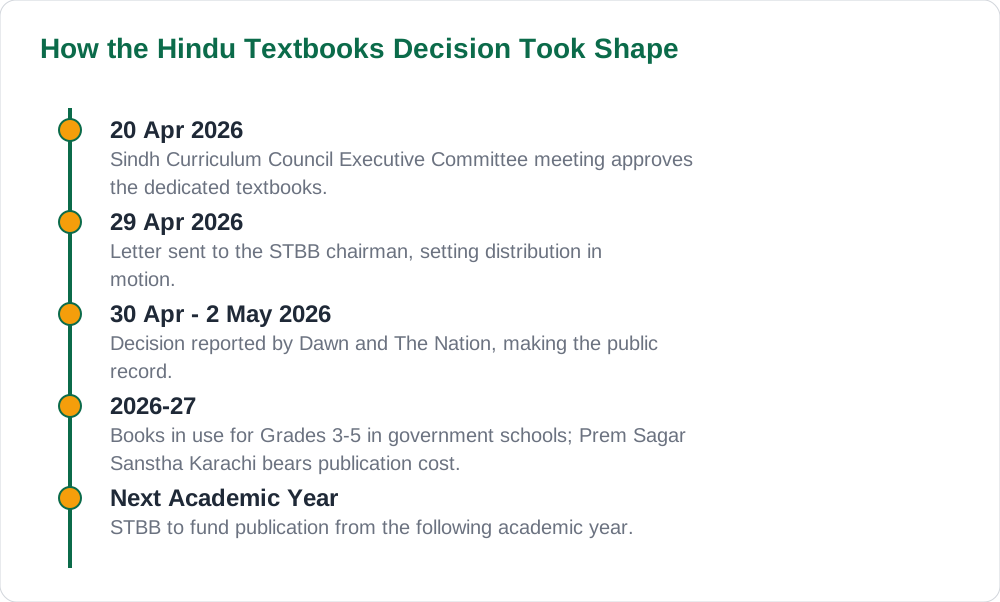
The decision is specific: the Sindh Education Department approved dedicated religious textbooks for Hindu students in government schools, for Grades 3, 4, and 5, for the academic year 2026-27. It was taken at the Sindh Curriculum Council Executive Committee meeting on 20 April 2026, and a letter followed to the STBB chairman on 29 April 2026, setting the arrangement in motion. The decision was then reported in the press, by Dawn on 30 April and 2 May 2026, and by The Nation on 1 May 2026, which is how the public record of the decision is dated. Students and families reading about the books should note these dates, because they show a decision made months before the school year, not a sudden announcement.
The scope of the decision is equally specific and worth stating plainly: it covers Grades 3 to 5, it covers government schools, and it covers Hindu students' religious education. It does not, on the verified record, extend to other grades or to other school types, and this guide does not claim otherwise. Keeping the scope exact matters, because a decision that is described more broadly than it was taken creates false expectations for families outside its range. The verified facts describe a focused first step, and that focus is itself part of the story.
Who Does What: STBB and Prem Sagar Sanstha
The arrangement divides responsibilities clearly. The Sindh Textbook Board oversees distribution of the books, which fits its role as the province's textbook body, while Prem Sagar Sanstha Karachi bears the publication cost for the 2026-27 academic year. From the next academic year onwards, STBB itself is to fund publication. That funding sequence is important to understand: the first year is carried by a community organisation, and the board takes over funding afterwards, which means the books' continuation does not depend on a single year's private support. Families and schools can therefore treat the books as a lasting part of the curriculum, not as a one-year experiment.
The division of roles also shows how curriculum decisions move from approval to classroom. Approval came from the Education Department through the Curriculum Council, distribution sits with STBB, and the first year's publication cost sits with Prem Sagar Sanstha. Each step has a named owner, which makes the arrangement accountable: if a school has not received the books, the question of who to ask has a clear answer in the distribution role. Schools that are still waiting should raise the matter through their normal departmental channels rather than assuming the books do not exist, since the decision and the distribution arrangement are both on the public record.
Why This Is a First for Sindh Government Schools
The decision is described as the first time such books are introduced for Hindu students in Sindh government schools, and that first is significant. Until now, Hindu students in government schools did not have dedicated religious textbooks of their own within the provincial system, which meant their religious education lacked the structured, grade-wise material that other subjects and other religious curricula provide. A dedicated textbook for Grades 3 to 5 gives young students age-appropriate material in their own religious tradition, taught in school rather than left entirely to home or community instruction, and that recognition within the formal system is itself meaningful for families.
The grade range also matters educationally. Grades 3 to 5 are the years when children move from learning to read to reading to learn, and when early ideas about faith, values, and community take shape. Providing structured religious material at exactly those ages means the books can support both religious knowledge and the broader values the curriculum emphasises, such as tolerance and respect for others. The STBB's wider 2026-27 textbook programme, the Shaheed Mohtarma Benazir Bhutto Textbook Series with 195 titles in Sindhi, Urdu, and English and 52 million sets, already emphasises tolerance among its revised curriculum themes, and the Hindu textbooks sit naturally alongside that direction.
What It Means for Students and Classrooms
For a Hindu student in Grade 3, 4, or 5 in a government school, the practical meaning is simple: there is now a textbook for their religious education, provided through the school system like other textbooks. That means lessons can follow a planned sequence, teachers have material to teach from, and students can revise from a book rather than from scattered notes. It also means Hindu students are visible in the curriculum in the same way as other students, which matters for a child's sense of belonging at school. A textbook is a small object, but its presence on a desk sends a message about whose learning counts.
For teachers, the books bring both an opportunity and a responsibility: to teach the material accurately and respectfully, and to handle classroom discussion with the sensitivity that religious topics deserve. Teachers who have not taught this material before may need time and support to use it well, and schools should make sure the books reach classrooms together with whatever guidance the department provides. For classmates of other faiths, the books are also a chance to learn respect in practice, since a classroom where every child's tradition is treated seriously is a classroom where tolerance is lived, not just listed as a curriculum theme. The wider solved-notes collection on Solved Notes supports classroom learning across subjects.
What to Watch Next
The honest position on what comes next is that the verified record covers the 2026-27 arrangement and the funding change from the next academic year, and nothing beyond that has been verified for this guide. Families and schools should watch for two things: whether distribution reaches all intended government schools for Grades 3 to 5 during 2026-27, and how the STBB-funded publication from the next academic year is arranged. Those are practical questions with observable answers, and they are the right things to track, rather than speculation about grades or subjects that no verified decision currently covers.
Students and parents who want to follow the story should rely on the Education Department, STBB, and reputable press reporting, as with the Dawn and Nation reports that documented the original decision, rather than on social media claims that expand the decision beyond its verified scope. A first step as significant as this one deserves accurate reporting, and accuracy means keeping the grade range, the school type, and the funding arrangement exactly as decided. The full book collection, including STBB textbooks, is listed on Books, and further board and curriculum news is covered on Blog.
AI Help: Muse AI
Muse AI is Meta's personal AI assistant, and it can help you understand this curriculum decision by explaining it in simple words or summarising what it means for a Grade 3, 4, or 5 student. You can ask it to explain the roles of STBB and Prem Sagar Sanstha, to list the key dates of the decision, or to help you discuss the topic respectfully for a class presentation. Muse AI does not give official STBB answers — always verify against your STBB book and your teacher. Always verify against your Sindh Textbook Board book and your teacher before using anything in classwork.
Join Muse with invite code LTGSWD — in the Muse app, go to Settings > Redeem token and enter the code. Disclosure: LTGSWD is the author's Muse invite code.
5 key points you must know
- Sindh approved dedicated Hindu religious textbooks for Grades 3-5 in government schools for 2026-27.
- Decision taken at the Sindh Curriculum Council Executive Committee meeting on 20 April 2026; letter to STBB chairman 29 April 2026.
- STBB oversees distribution; Prem Sagar Sanstha Karachi bears publication cost for 2026-27.
- STBB funds publication from the next academic year onwards.
- First time such books are introduced for Hindu students in Sindh government schools.
Frequently asked questions
Which classes do the new Hindu religious books cover?
The books cover Grades 3, 4, and 5, for Hindu students in government schools, for the academic year 2026-27. The decision does not, on the verified record, extend to other grades or school types. Families outside that range should not assume coverage until a further verified decision is announced.
When was the decision taken?
The decision was taken at the Sindh Curriculum Council Executive Committee meeting on 20 April 2026, followed by a letter to the STBB chairman on 29 April 2026. It was reported by Dawn on 30 April and 2 May 2026 and by The Nation on 1 May 2026, which forms the public record of the decision.
Who publishes and distributes the books?
The Sindh Textbook Board oversees distribution of the books. Prem Sagar Sanstha Karachi bears the publication cost for the 2026-27 academic year, and STBB itself is to fund publication from the next academic year onwards. That sequence means the books are intended to continue beyond the first year.
Why is this decision described as a first?
It is the first time dedicated religious textbooks for Hindu students have been introduced in Sindh government schools. Until now, Hindu students in government schools lacked structured, grade-wise religious textbooks within the provincial system. The books give Grades 3 to 5 students age-appropriate material taught in school.
What should families watch for next?
Families should watch whether distribution reaches all intended government schools for Grades 3 to 5 during 2026-27, and how STBB-funded publication is arranged from the next academic year. Those are the two practical, observable next steps. Claims that expand the decision to other grades or subjects should be checked against department or STBB announcements.
Solved notes — preview free
These guides work best with the solved exercises. Preview the solved notes free on this website — 119 solved notes for Classes 6–10 in Sindhi, Urdu, English and Arabic medium. Or browse the full solved notes catalogue for your class and medium. New solved notes are added regularly — check the catalogue for coming-soon books.