Less Book Burden, More Creative Thinking: Sindh's New Direction
The Sindh education book burden creative thinking debate began with a clear statement from the Education Minister. Syed Sardar Ali Shah said pupils should be relieved of excessive book burden and guided toward creative thinking. He was speaking about curriculum changes to be introduced from the next academic year, designed to align education with modern requirements. The revised curriculum will focus on research, scientific thinking and creativity, plus modern trends in science, technology, mathematics, languages and social sciences, with special emphasis on religious tolerance, mutual respect, gender studies and environmental protection. This article explains what the minister actually said, what it could mean for everyday study, and what has not changed. No policy details beyond the minister's statement are invented here.
What the minister actually said
The minister's message has two halves that belong together. The first half is about burden: pupils should be relieved of excessive book burden. The second half is about direction: pupils should be guided toward creative thinking. Together, they describe a shift in emphasis, from carrying more books and memorising more pages toward understanding ideas and thinking with them.
The same statement set out the shape of the revised curriculum. It will focus on research, scientific thinking and creativity, and it will cover modern trends in science, technology, mathematics, languages and social sciences. It will also give special emphasis to religious tolerance, mutual respect, gender studies and environmental protection. These are the minister's stated priorities, and they are the only details this article claims.
What book burden looks like in daily school life
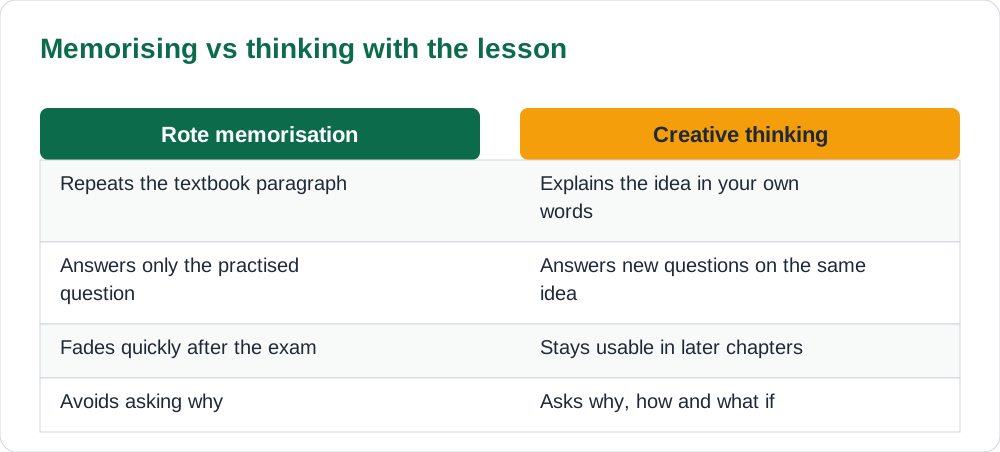
Book burden is not an abstract idea. It is the heavy bag, the long list of chapters to memorise, and the feeling that there is always another page to cover. When the burden grows too large, pupils often cope by memorising without understanding, because memorising feels faster. The knowledge fades quickly after the exam, and the pupil is left with little that can be used in a new question or a real situation.
Reducing the burden does not mean removing books or lowering standards. It means making the work pupils do with books more purposeful: fewer pages memorised blindly, more time spent understanding, discussing, questioning and applying. A pupil who truly understands one chapter can answer ten different questions on it. A pupil who memorised ten pages can often answer only the one question they practised.
Creative thinking versus rote memorisation
Rote memorisation asks one question: can you repeat what you read? Creative thinking asks a different one: can you use what you read? In a science chapter, memorisation repeats a definition. Creative thinking explains why the definition matters, gives a local example, and predicts what would happen if one condition changed. In a history chapter, memorisation repeats dates. Creative thinking explains why events happened and what they led to.
Board papers already reward the second kind of thinking more than pupils expect. Questions that ask why, how, compare, or what would happen cannot be answered well by memorised paragraphs alone. Pupils who practise explaining ideas in their own words, with their own examples, are preparing for exactly those questions.
Study habits that fit the new direction
Pupils do not need to wait for a new curriculum to start studying this way. The habits that build creative thinking can be used with today's books. After reading a lesson, close the book and explain it aloud in your own words. If you cannot explain it, you have found the exact place to re-read. Then ask one why question and one what-if question about the lesson, and try to answer both from the chapter.
Writing helps too. Short written summaries, one paragraph per lesson, force the brain to choose what matters. Making your own questions from a chapter, then answering them the next day, is one of the most reliable study methods known. Pupils who want a method for turning textbook lessons into notes can follow our guide to making notes from STBB books.
- Explain each lesson aloud in your own words after reading it
- Ask one why question and one what-if question per lesson
- Write a one-paragraph summary of each lesson in a notebook
- Make your own questions from a chapter and answer them the next day
- Discuss lessons with a classmate instead of only reading silently
What has not changed
One caution is important. The minister spoke about curriculum changes from the next academic year. Today's pupils still study today's books, sit today's papers, and are judged by today's marking. The statement is a direction for the future, not a reason to stop reading the current textbook or to ignore the current syllabus.
The sensible response is therefore twofold: keep mastering the current books, because they are what the next examination will test, and practise the thinking habits the new direction rewards, because those habits improve marks in any paper. Pupils who do both are ready for either version of the curriculum. For the wider picture of the coming changes, see our guide to Sindh curriculum reform from the next academic year.
AI Help: Muse AI
Muse AI is Meta's personal AI assistant, and it can help you practise creative thinking with your current lessons. For example, you can ask it to quiz you with why and what-if questions on a chapter you have just read, so you practise explaining ideas instead of only repeating them. Muse AI does not give official Sindh Textbook Board answers — always verify against your Sindh Textbook Board book and your teacher.
Join Muse with invite code LTGSWD — in the Muse app, go to Settings > Redeem token and enter the code.
Disclosure: LTGSWD is the author's Muse invite code.
5 key points you must know
- Education Minister Syed Sardar Ali Shah said pupils should be relieved of excessive book burden and guided toward creative thinking.
- The revised curriculum will focus on research, scientific thinking and creativity, plus modern trends across science, technology, mathematics, languages and social sciences.
- It will give special emphasis to religious tolerance, mutual respect, gender studies and environmental protection.
- Creative thinking means using ideas to answer new questions, not only repeating memorised paragraphs.
- Today's pupils still study today's books and sit today's papers, so the current syllabus remains the priority.
Frequently asked questions
What did the Sindh Education Minister say about book burden?
Education Minister Syed Sardar Ali Shah said pupils should be relieved of excessive book burden and guided toward creative thinking. He was speaking about curriculum changes to be introduced from the next academic year.
What will the revised curriculum focus on?
According to the minister, the revised curriculum will focus on research, scientific thinking and creativity, plus modern trends in science, technology, mathematics, languages and social sciences. It will give special emphasis to religious tolerance, mutual respect, gender studies and environmental protection.
Does less book burden mean pupils can stop reading textbooks?
No. The statement describes a shift in emphasis, from memorising more pages toward understanding ideas and thinking with them. Today's pupils still study today's books and are judged by today's papers, so the current syllabus remains essential.
How can a pupil practise creative thinking with current books?
Explain each lesson aloud in your own words, ask one why question and one what-if question per lesson, write a one-paragraph summary, and make your own questions from the chapter to answer the next day.
When will the curriculum changes take effect?
The minister said the curriculum changes will be introduced from the next academic year. No further policy details are claimed here. Pupils should follow official announcements from the School Education and Literacy Department and check the STBB 195-title textbook series for what is currently in use.
Solved notes — preview free
These guides work best with the solved exercises. Preview the solved notes free on this website — 119 solved notes for Classes 6–10 in Sindhi, Urdu, English and Arabic medium. Or browse the full solved notes catalogue for your class and medium. New solved notes are added regularly — check the catalogue for coming-soon books.