Sindh Boards in November 2026: What Students Should Watch For
November 2026 is a month of consequences for Sindh's students: the results announced in late October will turn into reappearance plans, an inquiry report will fall due, and the new 40% grading rule will move one step closer to Class 10. It is also a month in which rumours thrive, because several processes are running at once and students are eager for dates that have not yet been announced. This forward look separates what is genuinely on the calendar from what is merely expected, so students can plan around confirmed events and watch for official announcements without being misled by invented ones. No date in this article is claimed unless it comes from the verified record.
The Hyderabad Inquiry Report Window
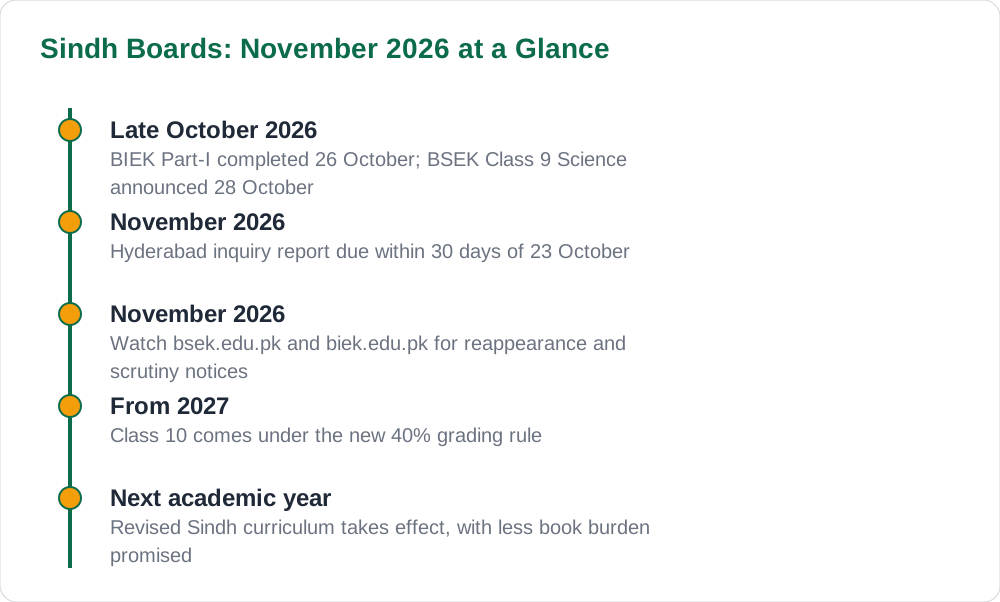
The most closely watched Sindh event of November is the report of the three-member inquiry committee into alleged irregularities in BISE Hyderabad's Class XII annual examination 2026 results. The committee, headed by Professor Dr Arbeela Bhutto with members Additional Secretary Amir Fazal Owaisi and Mehran University Registrar Dr Nasrullah Pirzada, was formed on 23 October 2026, and its report is due within 30 days of that date. This guide deliberately does not convert that window into a single calendar date, because the reporting states the window, not a confirmed date, and students should distrust any post that claims the report will land on a particular day before the authorities say so.
What should students do while waiting? In practical terms, very little changes. The announced Class XII results have not been cancelled, so students applying for further study should proceed on the results they hold. Students who believe their own mark sheet contains an error should use the board's formal rechecking route rather than waiting for the inquiry, since rechecking addresses an individual paper through a defined process. And everyone should treat the inquiry's subject matter — the allegations about pre-medical and pre-engineering results — as allegations until the committee reports. The report, when it genuinely appears, will be news everywhere at once; until then, patience and official sources are the best policy. The blog will carry further guidance when the report is published.
After the Karachi Results: Reappearance Notices to Watch
The second November watch item is quieter but affects far more students: the reappearance and scrutiny notices that should follow the late-October Karachi results. BSEK announced the Class 9 Science Group result on 28 October 2026, with 123,757 full passes and tens of thousands of partial passes, and BIEK completed its HSC Part-I results on 26 October 2026, with full-pass rates below half in every group. Students with ungraded or failed papers in either result now need the boards' next notices — the procedure, eligibility, fee, and dates for reappearing — and those notices have not yet been published in the reporting used for this guide. Students should therefore check bsek.edu.pk and biek.edu.pk regularly, and their school or college notice boards, rather than trusting dates from social media.
While waiting, the useful work is revision, not speculation. Students with open papers should already be revising them from their textbooks, paper by paper, aiming comfortably above the 40% threshold rather than at it. The BIEK scrutiny fee is Rs 1,000 per paper for students who believe a paper was marked wrongly, but no scrutiny deadline is stated in the release reporting used here, so confirm any deadline from the board's own notice. The pattern to avoid is the familiar one: waiting passively for a notice, then discovering that the gap between notice and examination is too short for real preparation. Revision started now is revision that counts whenever the notice arrives. For textbooks and solved exercises, see the book collection and the solved notes.
Next Door in Punjab: The Second Annual Examinations
Although this is a Sindh calendar, Punjab's second annual examinations running through November matter to Sindh students too, because many families follow both provinces' boards and because the same rumours cross provincial lines. Punjab's Part-II theory papers run from 3 to 16 November 2026, and Part-I theory papers from 17 to 28 November 2026, with morning reporting at 8:30 AM and papers at 9:00 AM, evening reporting at 1:30 PM and papers at 2:00 PM, and Friday evenings adjusted to 2:00 PM reporting and 2:30 PM papers. Sindh students should not confuse these dates with their own boards' schedules, but they should understand them if they have relatives or friends sitting the Punjab examinations, and they should be alert to rumours that mix the two provinces' timetables.
One Punjab detail deserves a warning for the same reason: the practical examinations scheduled from 1 to 11 December 2026 are the Multan board's schedule only, not a province-wide or national one. Posts that present Multan's practical dates as applying everywhere are a reliable sign of an unreliable source, and the same scepticism should be applied to any post that claims a Sindh practical or supplementary date without naming the board that published it. Keeping the provinces' calendars separate is a small discipline, but it prevents the most common calendar confusion of the examination season.
The Road to Class 10 Under the 40% Rule
November is also the month to look ahead to what the 40% rule means for the next examination cycle. Class 9 has used the new threshold since the 2026 annual examinations, and Class 10 follows from 2027, which means the current Class 9 cohort will sit its Class 10 examinations under the higher bar. Students now in Class 10 preparation, and students now in Class 9, should therefore treat 40% as the floor in every paper and build a margin above it, rather than aiming at the line and hoping the paper is kind. The habit that matters is regular testing: short weekly tests in each subject reveal weak chapters while there is still time to fix them, whereas a single pre-examination cram reveals them too late.
The curriculum itself is also set to change. The Sindh Textbook Board's 2026-27 textbooks — the Shaheed Mohtarma Benazir Bhutto Textbook Series, covering Early Childhood to Grade 10 with 195 titles in Sindhi, Urdu, and English and 52 million sets — were distributed from 19 February 2026, and a ministerial statement in about October 2026 described a revised curriculum from the next academic year, emphasising research, scientific thinking, creativity, modern science, technology, mathematics, languages, and social sciences, together with religious tolerance, mutual respect, gender studies, and environmental protection, and a promise to relieve pupils of excessive book burden. No new STBB announcement was verified on 29 October 2026 itself, so students should treat the curriculum change as a next-academic-year development to watch, not as a change already in force. The [home page](/) gathers the site's curriculum and textbook guides.
A Sensible November Routine for Sindh Students
Pulling the month together, a sensible November routine has four parts. First, check the official board websites weekly — bsek.edu.pk and biek.edu.pk — for reappearance and scrutiny notices, and check your school or college notice board just as often, since some notices reach institutions first. Second, keep revising open papers from the textbook, with timed practice, so that any notice finds you prepared rather than starting from scratch. Third, follow the Hyderabad inquiry only through established news sources and official announcements, ignoring social media claims that present allegations as findings or name students without evidence. Fourth, plan Class 10, or Part-II, study around the 40% standard from the start of the month, not from the eve of the examinations.
Above all, resist the temptation to fill every gap in the calendar with a rumoured date. The verified November calendar is genuinely busy — an inquiry report window, reappearance notices to come, a neighbouring province's examinations, and a grading rule moving towards Class 10 — and it needs no invented additions to be worth planning around. Students who work from the confirmed calendar, revise steadily, and check official sources weekly will be ready for whatever November actually brings, while students who chase rumours will spend the month anxious about dates that never existed. That difference, more than any single examination result, is what a well-managed November looks like.
AI Help: Muse AI
Muse AI is Meta's personal AI assistant. You can ask it to explain a concept in simple words, summarise a lesson, or make practice questions for revision.
For planning a busy month, you can ask Muse AI to help you draft a simple weekly study routine that balances new class work with revision of any open papers, then adjust it with your teacher's advice.
Join Muse with invite code LTGSWD — in the Muse app, go to Settings > Redeem token and enter the code.
Disclosure: LTGSWD is the author's Muse invite code.
Muse AI does not give official STBB answers — always verify against your Sindh Textbook Board book and your teacher.
5 key points you must know
- Hyderabad inquiry report due within 30 days of 23 October 2026 — no single date claimed.
- Watch bsek.edu.pk and biek.edu.pk for reappearance and scrutiny notices after the October results.
- Punjab second annual theory: Part-II 3–16 November, Part-I 17–28 November 2026.
- Class 10 comes under the new 40% grading rule from 2027.
- No new STBB announcement was verified on 29 October 2026; curriculum revision is a next-year change.
Frequently asked questions
When is the Hyderabad inquiry report due?
The three-member committee's report is due within 30 days of 23 October 2026. No confirmed calendar date is claimed here; watch official announcements rather than social media claims about a specific day.
Have BSEK and BIEK announced reappearance dates for October's results?
No reappearance dates are stated in the reporting used for this guide. Students with ungraded or failed papers should check bsek.edu.pk and biek.edu.pk and their institution's notice board regularly.
Does the 40% rule apply to Class 10 yet?
Class 9 has used the 40% threshold since the 2026 annual examinations, and Class 10 follows from 2027. Current Class 9 students will therefore sit Class 10 under the new rule.
Is there a new STBB announcement in November 2026?
No new STBB announcement was verified on 29 October 2026. The revised curriculum described in the ministerial statement is a next-academic-year development, not a change already in force.
Should Sindh students follow Punjab's second annual dates?
No, except to understand them for family or friends. Punjab's dates — Part-II 3–16 November and Part-I 17–28 November — belong to Punjab's boards, and Sindh students should plan from their own boards' schedules.
Solved notes — preview free
These guides work best with the solved exercises. Preview the solved notes free on this website — 119 solved notes for Classes 6–10 in Sindhi, Urdu, English and Arabic medium. Or browse the full solved notes catalogue for your class and medium. New solved notes are added regularly — check the catalogue for coming-soon books.