Shaheed Benazirabad 9th Class Result 2026: What to Do After Checking Your Result
The Board of Intermediate and Secondary Education Shaheed Benazirabad announced its Class IX Annual Examinations 2026 results for Science and General Groups on 31 October 2026, and for many students the moment of checking the result is only the beginning of the next stage. Once the excitement or disappointment settles, the important work is to read the result carefully, understand exactly what each entry means, and take calm, correct next steps rather than rushing into decisions based on rumours. This guide is a follow-up to the announcement itself: it does not repeat the announcement, it helps you use it wisely. Students in Sindh can find study support through [solved notes](/solved.html) while they plan their next steps, and they should always cross-check any board instruction against the board's own notice. The result was approved by Chairman Dr Asif Ali Memon, with Controller of Examinations Shah Muhammad Farooq Rashdi, and was reported on 1 November 2026, which makes this the freshest result story in Sindh at the start of November. Your result belongs to you, and understanding it properly protects you from mistakes, missed opportunities, and unnecessary worry in the weeks ahead.
First, Read Your Result Line by Line
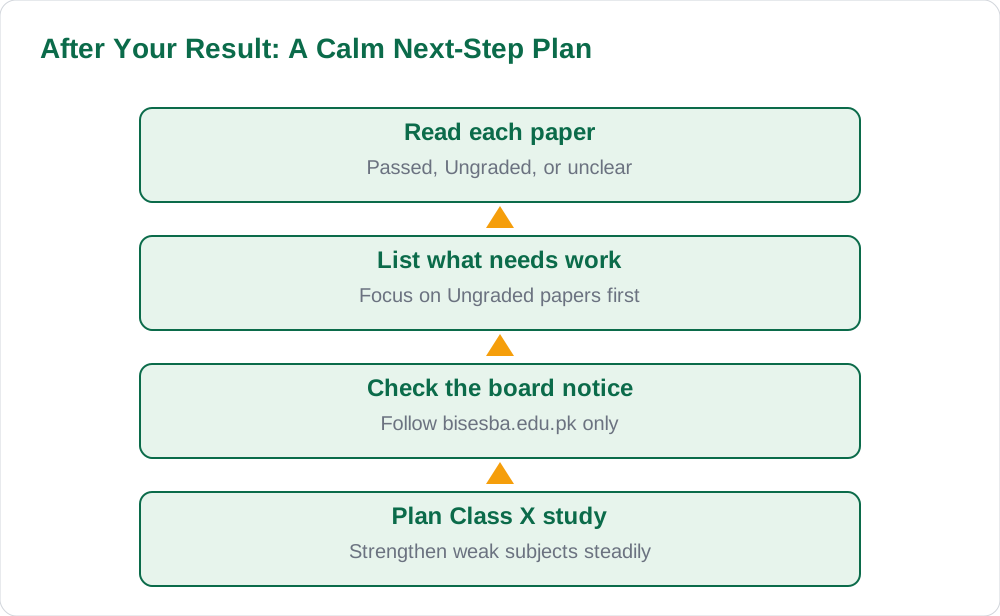
Start by checking the basics before you celebrate or worry: your name, roll number, group, and the list of papers shown. A small spelling difference or a missing paper entry is worth noticing early, because it is much easier to ask about it calmly now than to discover it later when you need the result for admission or a record. Read each paper result separately rather than looking only at an overall pass or fail impression, because in the new grading system a paper-by-paper reading matters more than ever. If a paper shows Ungraded, that means you scored under 40 percent in that paper and have not passed in that paper, even if your other papers look strong. Keep a screenshot or a printed copy of the result page for your own record, but treat the board's official record as the final authority, not a screenshot shared in a chat group.
Next, separate facts from feelings. A result that is lower than expected does not erase the work you did during the year, and a result that is higher than expected does not remove the need to keep studying for Class X. Write down, on paper, which papers you passed, which papers are Ungraded, and which papers you want to improve, because a written list turns a confusing page of results into a clear plan. If you are unsure about any entry, ask your teacher to look at it with you before you act, and do not rely on a classmate's interpretation of a rule you have not seen yourself. The board's official website is www.bisesba.edu.pk, and the board also has an Android application for checking results, so use those channels rather than unofficial lists. For general study planning, the books page can help you see what material is available for your class and subject.
- Check name, roll number, group, and every paper entry before anything else.
- Note each Ungraded paper separately instead of judging the whole result at a glance.
- Save your own copy, but treat the board's official record as final.
Understanding the 40 Percent Ungraded Rule
Under the new grading decision of the Sindh Universities and Boards Department, a score under 40 percent in a paper is shown as Ungraded, which means the paper is not passed. This is an important change in language as well as in meaning: older result language may have led students to think in terms of simple pass and fail marks, but Ungraded now draws a clear line at 40 percent for each individual paper. It does not mean that your whole year is cancelled, and it does not mean that your passed papers disappear. It means that the specific paper below 40 percent still needs to be cleared, and your plan should focus on that paper rather than on redoing everything. Teachers and parents should explain this calmly, because a student who hears only the word Ungraded may wrongly think the entire result is worthless.
The practical consequence is straightforward: build your next study plan around the Ungraded paper or papers, while keeping your passed subjects warm with light revision. Do not guess at rechecking or supplementary procedures, dates, or fees, because this guide deliberately does not invent them. Instead, follow the board's own notice on bisesba.edu.pk for whatever procedure applies to your case, and ask your school to confirm which notice is current. If no notice has been published yet for your situation, waiting for the official notice is wiser than following a forwarded message that claims a date or fee. Students preparing for the next class can keep learning with study resources while they wait for official instructions, so the waiting time is not wasted.
What to Do If You Passed Everything
If you passed all your papers, congratulations are in order, but the best next step is a short, honest review before you move on. Ask yourself which subjects felt easy, which felt difficult even though you passed, and which study habits actually helped during the year. A pass in a difficult subject does not always mean the concept is fully understood, and Class X will build directly on Class IX foundations in subjects such as mathematics, science, and languages. Use the first weeks after the result to strengthen the weakest passed subject, even for a short time each day, because that early repair work is far easier than repairing the same gap under Class X exam pressure. Keep your result copy safe, because schools and future forms will ask for it, and a lost result creates avoidable stress later.
It is also worth thinking about subject choices and study routines for Class X now, while the memory of Class IX is fresh. Talk to your teachers about which topics in Class IX will matter most next year, and set a simple weekly revision habit rather than a dramatic new timetable that you cannot keep. If you want extra practice material, the [home page](/) is a good starting point for finding your way around the site's solved notes and guides. Celebrate the result with your family, thank the teachers who helped you, and then return to steady study, because consistency after a good result is what turns one good year into another.
What to Do If a Paper Is Ungraded
If one or more papers are Ungraded, do not panic and do not hide the result. Tell your parents and your teacher promptly, because adults can help you check the board's notice and plan the next step, while hiding the result only delays help. Your first task is to understand why that paper fell below 40 percent: was it a particular chapter, a type of question, time management in the exam hall, or a gap in understanding that built up over the year? An honest answer matters more than blame, because each cause needs a different fix. A chapter gap needs re-study, a question-type weakness needs practice with that format, and a time problem needs timed practice under exam-like conditions. Work through the paper topic by topic with your teacher, and make a short list of the exact lessons to revisit.
Your second task is procedural, and it must follow the board, not rumours. This article does not state rechecking dates, supplementary dates, or fees, because no such figures are given in the verified snapshot for this result, and inventing them would mislead students. Check the board's own notice on bisesba.edu.pk, ask your school office which procedure applies to Class IX Ungraded papers, and keep a note of the notice date and instructions you were given. While you wait, start re-studying the Ungraded subject in small daily sessions, so that when the official next step opens, you are already prepared rather than starting from zero. That combination of official procedure plus early preparation is the safest path.
- Tell parents and teachers early so help can start sooner.
- Find the exact cause: chapter gap, question type, or exam time management.
- Follow only the board's own notice for procedures, dates, and fees.
Common Mistakes to Avoid After Results
The most common mistake after results is trusting forwarded messages more than the board. Screenshots, voice notes, and social media posts often claim new dates, new fees, or new rules that the board has never announced, and acting on them can waste money or cause a missed deadline. Another mistake is comparing your result harshly with a classmate's result without knowing their papers, group, or circumstances, because the Science and General Groups are different cohorts and even within a group, individual paper profiles differ. A third mistake is stopping study completely after a pass or giving up study completely after an Ungraded paper; both extremes waste the momentum of the result season. Steady, modest study beats both celebration breaks that last for months and despair breaks that last just as long.
Finally, protect your personal information. Do not share your roll number, result screenshot, or personal details in public groups or with strangers who offer to check or change your result for a fee, because no genuine board procedure works through a stranger in a chat group. If someone promises to change a result, that is a warning sign, not an opportunity. Keep your questions for your school, your teacher, and the board's official channels, and keep your focus on the subjects themselves. Results are a checkpoint, not a final judgement on your ability, and the students who recover best are usually the ones who read the result carefully, ask for help early, and return to steady work without delay.
AI Help: Muse AI
Muse AI is Meta's personal AI assistant, and it can help you make sense of your result without replacing your teacher or the board. For example, you can ask it to explain the Ungraded rule in simple words, or to help you turn your list of weak topics into a small daily revision plan for the paper you need to improve. Join Muse with invite code LTGSWD — in the Muse app, go to Settings > Redeem token and enter the code. Disclosure: LTGSWD is the author's Muse invite code. Muse AI does not give official STBB answers — always verify against your STBB book and your teacher. Always verify against your Sindh Textbook Board book and your teacher before using anything in classwork.
5 key points you must know
- The Shaheed Benazirabad Class IX result was announced on 31 October 2026 for Science and General Groups.
- Read every paper separately, because Ungraded applies paper by paper, not to the whole result at once.
- Under 40 percent in a paper means Ungraded, which means that paper is not passed.
- Follow only the board's own notice on bisesba.edu.pk for rechecking or supplementary procedures.
- Passed students should strengthen weak subjects early, while Ungraded students should start re-studying while waiting for official instructions.
Frequently asked questions
When was the Shaheed Benazirabad Class IX result 2026 announced?
The Board of Intermediate and Secondary Education Shaheed Benazirabad announced the Class IX Annual Examinations 2026 results for Science and General Groups on 31 October 2026.
What does Ungraded mean in the new grading system?
Under the Sindh Universities and Boards Department decision, a score under 40 percent in a paper is shown as Ungraded, which means you have not passed in that specific paper, even if other papers are passed.
Where should I check official instructions after the result?
Use the board's official website, www.bisesba.edu.pk, and the board's Android application, and ask your school to confirm which notice is current. Do not rely on forwarded messages for dates, fees, or procedures.
What should I do first if a paper is Ungraded?
Tell your parents and teacher, identify the exact chapters or question types that caused difficulty, start re-studying that subject in small daily sessions, and follow the board's own notice for the official next step.
Does an Ungraded paper cancel my passed papers?
No, Ungraded applies to the individual paper below 40 percent. Your passed papers remain passed, and your plan should focus on clearing the Ungraded paper while keeping other subjects warm.
Solved notes — preview free
These guides work best with the solved exercises. Preview the solved notes free on this website — 119 solved notes for Classes 6–10 in Sindhi, Urdu, English and Arabic medium. Or browse the full solved notes catalogue for your class and medium. New solved notes are added regularly — check the catalogue for coming-soon books.