Shah Abdul Latif Bhittai: Poet of Sindh
Shah Abdul Latif Bhittai is the greatest poet of Sindh and one of the greatest poets of South Asia. His collection, Shah Jo Risalo, is loved across Sindh, sung in villages and cities, and studied in schools and universities. Through his poetry, he told stories of Sindhi heroes and heroines, praised love, truth, and humanity, and criticised greed and cruelty. He lived simply at Bhit Shah, where his shrine still attracts thousands of visitors. For students, Bhittai is not only a poet for exams. He is a guide to Sindhi culture, values, and the beauty of the Sindhi language.
Life at Bhit Shah
Shah Abdul Latif Bhittai was born in 1689 in Hala Haveli in Sindh, into a family of scholars and saints. He received traditional education and travelled widely in Sindh, meeting farmers, fishermen, potters, weavers, and travellers. These journeys shaped his poetry, because he learned about ordinary life directly from ordinary people. Later he settled at Bhit Shah, a small mound village, where he lived simply, taught seekers, and composed his poetry. He passed away in 1752, but his shrine at Bhit Shah remains a centre of Sindhi culture.
Students can learn from his simple life. Bhittai did not chase wealth or high office. He valued knowledge, nature, and human company. He listened to folk stories, observed rivers and deserts, and turned everyday life into great poetry. A student who observes carefully, listens to elders, and reads folk tales will also learn deeply. Knowledge does not only come from textbooks. It comes from people, places, and careful attention to the world around you. Find class notes on the solved notes page.
Shah Jo Risalo: A Treasure of Sindhi Poetry
Shah Jo Risalo is the collection of Bhittai's poetry, organised into chapters called Surs. Each Sur is based on a musical mode and tells stories through famous Sindhi characters. The Risalo was first collected and preserved by his followers after his death, because he himself did not publish books in the modern sense. Today it is available in many editions, with translations and explanations, and it is studied as the foundation of Sindhi literature.
For students, the Risalo is a doorway into Sindhi language and culture. Even if you study in Urdu or English medium, reading a simple translation of one Sur can teach you about Sindh's rivers, deserts, crafts, and values. Poetry builds language skills: vocabulary, imagery, and expression. It also builds empathy, because poems let you feel the life of a fisherman, a potter, or a woman searching for her beloved. Start with one famous Sur and read its story summary before reading verses. Explore books on the books page.
Famous Surs and Their Heroines
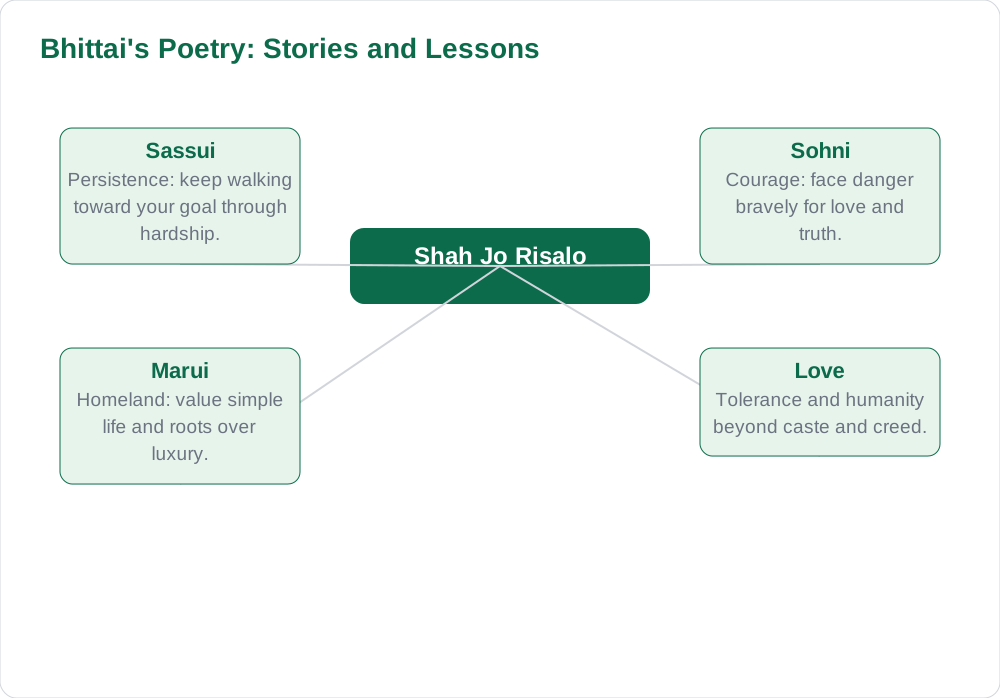
Bhittai's most famous Surs tell the stories of Sindh's heroines: Sassui, Sohni, Marui, Momal, and Noori. Sassui travels through deserts searching for her beloved Punhun, showing loyalty and determination. Sohni crosses the river at night to meet Mehar, showing courage and love. Marui refuses the comforts of a king's palace and longs for her desert home, showing love for one's homeland and simple life. Momal and Noori tell stories of beauty, love, and fate. These women are not passive characters. They are brave, loyal, and determined.
Students can learn powerful lessons from these heroines. Sassui teaches persistence: keep walking toward your goal even when the path is hard. Sohni teaches courage: face danger for what you love and believe. Marui teaches contentment and patriotism: love your home and do not trade your values for luxury. These stories are not only romance. They are lessons in character, told through unforgettable images of rivers, deserts, and journeys. That is why they have lived in Sindhi memory for centuries.
- Sassui: loyalty and persistence on a desert journey.
- Sohni: courage in crossing the river for love.
- Marui: love for homeland and simple life over palace luxury.
Message of Love, Truth, and Humanity
Bhittai's poetry carries a message of divine love, human love, truth, and tolerance. He praised honest labour, whether by a farmer, a fisherman, or a craftsman, and he criticised rulers and priests who used religion or power for greed. He believed that God is found through love and service to humanity, not through show and ritual alone. His poetry welcomes all people, regardless of caste or creed, because love recognises no boundaries. This message of tolerance is precious for Sindh, where people of many communities live together.
For students, Bhittai's message means respect for every worker and every faith. Do not judge a classmate by caste, religion, or wealth. Respect the farmer who grows your food, the sweeper who cleans your school, and the shopkeeper who serves your family. Speak truthfully, even when lying is easier, and help others without expecting reward. Bhittai taught that the highest knowledge is not bookish pride but a loving heart. A student who practises kindness daily understands Bhittai better than one who only memorises his verses.
How Students Can Enjoy Bhittai Today
Many students find classical Sindhi poetry difficult, but Bhittai can be enjoyed step by step. Start with a story summary of one Sur in your own language. Then listen to a good singer performing that Sur, because Bhittai's poetry was made to be sung. Note the images: the river, the desert, the spinning wheel, the potter's clay. Ask your teacher what each image means. Keep a notebook of favourite lines and their simple meanings. Over time, the poetry will feel familiar and beautiful.
You can also visit Bhit Shah with family or school, if possible, to see the shrine, the museum, and the cultural atmosphere. Even without travel, you can celebrate Bhittai by reading, singing, or presenting one Sur in a school programme. Sindhi culture lives when young people carry it forward. Learning Bhittai is not only about passing a literature exam. It is about keeping Sindh's soul alive: its language, its stories, its music, and its message of love for all humanity. More guides are on the blog home.
AI Help: Muse AI
Muse AI is Meta's personal AI assistant. It can explain poetry in simple words, summarise a lesson, and make practice questions for revision. For this article, you can ask Muse AI to summarise the story of Sassui in five simple sentences for students. Join Muse with invite code LTGSWD — in the Muse app, go to Settings > Redeem token and enter the code. Disclosure: LTGSWD is the author's Muse invite code. Muse AI does not give official Sindh Textbook Board answers — always verify against your Sindh Textbook Board book and your teacher.
4 key points you must know
- Shah Abdul Latif Bhittai is the greatest poet of Sindh.
- Shah Jo Risalo is organised into Surs based on musical modes.
- Heroines like Sassui, Sohni, and Marui teach courage and loyalty.
- His message is love, truth, tolerance, and respect for honest labour.
Frequently asked questions
What is Shah Jo Risalo?
It is the collection of Shah Abdul Latif Bhittai's poetry, organised into chapters called Surs, each based on a musical mode and telling stories of Sindhi heroes and heroines.
Who are the famous heroines in Bhittai's poetry?
Sassui, Sohni, Marui, Momal, and Noori are among the most famous, each showing loyalty, courage, love for homeland, and determination.
Where did Bhittai live?
He settled at Bhit Shah in Sindh, where he lived simply, taught seekers, and composed poetry. His shrine there remains a cultural centre.
How can a student start reading Bhittai?
Start with a story summary of one Sur, listen to a singer performing it, note the images, and keep a notebook of favourite lines with simple meanings.
Solved notes — preview free
These guides work best with the solved exercises. Preview the solved notes free on this website — 119 solved notes for Classes 6–10 in Sindhi, Urdu, English and Arabic medium. Or browse the full solved notes catalogue for your class and medium. New solved notes are added regularly — check the catalogue for coming-soon books.