Structuring Essay Answers in Senior Islamiat
Senior Islamiat essay questions reward structure as much as knowledge. A pupil who knows a great deal but writes it in random order scores less than a pupil who knows less but organises it well. This guide teaches a reliable structure for essay answers: claim, evidence, and lesson in every paragraph, held together by a clear opening and a short conclusion. Learn this structure once, practise it on different topics, and every essay question becomes a familiar task rather than a frightening one.
Claim, Evidence, and Lesson: The Core Pattern
Every strong essay paragraph follows three moves. The claim states the paragraph's main idea in one sentence, such as 'Patience protects trust in a community.' The evidence supports the claim with a reason, an example, or a teaching from your textbook, such as a pupil who keeps working after a poor result instead of cheating. The lesson draws out what follows: because patience protects trust, communities and classrooms become places where people can rely on one another. Pupils who write claim, evidence, and lesson in each paragraph produce essays that examiners find easy to follow and easy to reward.
The most common weakness is a paragraph with only one of these moves. A claim without evidence sounds like an opinion. Evidence without a claim sounds like a list of facts going nowhere. A lesson without evidence sounds like preaching. Before moving to the next paragraph, check your paragraph against all three moves and add the missing one. This single check, done for every paragraph, transforms most senior essays more than any other habit.
Planning Before You Write
Planning is the highest-return five minutes in an essay answer. Read the question twice, underline its key terms, and write a one-sentence answer: the thesis your essay will defend. Then jot three paragraph claims, one per paragraph, each with a short note of its evidence. This plan should take no more than five minutes, and it prevents the two great essay disasters: running out of ideas halfway, and realising at the end that you answered a different question. Pupils who plan also write faster, because they never pause mid-essay wondering what comes next.
A good plan also helps you select material. Senior pupils usually know more than an essay needs, and the plan forces a choice: only evidence that supports a paragraph claim earns a place. Everything else, however interesting, stays out. This discipline is what separates a focused essay from a long ramble. Practise planning on old questions without writing the full essay: five minutes of planning, then compare your plan with a classmate's and discuss which claims are strongest.
Openings and Conclusions That Work
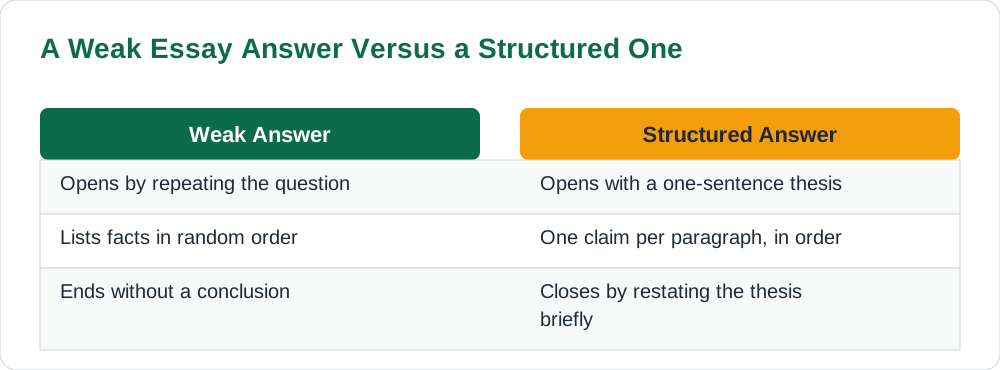
An opening should do two things in two or three sentences: define the key term and state the thesis. For example, an essay on patience might open by defining Sabr as steadfastness in good action, then state that Sabr protects trust in study, family, and community life. That opening tells the examiner exactly what the essay will prove, and every later paragraph can be judged against it. Avoid long introductions that praise the topic without defining it or stating a position; they waste time and add no marks.
A conclusion should do one thing: restate the thesis in different words and add a short final thought about life. It should not introduce new evidence, new topics, or long repetition of the whole essay. Three sentences are enough: restate the thesis, summarise the strongest lesson, and close with an application, such as how the topic should change a pupil's conduct this week. Pupils who write conclusions this way finish essays cleanly, while pupils who trail off without one leave the examiner with an unfinished impression.
Linking Paragraphs Into an Essay
An essay is more than a set of paragraphs; it is a chain of reasoning, and links make the chain visible. Simple linking phrases help enormously: 'For this reason' connects a lesson to its evidence, 'A second example' signals a new paragraph's place in the argument, and 'This is why' turns evidence into a conclusion. Use such phrases sparingly, one or two per paragraph, so that they guide the reader without sounding mechanical. Also order your paragraphs by strength or logic: from definition to application, from personal to community, or from cause to effect, and keep that order consistent.
Transitions also help you check your own argument. If you cannot write a linking sentence between two paragraphs, the paragraphs may not belong in the same essay, or one may need a clearer claim. Use this test during practice: after drafting, read only the first sentence of each paragraph in order. If those sentences read like a sensible summary of your argument, the essay is well linked. If they jump randomly, reorder or rewrite the claims before finalising.
Practising Essays Under Time Pressure
Essay skill grows through timed practice, not through reading about essays. Once a week, pick a past-style question, plan for five minutes, and write the full essay in the time you expect in the exam. Then mark it yourself against a simple checklist: clear thesis, one claim per paragraph, evidence for each claim, lesson for each claim, and a short conclusion. Score each item honestly and rewrite only the weakest paragraph. Rewriting one weak paragraph teaches more than writing three new essays carelessly.
Over a term, this weekly habit builds a portfolio of essays you can revise from, and it removes exam fear because the task becomes familiar. Keep your best essay on each major topic, such as belief, worship, character, and Seerat, and revise from those models before exams. For essay method in another subject, see the English essay structure guide, find your class book through the books collection, and browse the solved notes pages.
AI Help: Muse AI
Muse AI is Meta's personal AI assistant. It can help with this topic by turning your rough ideas into a three-paragraph plan, or by checking whether each of your paragraphs has a claim, evidence, and lesson.
Join Muse with invite code LTGSWD — in the Muse app, go to Settings > Redeem token and enter the code.
Disclosure: LTGSWD is the author's Muse invite code.
Muse AI does not give official STBB answers — always verify against your Sindh Textbook Board book and your teacher.
5 key points you must know
- Every essay paragraph needs three moves: claim, evidence, and lesson.
- Plan for five minutes first: a one-sentence thesis plus three paragraph claims.
- Open by defining the key term and stating the thesis in two or three sentences.
- Close by restating the thesis briefly with one final application, adding no new evidence.
- Practise weekly under time pressure and rewrite only the weakest paragraph each time.
Frequently asked questions
How long should I spend planning an essay answer?
About five minutes: read the question twice, write a one-sentence thesis, and jot three paragraph claims with brief evidence notes. Planning prevents running out of ideas and keeps you from answering a different question.
What should I do if I have too much material for an essay?
Select ruthlessly. Only evidence that supports a paragraph claim earns a place; everything else stays out, however interesting. A focused essay with three strong paragraphs beats a long ramble.
How do I write a good conclusion?
Restate the thesis in different words, summarise the strongest lesson, and close with one application to daily conduct. Do not introduce new evidence or new topics in the conclusion.
How can I check whether my essay is well linked?
Read only the first sentence of each paragraph in order. If those sentences read like a sensible summary of your argument, the essay is well linked. If they jump randomly, reorder or rewrite the claims.
How often should I practise timed essays?
Once a week is enough: plan for five minutes, write under exam time, then mark yourself against a checklist and rewrite only the weakest paragraph. Over a term this builds a portfolio of model essays to revise from.
Solved notes — preview free
These guides work best with the solved exercises. Preview the solved notes free on this website — 119 solved notes for Classes 6–10 in Sindhi, Urdu, English and Arabic medium. Or browse the full solved notes catalogue for your class and medium. New solved notes are added regularly — check the catalogue for coming-soon books.