Science in Weather: Clouds, Rain and Wind

Every day we ask the same question: what will the weather be like? The answer comes from science, because weather is driven by heat from the Sun, water moving between land, sea and sky, and air moving from place to place. Clouds, rain, wind, fog and storms are all visible signs of invisible processes such as evaporation and condensation. Once you understand the water cycle and how air pressure works, you can read the sky with more confidence, understand forecasts better, and explain why a hot afternoon often ends in a thunderstorm while a clear winter night feels so cold.
The Water Cycle: Earth's Endless Recycling
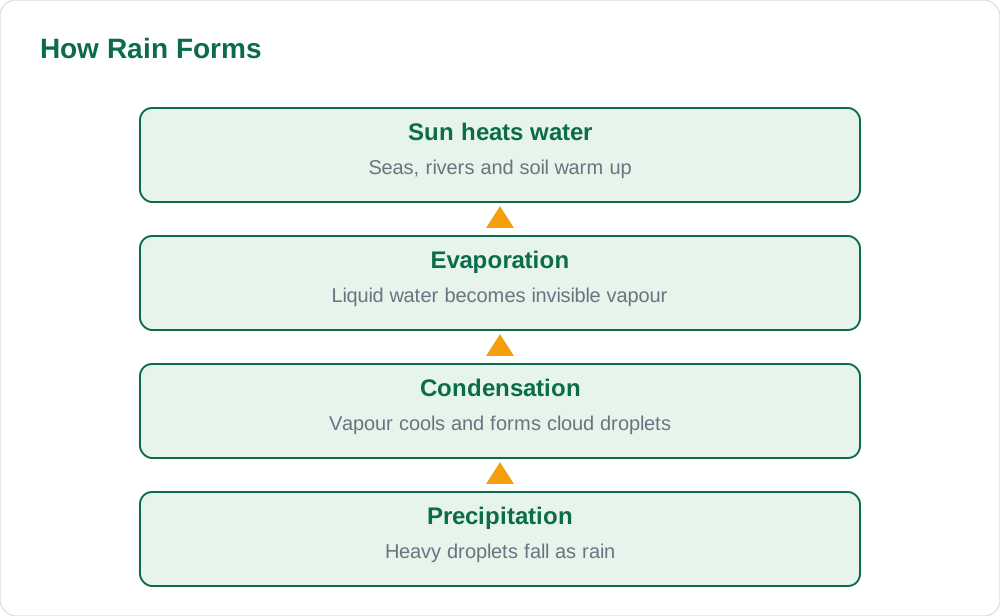
The water cycle begins when heat from the Sun evaporates water from seas, rivers, lakes, soil and leaves. Evaporation means liquid water changes into invisible water vapour and rises into the air. Plants also release vapour through tiny pores in their leaves, a process called transpiration. Together, evaporation and transpiration lift huge amounts of water into the atmosphere every day, even though you cannot see the vapour itself.
High in the sky, the air is cooler, so the vapour condenses: it changes back into tiny liquid droplets around dust particles. Billions of these droplets form a cloud. When droplets grow heavy enough, they fall as precipitation, which may be rain, drizzle, hail or snow depending on temperature. Rainwater then flows into rivers, soaks into the ground, or returns to the sea, and the cycle begins again. This is why Earth never runs out of water, even though water is always moving.
Clouds: Reading Shapes in the Sky
Clouds are not all the same, and their shapes tell us about the air above us. Flat, layered stratus clouds often bring dull, drizzly weather, while puffy cumulus clouds on a sunny day usually mean fair weather, though they can grow tall and dark before a storm. Thin, wispy cirrus clouds are made of ice crystals high in the sky and often appear before a change in weather. Dark, heavy nimbostratus clouds are the rain-bearers that can soak a whole region for hours.
Cloud colour also gives clues. White clouds scatter sunlight in all directions, while thick, tall clouds look dark grey from below because sunlight struggles to pass through so many droplets. When a cumulus cloud grows into a towering cumulonimbus, its top may flatten into an anvil shape, and that is a strong sign of thunder, lightning and heavy rain. Learning cloud names turns sky-watching into a useful skill, and a notebook of daily cloud sketches is a great science project.
Wind: Why Air Moves Across the Land
Wind is moving air, and it moves because the Sun heats different places unevenly. Warm air expands, becomes lighter and rises, while cooler, heavier air flows in to take its place. This movement from high pressure to low pressure is what we feel as wind. Near the sea, this creates daily sea breezes: during the day land heats faster than water, air over land rises, and cool air flows in from the sea, which is why coastal afternoons often feel fresh even in summer.
At night the pattern reverses into a land breeze, as land cools faster than the sea. On a larger scale, these same ideas drive monsoon winds, which bring seasonal rain to Pakistan and South Asia when moist air flows in from the sea. Wind speed is measured with an anemometer, and wind direction with a wind vane. Strong winds can cool us through evaporation from our skin, which is why a fan feels pleasant on a hot day even though it does not lower the room temperature much.
Thunderstorms, Lightning and Safety
A thunderstorm forms when warm, moist air rises rapidly and builds a tall cumulonimbus cloud. Inside the cloud, ice crystals and soft hail collide, and the collisions separate electric charge: the top of the cloud becomes positively charged and the base negatively charged. When the charge difference grows too large, lightning flashes, either inside the cloud or down to the ground, heating the air so suddenly that it expands with a bang we hear as thunder. Because light travels faster than sound, you see lightning before you hear thunder.
Lightning safety is important science in action. During a storm, stay indoors away from windows, water pipes and electrical appliances, and never shelter under a lone tall tree, because lightning seeks the highest point. If you are caught outside, move away from open fields, water and metal objects, and crouch low without lying flat. Counting seconds between flash and thunder gives a rough idea of distance, since sound travels about one kilometre every three seconds.
- Lightning is seen before thunder because light travels faster than sound.
- Stay indoors during a storm and avoid lone trees and open water.
- Rough distance in kilometres is seconds between flash and thunder divided by three.
Forecasts, Seasons and Watching Weather Yourself
Weather forecasts combine observations from satellites, weather stations, balloons and radar with computer models of the atmosphere. Forecasters track temperature, pressure, humidity, wind and cloud cover, then predict how those patterns will move. No forecast is perfect, because tiny changes in the atmosphere can grow into larger changes, but forecasts are far more accurate than guessing, and they help farmers plan irrigation, travellers plan journeys, and schools plan outdoor events.
You can become a young weather watcher with simple tools: a thermometer for temperature, a rain gauge made from a straight-sided jar for rainfall, and a daily diary of cloud type, wind direction and temperature. Over a month, patterns emerge, such as cooler nights after clear skies, because clouds act like a blanket that traps heat at night. For more everyday science, visit the blog and the about page of this site, and compare your diary with the official forecast to see how well your own sky-reading improves.
AI Help: Muse AI
Muse AI is Meta's personal AI assistant, and it can explain weather ideas in simple language with everyday examples. For this article, you can ask it why clouds form or why lightning comes before thunder, and it will break the answer into easy steps. Join Muse with invite code LTGSWD — in the Muse app, go to Settings > Redeem token and enter the code. Disclosure: LTGSWD is the author's Muse invite code. Muse AI does not give official Sindh Textbook Board answers — always verify against your Sindh Textbook Board book and your teacher.
5 key points you must know
- Evaporation lifts invisible water vapour into the air from seas and land.
- Condensation turns vapour into cloud droplets around dust particles.
- Wind blows from high pressure toward low pressure areas.
- Lightning heats air suddenly, and the expansion creates thunder.
- Clouds trap heat at night, so clear nights are usually colder.
Frequently asked questions
What is the difference between evaporation and condensation?
Evaporation is liquid water changing into invisible vapour when heated, while condensation is vapour cooling and changing back into tiny liquid droplets, which is how clouds form.
Why do we see lightning before hearing thunder?
Light travels much faster than sound, so the flash reaches your eyes almost instantly while thunder takes several seconds to travel the same distance.
Why is a cloudy night warmer than a clear night?
Clouds act like a blanket, trapping heat radiated from the ground. On a clear night that heat escapes into space, so temperatures fall further.
What causes a sea breeze?
During the day land heats faster than the sea, warm air over land rises, and cooler air from the sea flows in to replace it, creating a refreshing breeze.
How is rainfall measured?
Rainfall is measured with a rain gauge, a straight-sided container that collects rain so its depth can be read in millimetres over a set period.
Solved notes — preview free
These guides work best with the solved exercises. Preview the solved notes free on this website — 119 solved notes for Classes 6–10 in Sindhi, Urdu, English and Arabic medium. Or browse the full solved notes catalogue for your class and medium. New solved notes are added regularly — check the catalogue for coming-soon books.