Science in Transport: Wheels, Engines and Roads
Every journey, from a bicycle ride to school to a bus trip across the city, is a moving science lesson. Wheels reduce friction, engines turn fuel or electricity into motion, brakes turn motion back into heat, and roads are shaped to keep vehicles safe. The same ideas of force, friction, energy and balance explain why a cyclist leans into a turn, why a heavy truck needs a longer distance to stop, and why smooth tyres slip on a wet road. This article explores transport science through vehicles you see every day in Pakistan, from bicycles and rickshaws to buses and trains.
Wheels: A Simple Idea That Changed Travel
Before wheels, moving a heavy load meant dragging it, which created huge friction between the load and the ground. A wheel changes sliding friction into rolling friction, which is much smaller, so the same push moves a load much farther. That is why a child can pull a loaded cart on wheels but could barely drag the same load on the ground. Larger wheels roll over bumps more easily, while smaller wheels turn faster, which is one reason bicycles, buses and trucks use different wheel sizes for different jobs.
Tyres add grip and comfort to the wheel. Their rubber tread presses against the road and creates friction in the right amount: enough to grip when starting, turning and stopping, but not so much that the vehicle wastes energy. Air inside a tyre acts like a cushion, absorbing small bumps and protecting both the wheel and the rider. A flat or under-inflated tyre increases rolling resistance, wastes fuel or rider energy, and wears out faster, which is why checking tyre pressure is a simple piece of transport science.
Forces at Work: Push, Friction and Air Resistance
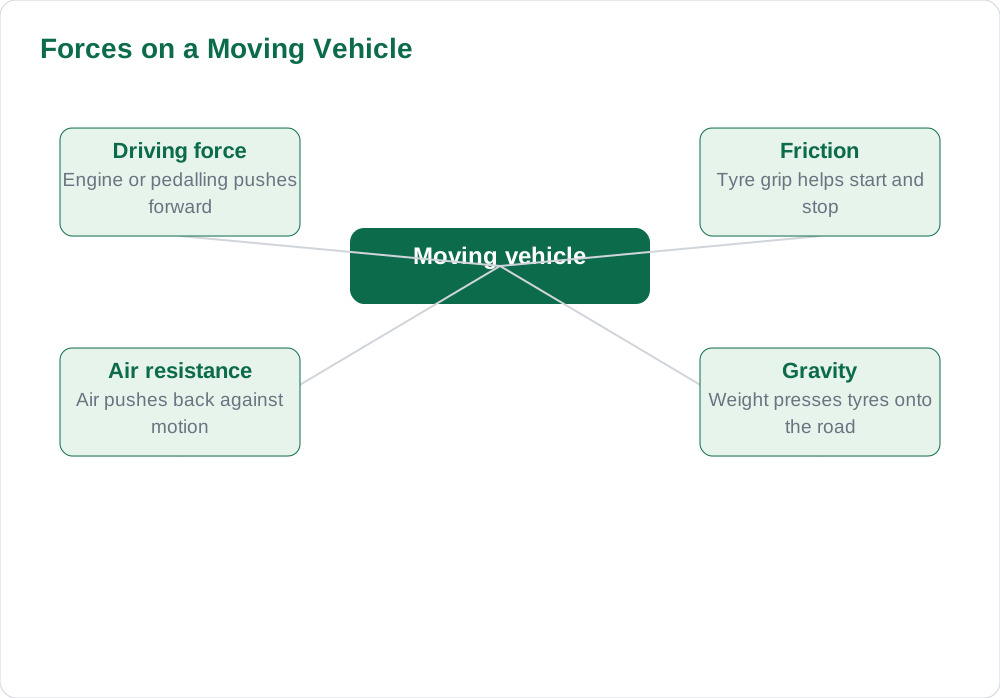
A moving vehicle is a balance of forces. The engine or the rider's legs provide a forward driving force, friction between tyres and road helps the vehicle grip and move, air resistance pushes back against motion, and gravity pulls the vehicle down onto the road. When the driving force is larger than the resisting forces, the vehicle speeds up; when they balance, it moves at a steady speed; and when the driver brakes or stops pedalling, resisting forces slow it down.
Friction is both friend and enemy in transport. Without friction, tyres would spin uselessly and brakes could not stop the vehicle, which is why icy or oily roads are so dangerous. At the same time, friction inside engines and bearings wastes energy as heat, so vehicles use oil as a lubricant to reduce it. Streamlined shapes reduce air resistance, which is why fast vehicles have smooth, rounded fronts rather than flat, boxy ones, and why cyclists crouch low when racing against the wind.
Engines: Turning Energy Into Motion
A petrol or diesel engine burns fuel inside cylinders, and the hot expanding gases push pistons that turn the wheels through gears. Gears are important because they trade speed for force: low gears give strong pulling power for starting and climbing hills, while high gears give speed on flat roads with less engine effort. That is why a bus changes gear when it climbs a slope and why a cyclist shifts to an easier gear on a hill.
Electric vehicles work differently and more quietly. A battery stores electrical energy, a motor turns that energy into motion, and braking can even send some energy back into the battery, a process called regenerative braking. Electric motors give strong pulling power from a standstill, which is useful in city traffic with frequent stops. Whether the energy comes from fuel or a battery, the principle is the same: stored energy is changed into kinetic energy, the energy of motion, and some is always lost as heat and sound.
- Low gears give pulling power for hills and starting.
- High gears give efficient speed on flat roads.
- Electric braking can return some energy to the battery.
Brakes, Balance and Staying Safe
Brakes work by friction: brake pads press against a disc or drum attached to the wheel, and friction turns the kinetic energy of motion into heat energy, slowing the vehicle. This is why brakes get hot on a long downhill stretch, and why a heavy, fast vehicle needs a longer stopping distance than a light, slow one. Wet roads reduce tyre grip, so stopping distances grow, and drivers must slow down and leave extra space in rain.
Balance matters especially on two wheels. A cyclist stays upright by steering slightly into a lean, keeping the centre of gravity above the wheels, and by the spinning wheels' tendency to resist tipping. Leaning into a turn helps because it lines up gravity and the turning force. Helmets protect the head by spreading the force of an impact and absorbing energy, while seat belts hold passengers in place so they slow down with the vehicle instead of continuing forward in a crash, following the idea of inertia.
Roads, Signals and Smarter Journeys
Road science is not only about vehicles. Roads are slightly curved, or cambered, so rainwater drains to the sides instead of pooling in the middle, and sharp bends are banked so vehicles can turn more safely. Rough surfaces give grip but wear tyres faster, while very smooth surfaces can become slippery when wet. Traffic signals, signs and lane markings organise forces and flows of vehicles, reducing sudden stops and collisions by giving everyone clear, shared rules.
Public transport uses science for efficiency too: one bus carrying many passengers uses less fuel and road space per person than many separate cars, and trains reduce rolling friction further by using smooth steel wheels on steel rails. Walking and cycling are the most energy-efficient of all for short trips, and they keep riders healthy. To explore more everyday science, visit the blog and the [home page](/) of this site, and next time you travel, notice the gears, brakes, road camber and signals working around you.
AI Help: Muse AI
Muse AI is Meta's personal AI assistant, and it can explain transport physics in simple, everyday language. For this article, you can ask it why brakes get hot or why a cyclist leans into a turn, and it will explain the forces step by step. Join Muse with invite code LTGSWD — in the Muse app, go to Settings > Redeem token and enter the code. Disclosure: LTGSWD is the author's Muse invite code. Muse AI does not give official Sindh Textbook Board answers — always verify against your Sindh Textbook Board book and your teacher.
5 key points you must know
- Wheels change sliding friction into much smaller rolling friction.
- Tyre tread gives grip for starting, turning and stopping.
- Low gears give power for hills, high gears give speed on flats.
- Brakes turn kinetic energy into heat energy through friction.
- Heavy, fast vehicles need longer stopping distances than light, slow ones.
Frequently asked questions
Why is rolling easier than dragging?
Rolling friction between a wheel and the ground is much smaller than sliding friction between a dragged load and the ground, so the same push moves a wheeled load much farther.
Why do brakes get hot?
Brakes press pads against a disc or drum, and friction changes the kinetic energy of motion into heat energy, which warms the brakes, especially on long downhill stretches.
Why does a cyclist lean into a turn?
Leaning lines up gravity and the turning force so the rider stays balanced above the wheels instead of being pushed outward and toppling over.
Why are stopping distances longer in rain?
Wet roads reduce friction between tyres and the surface, so brakes and tyres grip less well and the vehicle travels farther before it stops.
Why do buses change gear on hills?
Low gears give more pulling force at lower speed, which a heavy bus needs to climb a hill, while high gears are more efficient for steady speed on flat roads.
Solved notes — preview free
These guides work best with the solved exercises. Preview the solved notes free on this website — 119 solved notes for Classes 6–10 in Sindhi, Urdu, English and Arabic medium. Or browse the full solved notes catalogue for your class and medium. New solved notes are added regularly — check the catalogue for coming-soon books.