Science in Sports: Cricket, Football and Running

Sport feels like pure fun, but every run, kick, throw and catch is governed by physics and biology. A cricket ball swings because of air pressure, a football curves because of spin, a runner speeds up by pushing against the ground, and muscles turn food energy into motion. Understanding these ideas does not spoil the game; it makes watching and playing far more interesting, and it helps young athletes train smarter and stay safer. This article explores the science behind cricket, football and running, three sports loved across Pakistan and the world.
Force, Motion and Newton's Ideas on the Field
Newton's laws explain much of sport in plain language. An object stays still or keeps moving steadily unless a force acts on it, which is why a ball rolls on until friction and air resistance slow it down. Force equals mass times acceleration, so a heavier ball needs a stronger push to speed up as quickly as a lighter one. Every action also has an equal and opposite reaction: when a runner pushes backward against the ground, the ground pushes the runner forward, and when a footballer kicks a ball, the ball pushes back on the foot.
Momentum, which combines mass and speed, explains why a fast, heavy player is harder to stop than a slow, light one, and why a goalkeeper must absorb the momentum of a hard shot with hands, arms and body. Impulse, the effect of force over time, explains why catching a fast ball with soft, moving hands hurts less than catching it stiffly: giving more time spreads the same momentum change over a longer period, reducing the peak force on your hands.
Cricket Science: Swing, Spin and Timing
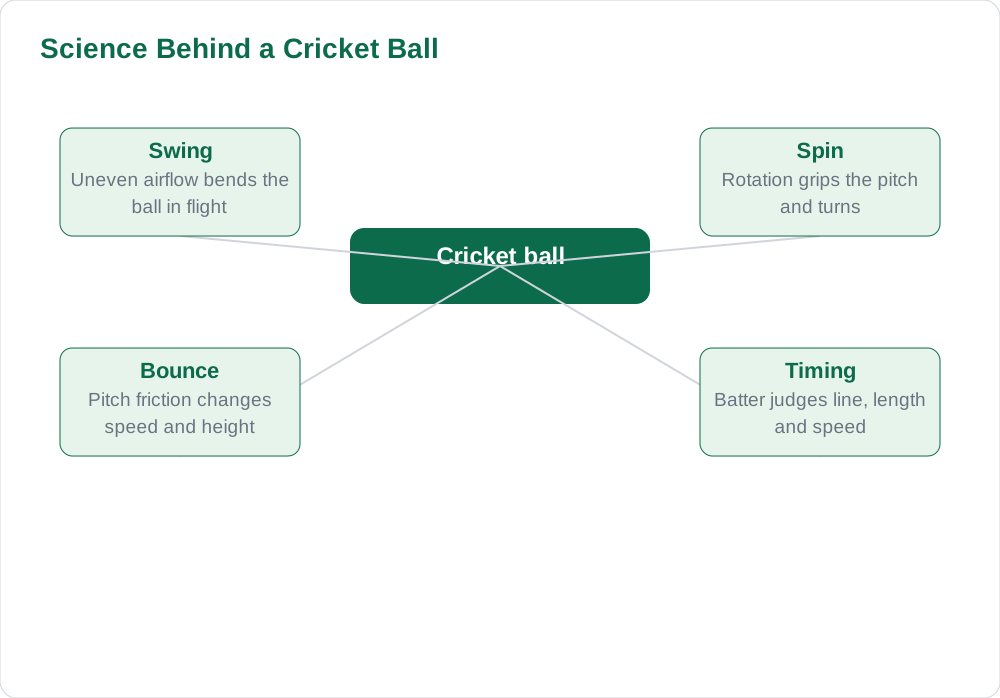
A cricket ball swings when air flows differently on its two sides. A shiny side lets air flow smoothly, while a rough side slows air and changes pressure, and the pressure difference bends the ball's path through the air. Bowlers polish one side and let the other roughen to increase this effect, and they also use seam position to disturb airflow. Reverse swing, seen with older balls, reverses the usual pattern because of complex airflow at higher speeds, which is why it puzzles even experienced batters.
Spin bowling uses friction and rotation. A spinner grips the ball so it rotates as it leaves the hand, and when it lands, friction with the pitch grips the spinning surface and changes direction. Topspin dips and bounces higher, backspin floats and skids lower, and sidespin turns the ball left or right. Batting timing is applied physics too: the batter must judge speed, bounce and line, move feet into position, and meet the ball with a bat angled to send it where fielders are not, all within a fraction of a second.
Football Science: Curves, Bounce and Kicking Power
A curving free kick is a beautiful example of the Magnus effect. When a football spins in flight, it drags air around with it, speeding airflow on one side and slowing it on the other. The resulting pressure difference pushes the ball sideways, curving its path in the direction of the spin. Striking the ball off-centre with the inside or outside of the foot creates the spin, and the amount of curve depends on spin speed, ball speed and air conditions, which is why the same kick behaves slightly differently on a windy day.
Kicking power comes from the whole body, not just the foot. A run-up builds momentum, the planted foot gives balance and direction, the kicking leg swings like a pendulum from the hip, and the follow-through transfers energy smoothly into the ball. The angle of the kick decides height and distance: a low, driven pass uses a flatter strike, while a high clearance uses a strike lower on the ball. Ball bounce depends on air pressure inside the ball and the hardness of the surface, which is why a properly inflated ball bounces predictably and an under-inflated one feels dead.
- Spin creates a pressure difference that curves the ball.
- A run-up and follow-through add power to a kick.
- Correct ball pressure gives a predictable bounce.
Running Science: Energy, Muscles and Breathing
Running turns chemical energy from food into kinetic energy of motion. Muscles contract by sliding tiny fibres past each other, using energy released from glucose, and that contraction pulls on bones through tendons to move the legs. The faster you run, the more energy your muscles need, and the more oxygen your lungs and heart must deliver, which is why breathing quickens and heart rate rises during a sprint. Training improves this system: the heart grows stronger, muscles become more efficient, and the body learns to clear waste products faster.
Running technique is also physics. Short, quick steps with feet landing under the body waste less braking force than long, overreaching strides that land far ahead. Arms swing opposite to legs to balance rotation, and leaning slightly forward helps gravity assist forward motion without toppling. Good running shoes grip the surface, cushion impact and protect joints, but no shoe replaces gradual training: increasing distance or speed too fast is the commonest cause of strains, shin pain and stress injuries in young runners.
Balance, Reaction Time and Playing Safely
Balance depends on keeping your centre of gravity above your base of support. A footballer with feet wide apart is harder to push over than one standing narrowly, and a batter with a stable stance can react faster because the body is already balanced. Reaction time is the delay between seeing an event and responding to it, and it improves with practice because the brain learns to recognise patterns, such as a bowler's action or a goalkeeper's movement, and prepare a response before the ball arrives.
Safety science protects players at every level. Warming up raises muscle temperature, increases blood flow and loosens joints, reducing injury risk, while cooling down and stretching help muscles recover. Helmets, pads, shin guards and mouthguards spread impact forces and protect vulnerable parts, and drinking water before, during and after play prevents dehydration, especially in hot weather. Rest days are part of training, not laziness, because muscles grow stronger during recovery. For more everyday science, visit the blog and the solved notes on this site, and try timing your own reaction with a dropped ruler experiment.
AI Help: Muse AI
Muse AI is Meta's personal AI assistant, and it can explain sports physics in simple, fun language. For this article, you can ask it why a football curves or how a cricket ball swings, and it will explain the forces step by step. Join Muse with invite code LTGSWD — in the Muse app, go to Settings > Redeem token and enter the code. Disclosure: LTGSWD is the author's Muse invite code. Muse AI does not give official Sindh Textbook Board answers — always verify against your Sindh Textbook Board book and your teacher.
5 key points you must know
- Pushing backward on the ground drives a runner forward.
- Uneven airflow makes a cricket ball swing in flight.
- Spin creates a pressure difference that curves a football.
- Muscles turn food energy into motion through contraction.
- Warming up and rest both reduce injury risk.
Frequently asked questions
Why does a cricket ball swing?
Air flows differently over the shiny and rough sides of the ball, creating a pressure difference that bends its path through the air.
Why does a spinning football curve?
Spin drags air around the ball, speeding airflow on one side and slowing it on the other, and the pressure difference, called the Magnus effect, pushes the ball sideways.
Why does a runner breathe faster when sprinting?
Muscles need more oxygen to release energy quickly during a sprint, so the lungs breathe faster and the heart pumps harder to deliver that oxygen.
Why does catching with soft hands hurt less?
Soft, moving hands spread the change in momentum over a longer time, reducing the peak force on the hands compared with a stiff, sudden catch.
Why is warming up important?
Warming up raises muscle temperature, increases blood flow and loosens joints, which prepares the body for effort and lowers the risk of strains and injuries.
Solved notes — preview free
These guides work best with the solved exercises. Preview the solved notes free on this website — 119 solved notes for Classes 6–10 in Sindhi, Urdu, English and Arabic medium. Or browse the full solved notes catalogue for your class and medium. New solved notes are added regularly — check the catalogue for coming-soon books.