Science Inside a Mobile Phone

A mobile phone looks like a simple glass rectangle, but inside it is a pocket-sized collection of physics, chemistry and computing. It sends invisible radio waves to a tower, turns your voice into digital signals, stores energy in a chemical battery, shows pictures with millions of tiny lights, and senses motion, light and touch. Understanding how these parts work together turns a familiar device into a fascinating science lesson. This article opens up the phone, piece by piece, and explains each part in language a school student can follow, without needing any technical background.
Signals: How Your Voice Travels Without Wires
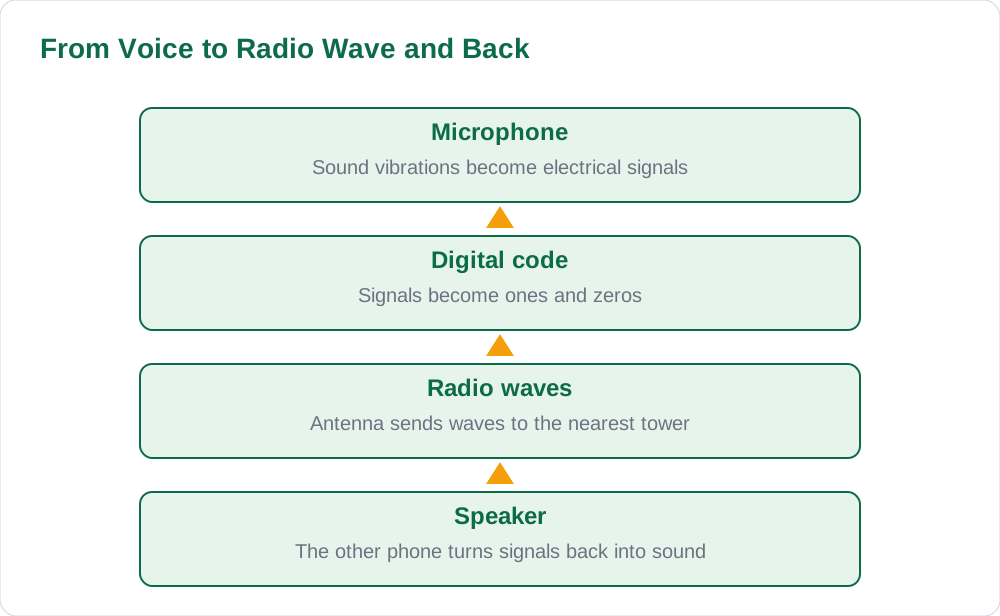
When you speak into a phone, a microphone changes sound vibrations in the air into electrical signals. The phone then changes those signals into digital code, a stream of ones and zeros, and sends them out as radio waves through its antenna. Radio waves are a form of electromagnetic radiation, like light but invisible and with longer wavelengths, and they travel through the air at the speed of light to the nearest mobile tower.
The tower passes your call through a network of cables, switches and other towers until it reaches the other person's phone, which reverses the whole process: radio waves become electrical signals, digital code becomes sound vibrations, and a speaker recreates your voice. Because the phone connects to the nearest tower, the network is divided into small areas called cells, which is why the device is called a cellular or mobile phone. Moving between cells hands your call smoothly from one tower to the next.
Batteries: Stored Chemical Energy in Your Pocket
A phone battery stores energy chemically and releases it as electricity when needed. Most modern phones use lithium-ion batteries, in which tiny charged particles called lithium ions move between two electrodes through a special liquid or gel. When the phone is used, ions flow one way and release energy; when it is charged, the charger pushes them back the other way, ready for the next use. This reversible chemical dance is what makes rechargeable batteries possible.
Batteries slowly lose capacity over hundreds of charge cycles because their internal materials gradually wear out, which is why an old phone may need charging more often. Heat speeds up this wear, so leaving a phone in direct sunlight or charging it under a pillow is unwise. Saving battery is also applied physics: dimming the screen, turning off unused radios, and closing power-hungry apps all reduce the electrical energy the phone must supply every second.
Screens: Millions of Tiny Lights Making Pictures
A phone screen is made of millions of tiny picture elements called pixels, and each pixel can glow red, green and blue in different strengths. By mixing these three colours at different brightness levels, the screen can create almost any colour your eye can see, just as mixing paints creates new shades. In many modern phones, each pixel produces its own light, so black pixels can simply switch off, giving deep blacks and saving energy.
Touchscreens add another layer of science. A capacitive touchscreen holds a tiny electric field across its surface, and your finger, which conducts electricity slightly, disturbs that field at the exact point of touch. The phone's processor works out the position from this disturbance and responds as a tap, swipe or pinch. That is why a touchscreen responds to a bare finger but not to an ordinary glove, and why a special stylus must be designed to disturb the field in the same way.
Sensors: How a Phone Knows Motion, Light and Direction
Phones carry several sensors that quietly gather information about the world. An accelerometer measures changes in motion and tilt, which is why the screen rotates when you turn the phone and why games can respond when you tilt the device. A gyroscope measures rotation more precisely, helping with stabilised photos and virtual reality. A light sensor measures brightness and adjusts the screen so it is readable in sunlight without wasting battery indoors.
Other sensors include a magnetometer, which acts like a tiny compass by sensing Earth's magnetic field and helps maps point the right way, and a proximity sensor, which turns the screen off when the phone is held to your ear during a call. The camera is itself a sensor: a lens focuses light onto millions of light-sensitive points, each recording brightness and colour, and software combines them into a photograph. Modern phones use several lenses and clever software to sharpen images, reduce blur and brighten dark scenes.
- Accelerometer: senses tilt and changes in motion.
- Magnetometer: senses Earth's magnetic field like a compass.
- Light sensor: adjusts screen brightness to save battery.
Using Phones Wisely: Health, Safety and Balance
Understanding phone science also helps you use phones wisely. Radio waves from phones are non-ionising, meaning they do not carry enough energy to break apart atoms in the way X-rays do, but health guidance still encourages balanced use, especially for children. Holding the phone away from your body when possible, using speaker mode or earphones for long calls, and taking regular screen breaks all reduce exposure and eye strain. Bright screens at night can also make sleep harder, because blue-rich light signals to the brain that it is daytime.
Good habits include charging with the correct charger, keeping the phone dry and cool, and never using it while crossing a road or driving, because attention is a limited resource and a screen can steal it at a dangerous moment. Phones are powerful learning tools when used with purpose: you can read, revise, photograph notes and explore science. For more study ideas, visit the solved notes and the blog on this site, and try explaining one phone part to a friend in your own words.
AI Help: Muse AI
Muse AI is Meta's personal AI assistant, and it can explain phone technology in simple steps for school students. For this article, you can ask it how a touchscreen senses your finger or why a battery stores energy chemically. Join Muse with invite code LTGSWD — in the Muse app, go to Settings > Redeem token and enter the code. Disclosure: LTGSWD is the author's Muse invite code. Muse AI does not give official Sindh Textbook Board answers — always verify against your Sindh Textbook Board book and your teacher.
5 key points you must know
- Microphones turn sound vibrations into electrical signals.
- Radio waves carry digital calls between phones and towers.
- Lithium-ion batteries store energy through reversible chemistry.
- Screens mix red, green and blue pixels to make colours.
- Sensors detect motion, light, direction and touch.
Frequently asked questions
Why is it called a mobile or cellular phone?
The network is divided into small areas called cells, each served by a tower, and your phone connects to the nearest cell, handing over smoothly as you move.
How does a touchscreen know where I touched?
A capacitive screen holds a tiny electric field, and your finger disturbs it at the touch point. The phone measures the disturbance to find the exact position.
Why does an old phone battery drain faster?
After many charge cycles the battery materials wear out and hold less charge, so the same use drains the battery sooner. Heat speeds up this ageing.
How does a phone camera make a photo?
A lens focuses light onto millions of light-sensitive points, each recording brightness and colour, and software combines them into a complete image.
Why does the screen rotate when I turn my phone?
An accelerometer senses the change in tilt and motion, and the phone software rotates the display to match the new orientation.
Solved notes — preview free
These guides work best with the solved exercises. Preview the solved notes free on this website — 119 solved notes for Classes 6–10 in Sindhi, Urdu, English and Arabic medium. Or browse the full solved notes catalogue for your class and medium. New solved notes are added regularly — check the catalogue for coming-soon books.