Science of Electricity at Home

Electricity lights our rooms, runs our fans, charges our phones and keeps food cold, yet it is invisible. What flows through the wires in your home is electric current: a flow of tiny charged particles called electrons through a metal conductor. Understanding circuits, voltage, fuses and safe habits turns this invisible force into a clear science topic and helps you use it safely. This article explains home electricity step by step, from the power station to the switch on your wall, and finishes with practical ways to save electricity without losing comfort.
Current, Voltage and Resistance in Plain Words
Think of electric current like water flowing through a pipe. Current is the rate at which charge flows, voltage is like the pressure pushing it along, and resistance is like narrowness in the pipe that slows the flow. A battery or the mains supply provides the push, copper wires provide an easy path with low resistance, and devices such as bulbs, fans and heaters turn electrical energy into light, motion or heat. The unit of current is the ampere, voltage is measured in volts, and resistance in ohms.
Materials matter in electricity. Metals such as copper are conductors because their electrons move freely, while plastic, rubber, wood and glass are insulators because their electrons are held tightly and do not flow easily. That is why wires are copper inside and plastic outside: the copper carries current, and the plastic coating protects you from touching it. Water can conduct electricity when it contains dissolved salts, which is why wet hands, wet appliances and water near sockets are dangerous combinations.
Circuits: The Complete Path Electricity Needs
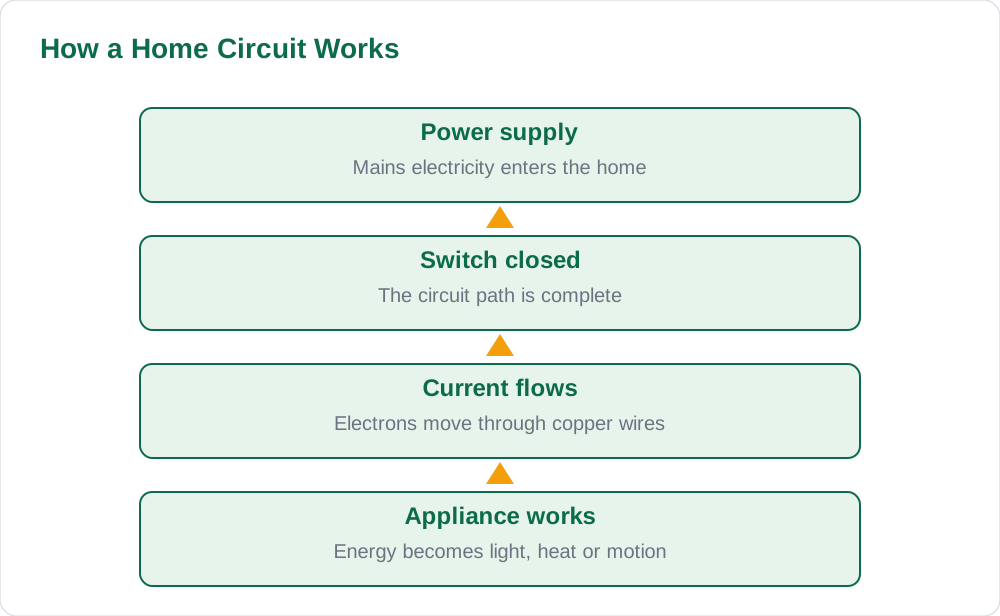
Electricity only flows when it has a complete, unbroken path called a circuit. A simple circuit has a power source, a conductor path, a device that uses energy, and a switch to open or close the path. When the switch is closed, current flows and the bulb lights; when it is open, the path breaks and current stops. This is exactly what happens when you flip a light switch at home, though home circuits are more complex and carry mains electricity at a much higher voltage than a small battery circuit.
Homes use parallel circuits, which means each appliance gets its own path to the supply. That is why switching off one light does not switch off the whole house, and why each appliance still receives the full mains voltage. In a series circuit, by contrast, devices share one path, so if one bulb fails, the whole chain goes out, like some older strings of decorative lights. Parallel wiring is safer and more convenient for homes, but it also means many appliances can draw current at once, which brings us to fuses and breakers.
Fuses, Breakers and Earthing: Silent Protectors
A fuse is a thin wire designed to melt and break the circuit if too much current flows, protecting wires from overheating and catching fire. A circuit breaker does the same job with a switch that trips open and can be reset after the fault is fixed. Both exist because excess current heats wires, just as too much water pressure could burst a pipe. Overloading a socket with many high-power heaters, or a short circuit where current takes a wrong shortcut, can both cause that dangerous excess.
Earthing is another protector. Many appliances have a metal case connected to an earth wire, which gives any leaking current a safe path into the ground instead of through a person touching the case. Three-pin plugs carry this earth connection, which is why damaged plugs, exposed wires and broken sockets must never be used. If a fuse blows or a breaker trips repeatedly, it is warning of a real fault, and an adult should call a qualified electrician rather than replacing the fuse with a thicker wire, which would remove the protection entirely.
- A fuse melts to break an overloaded circuit.
- A breaker trips open and can be reset after repair.
- Earthing gives leaking current a safe path to ground.
Where Home Electricity Comes From
Most home electricity is generated far away in power stations, where turbines spin generators that convert motion energy into electrical energy. The turbines may be driven by steam from burning fuel, falling water in a hydroelectric dam, wind turning large blades, or sunlight falling on solar panels, which convert light directly into electricity without moving parts. Electricity then travels through high-voltage transmission lines, because high voltage reduces energy lost as heat over long distances, before transformers lower the voltage for safe use in homes.
Solar panels are becoming common on rooftops in Pakistan because sunlight is plentiful. A panel produces direct current, and an inverter changes it into the alternating current used by home appliances. Alternating current changes direction many times per second, while direct current from batteries flows in one direction only. Learning where your electricity comes from helps you understand why saving electricity also saves fuel, reduces pollution, and lowers bills for your family.
Saving Electricity and Staying Safe Every Day
Saving electricity is applied science. LED bulbs turn far more electrical energy into light and far less into waste heat than old filament bulbs, fans use less energy than air conditioners, and switching off lights and devices when leaving a room stops wasted energy immediately. Ironing clothes in one session, using natural daylight, keeping fridge doors closed, and cleaning fan blades all reduce energy use in small ways that add up over a month. Standby lights may look tiny, but a device left on standby all year still consumes energy.
Safety rules are simple and must always be followed: never touch switches or plugs with wet hands, never poke objects into sockets, never use a damaged charger or frayed wire, and never try to repair mains wiring yourself. Keep water away from sockets, unplug appliances by holding the plug rather than pulling the cord, and ask an adult to deal with any sparking, burning smell or repeatedly tripping breaker. For more everyday science, explore the books page and the about page on this site, and try listing every electrical device in one room with its energy job.
AI Help: Muse AI
Muse AI is Meta's personal AI assistant, and it can explain electricity concepts in simple, everyday language. For this article, you can ask it why a fuse melts or how a solar panel turns sunlight into electricity. Join Muse with invite code LTGSWD — in the Muse app, go to Settings > Redeem token and enter the code. Disclosure: LTGSWD is the author's Muse invite code. Muse AI does not give official Sindh Textbook Board answers — always verify against your Sindh Textbook Board book and your teacher.
5 key points you must know
- Current is flowing charge, voltage is the push, resistance slows the flow.
- Copper conducts electricity while plastic insulates and protects.
- Homes use parallel circuits so each appliance works independently.
- Fuses and breakers stop dangerous excess current.
- LED bulbs and switched-off devices save real energy and money.
Frequently asked questions
What is an electric circuit?
A circuit is a complete, unbroken path that lets electric current flow from a power source, through a device, and back to the source. An open switch breaks the path and stops the current.
Why do homes use parallel circuits?
In parallel circuits each appliance has its own path and receives full voltage, so switching off one light does not affect the others, unlike a series circuit where one break stops everything.
What does a fuse do?
A fuse contains a thin wire that melts when current becomes too large, breaking the circuit and protecting wires and appliances from overheating and fire.
Why are wet hands dangerous near electricity?
Water with dissolved salts can conduct electricity, so wet skin offers current an easier path through the body, greatly increasing the risk of electric shock.
How does a solar panel make electricity?
Sunlight falling on the panel's semiconductor material frees electrons and creates direct current, which an inverter changes into alternating current for home use.
Solved notes — preview free
These guides work best with the solved exercises. Preview the solved notes free on this website — 119 solved notes for Classes 6–10 in Sindhi, Urdu, English and Arabic medium. Or browse the full solved notes catalogue for your class and medium. New solved notes are added regularly — check the catalogue for coming-soon books.