Electric Circuits: Safe Classroom Experiments with Batteries and Bulbs
An electric circuit is a complete path that lets electricity flow from a battery, through wires and parts such as bulbs and switches, and back to the battery. When the path is complete, the bulb lights. When the path is broken, the bulb goes out. That simple idea explains every circuit experiment in school science. You do not need mains electricity or complicated equipment to learn it. A small battery, a bulb, wires, and a switch are enough to test what makes a circuit work, what breaks it, and how two bulbs behave differently in different arrangements. This article explains circuits in plain words, with safe classroom experiments and the safety rules that must come first. For chapter revision, see the [solved notes](/books.html) and the [books page](/books.html).
Safety First: Rules That Never Change
Safety comes before any circuit experiment. In school science, you use only low-voltage batteries, never mains electricity from a wall socket. Never connect wires directly across a battery without a bulb or other load, because that can make wires hot. Never touch a wire or battery that feels hot, and tell your teacher at once if you smell burning, see smoke, or notice a wire getting warm. Keep water away from circuits and dry your hands before handling equipment. These rules are not extra paperwork; they are the reason classroom circuit work can be safe and enjoyable.
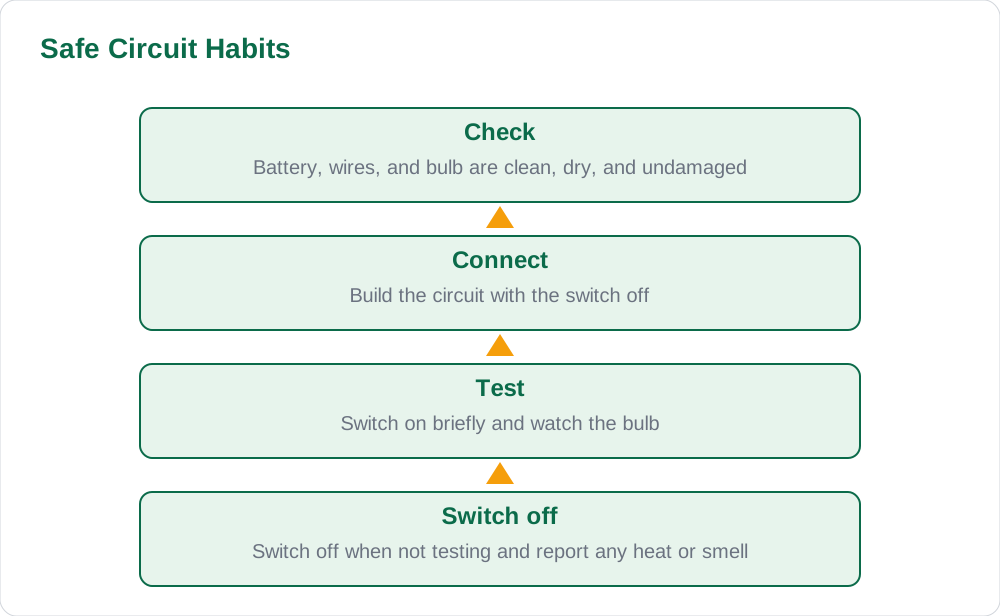
Good habits also protect the equipment. Connect wires gently, do not pull them by the metal ends, and check that battery terminals are clean and dry. Switch off the circuit when you are not testing it, so the battery does not drain and the bulb does not overheat. Work in a clear space, keep bags and books away from wires, and let the teacher check any circuit you are unsure about. If you follow these rules every time, they become automatic. A safe experiment is one where you can focus on learning, not on worrying about a hot wire or a dead battery.
- Use only low-voltage batteries in school experiments, never mains electricity.
- Never short a battery with a bare wire; always include a bulb or load.
- Stop and tell the teacher if a wire feels hot or smells of burning.
- Keep water away, dry hands, and switch off when not testing.
The Simplest Circuit: Battery, Wire, and Bulb
The simplest circuit has three parts: a battery, a bulb, and wires that connect them in a loop. One wire connects one end of the battery to one side of the bulb, and another wire connects the other side of the bulb back to the other end of the battery. When both connections are complete, electricity flows around the loop and the bulb lights. If you disconnect either wire, the loop breaks and the bulb goes out. That complete loop is the key idea. A circuit is not about one wire touching a battery; it is about a full path that returns to the battery.
A bulb lights because electricity flowing through its thin filament makes it hot enough to glow. The bulb holder and wires help the electricity reach the filament safely. If the bulb does not light, check the loop step by step: are both wires firmly connected, is the bulb screwed in properly, and is the battery fresh. Pupils often find that a loose wire, not a broken bulb, is the problem. Learning to check connections in order is a useful skill, and it is the same careful checking used in the article on diagrams and labelling, where neat, complete work matters more than speed.
- A circuit needs a complete loop back to the battery.
- Battery, wires, and bulb must all be connected firmly.
- A broken loop means no flow and no light.
- Check connections in order before assuming a part is broken.
Switches: Opening and Closing the Path
A switch is a simple gap that you can open or close. When the switch is closed, the gap is bridged and electricity can flow around the circuit, so the bulb lights. When the switch is open, the gap breaks the loop and the bulb goes out. That is why a switch is often drawn as a small break in the wire: it controls the whole circuit by opening or closing one point. A classroom switch can be a proper switch from a science kit, or a simple strip of metal that touches a drawing pin to close the gap. Either version teaches the same idea.
Switches help pupils understand control in circuits. A torch switch, a room light switch, and a fan switch all do the same job: they open or close a path. In an experiment, keep the switch off while you build, then switch on briefly to test. If the bulb lights, the circuit is complete. If it does not, switch off and check connections before trying again. That switch-off-while-checking habit protects the battery and keeps the experiment safe. It also makes your testing fair, because each test starts from the same off state.
- Closed switch: gap bridged, electricity flows, bulb lights.
- Open switch: gap breaks the loop, bulb goes out.
- Build with the switch off, then test briefly.
- Switch off before checking connections.
Two Bulbs: Series and Parallel Ideas
With two bulbs, you can build two different arrangements. In a series circuit, the bulbs are in one single loop, one after the other, so the same electricity flows through both. If one bulb is removed or fails, the loop breaks and both bulbs go out. The bulbs may also look dimmer than a single bulb, because the battery energy is shared. In a parallel circuit, each bulb has its own path back to the battery, so electricity can flow to one bulb even if the other is removed. Each bulb can glow with full brightness, and removing one does not stop the other.
The difference matters in real life. Old decorative lights wired in series all went out when one bulb failed, which was frustrating. Modern lights and house wiring use parallel paths so one light can fail without switching off the whole house. In class, build both arrangements and compare them with the same batteries and bulbs. Record which bulbs glow, how bright they look, and what happens when you unscrew one bulb. That comparison, written in a small table, is a strong exam answer because it shows you tested both ideas fairly. For more on fair comparisons, see observation and hypothesis.
- Series: one loop, both bulbs share the path; one failure stops both.
- Parallel: each bulb has its own path; one failure leaves the other lit.
- Series bulbs often look dimmer because energy is shared.
- Compare both with the same batteries and bulbs for a fair test.
Conductors, Insulators, and Simple Tests
Conductors are materials that let electricity flow easily, such as copper wire, aluminium foil, and steel spoons. Insulators are materials that do not let electricity flow easily, such as plastic, wood, rubber, and dry paper. In a circuit, wires are conductors covered with insulating plastic so you can hold them safely. The metal inside carries the electricity, while the plastic stops it from flowing into your hand. That combination is why classroom wires look simple but work safely when used correctly.
You can test materials safely with a simple circuit. Build a working bulb circuit with a gap in one wire. Touch the two ends of the gap to the material you are testing. If the bulb lights, the material is a conductor. If it stays dark, the material is an insulator. Test a coin, a pencil lead, a plastic ruler, a wooden stick, and a rubber eraser, and record each result. Do not test liquids, powders, or anything from a socket, and always use a low-voltage battery circuit. This test shows why electricians use metal tools with plastic handles, and why you should never touch a bare wire. More careful recording habits are in the science write-up guide.
- Conductors let electricity flow: copper, aluminium, steel.
- Insulators block flow: plastic, wood, rubber, dry paper.
- Test materials with a gap in a low-voltage bulb circuit.
- Never test liquids, powders, or mains electricity.
AI Help: Muse AI
Muse AI is Meta's personal AI assistant, and it can help you draw a simple circuit diagram in words and explain why a bulb lights in one arrangement but not in another.
Join Muse with invite code LTGSWD — in the Muse app, go to Settings > Redeem token and enter the code.
Disclosure: LTGSWD is the author's Muse invite code.
Muse AI does not give official STBB answers — always verify against your Sindh Textbook Board book and your teacher.
5 key points you must know
- A circuit needs a complete loop back to the battery for electricity to flow.
- A switch opens or closes one gap in that loop.
- Series bulbs share one path; parallel bulbs have separate paths.
- Conductors let electricity flow; insulators block it.
- School circuits use only low-voltage batteries and strict safety rules.
Frequently asked questions
Why does the bulb go out when I disconnect one wire?
The circuit needs a complete loop back to the battery. Disconnecting one wire breaks that loop, so electricity cannot flow and the bulb cannot light. Reconnecting the wire closes the loop again.
What is the difference between series and parallel bulbs?
In series, bulbs share one loop, so one failure stops both and they may look dimmer. In parallel, each bulb has its own path, so one can fail while the other stays lit at full brightness.
Why should I never connect a wire straight across a battery?
A bare wire across a battery gives electricity a very easy path with no bulb to use the energy, so the wire can get hot quickly. Always include a bulb or other load in a classroom circuit.
How can I test whether a material is a conductor?
Build a working bulb circuit with a small gap in one wire. Touch the gap ends to the material. If the bulb lights, it is a conductor. If it stays dark, it is an insulator. Use only solid, dry classroom materials and a low-voltage battery.
Why are wires covered in plastic?
The metal inside the wire conducts electricity, while the plastic outside insulates it. The plastic stops electricity from flowing into your hand and keeps the circuit safe to hold when used correctly.
Solved notes — preview free
These guides work best with the solved exercises. Preview the solved notes free on this website — 119 solved notes for Classes 6–10 in Sindhi, Urdu, English and Arabic medium. Or browse the full solved notes catalogue for your class and medium. New solved notes are added regularly — check the catalogue for coming-soon books.