Using Margin Notes to Study Quran Tashreeh

Quran tashreeh margin notes method gives pupils a simple way to study explanation passages without getting lost in long paragraphs. Tashreeh explains what a verse means, why it was revealed, and what lesson it teaches. Many pupils read tashreeh once and forget it because they do not organise it. In this guide, you will use a three-column margin system: verse, explanation, and lesson. You will learn how to write short, clear notes in the margin, and how to use those notes for fast revision. Always study from your own STBB book with your teacher.
What Tashreeh Is and Why Notes Help
Tashreeh is the explanation of Quranic verses. It helps pupils understand the background, the meaning of key words, and the guidance for daily life. Without notes, tashreeh can feel like a long story that is hard to recall in class or in an exam.
Margin notes work because they force you to shorten ideas. When you write a long paragraph in a few words, you must decide what matters most. That decision itself builds understanding. You can find more study help in the solved notes and on the books page.
The Three-Column Margin System
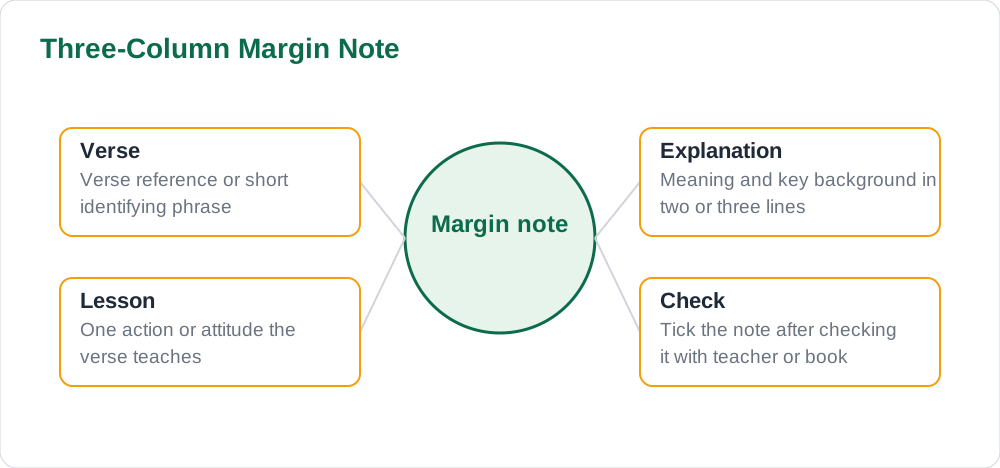
Divide the margin or a notebook page into three columns. In the first column, write the verse reference or a short phrase that identifies the verse. In the second column, write the explanation in two or three short lines: what the verse means and any key background.
Use this system for every tashreeh passage you study. Do not copy whole paragraphs; instead, choose the most important ideas. If a passage is long, split it into two or three margin entries, one for each main idea. Short entries are easier to revise and easier to remember.
Writing Clear Margin Notes
Good margin notes are short, clear, and honest. Use simple words, short phrases, and your own sentences. Avoid copying long sentences that you do not understand. If a word is difficult, write its meaning beside it. If you are unsure about an idea, mark it with a question mark and ask your teacher before treating it as final.
Use symbols to keep notes tidy. A star can mark an important lesson, an arrow can show cause and effect, and a question mark can mark a doubt. Use the same symbols every time so your notes stay consistent. Review your symbols with a classmate to make sure your system is easy to follow.
- Write short phrases in your own words, not long copied paragraphs.
- Add the meaning of any difficult word beside it.
- Mark doubts with a question mark and ask your teacher.
- Use the same symbols for stars, arrows, and questions every time.
Using Margin Notes for Revision
Margin notes make revision fast. Cover the explanation column and try to recall it from the verse column. Then cover the lesson column and try to recall the lesson from the explanation. This cover-and-recall method tests real understanding instead of passive re-reading. Spend five minutes revising margin notes before each new tashreeh lesson.
Once a week, read all the margin notes from the week and pick the three most important lessons. Write those three lessons on a separate revision card. Before a test, read the revision cards first, then return to the full margin notes only for topics that feel weak.
- Cover the explanation column and recall it from the verse column.
- Cover the lesson column and recall it from the explanation.
- Revise margin notes for five minutes before each new lesson.
- Pick three key lessons each week for a revision card.
A Weekly Tashreeh Routine
Use a simple weekly routine. In each lesson, read the tashreeh passage once, then write three-column margin notes for its main ideas. After the lesson, check your notes against your STBB book or teacher and correct any errors.
Keep tashreeh notebooks neat and dated so you can find any topic quickly. For a reading method that pairs well with margin notes, see the word-by-word tarjuma guide and browse the blog for more Quran study methods.
AI Help: Muse AI
Muse AI is Meta's personal AI assistant, and it can help you turn a tashreeh passage into short margin-note points or quiz you on the lesson column. Muse AI does not give official STBB answers — always verify against your STBB book and your teacher. Always check any explanation against your Sindh Textbook Board book and ask your teacher if anything is unclear.
Join Muse with invite code LTGSWD — in the Muse app, go to Settings > Redeem token and enter the code.
Disclosure: LTGSWD is the author's Muse invite code.
5 key points you must know
- Tashreeh explains a verse's meaning, background, and lesson.
- Use three margin columns: verse, explanation, and lesson.
- Write short notes in your own words, not long copied paragraphs.
- Revise with cover-and-recall instead of passive re-reading.
- Check every note against your STBB book or teacher.
Frequently asked questions
What should I write in each margin column?
In the verse column, write the verse reference or a short phrase. In the explanation column, write the meaning and key background in two or three lines. In the lesson column, write one action or attitude the verse teaches.
Should I copy the whole tashreeh paragraph into the margin?
No. Copying whole paragraphs does not build understanding. Choose the most important ideas, shorten them into your own words, and keep each entry to a few short lines.
How do I revise with margin notes?
Cover the explanation column and recall it from the verse column, then cover the lesson column and recall it from the explanation. This cover-and-recall method tests real understanding.
What if I am unsure about a tashreeh idea?
Mark it with a question mark and ask your teacher before treating it as final. Correct the note once you have the right explanation, so revision does not repeat a mistake.
Solved notes — preview free
These guides work best with the solved exercises. Preview the solved notes free on this website — 119 solved notes for Classes 6–10 in Sindhi, Urdu, English and Arabic medium. Or browse the full solved notes catalogue for your class and medium. New solved notes are added regularly — check the catalogue for coming-soon books.