Quaid-e-Azam: Leadership Lessons for Students

Quaid-e-Azam Muhammad Ali Jinnah is remembered as the Founder of Pakistan because he combined a clear goal with steady character. He was not a leader who changed his message with every crowd. He believed in the rule of law, in hard work, and in treating every citizen with fairness. For students, his life is useful not only as history but as a practical guide. His famous guiding words, unity, faith and discipline, were not slogans for posters. They were habits he practised every day, in his work, his health, and his dealings with others. This article looks at his story and draws simple lessons that a student can use in class, at home, and in friendships.
From a Young Student to a Determined Lawyer
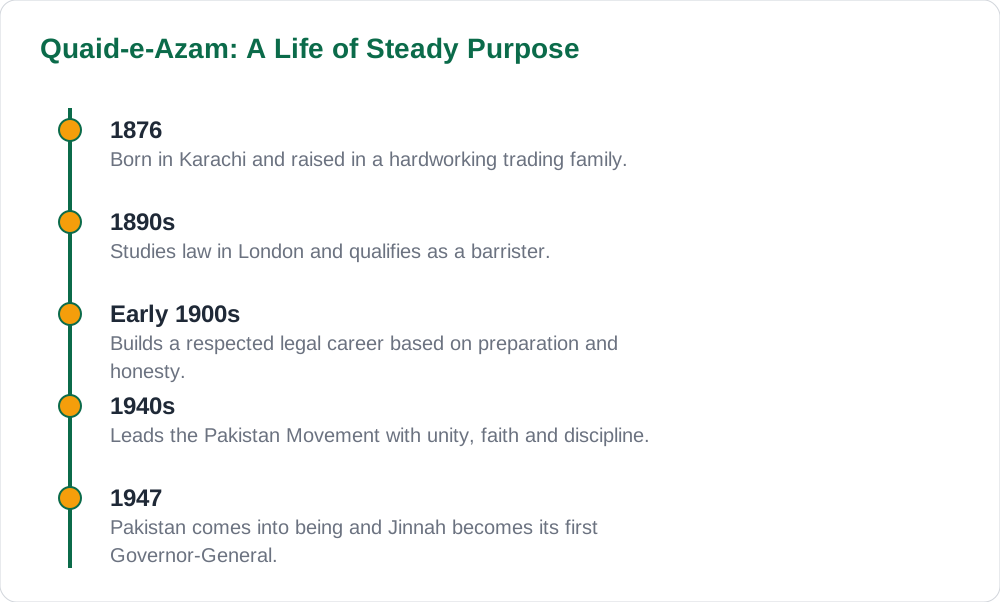
Muhammad Ali Jinnah was born in Karachi in 1876 and grew up in a trading family. As a young man he went to London to study law, and he worked hard to qualify as a barrister. This part of his life matters for students because it shows the value of patience. He did not become a national leader overnight. He first learned a profession, practised it honestly, and earned a reputation for preparation and clear argument. A student who prepares notes properly, revises regularly, and speaks carefully in class is following the same pattern on a smaller scale.
His early career also teaches the importance of discipline with time and money. Jinnah was known for punctuality, neat work, and careful use of resources. He avoided wasteful habits and kept his promises. Students can copy this in simple ways: keeping a fixed study time, finishing homework before play, and keeping books and notes in order. Discipline is not about being harsh with yourself. It is about making small promises and keeping them, day after day, until they become character. You can explore solved study material for your class on the solved notes page and plan your revision around the same steady routine.
- Learn a skill properly before expecting leadership or respect from others.
- Keep fixed study hours and finish small tasks on time.
- Speak clearly and honestly instead of using loud or careless words.
Unity: Bringing Different People Together
The Pakistan Movement brought together people from different regions, languages, and backgrounds. Jinnah understood that a divided people could not achieve a big goal. His call for unity meant that personal quarrels, provincial pride, and selfish interests had to come second to a shared purpose. He listened to different groups, tried to build agreement, and kept the main goal in front of everyone. For students, unity starts in the classroom. A class works well when students help one another, share notes fairly, and include classmates who are shy or new.
Unity also means respect in disagreement. Jinnah debated strongly, but he argued with facts and law rather than abuse. Students can practise the same habit in group work. When a group disagrees about an answer or a project plan, the best response is to check the book, listen to each side, and choose the answer with the strongest evidence. That habit builds trust. A group that trusts one another learns faster than a group where everyone only wants to win the argument. Find class-wise material to revise together on the books page.
Faith: Belief in the Cause and in Yourself
Faith, in Jinnah's guiding words, meant faith in the cause, faith in hard work, and faith that honest effort would succeed even when the road was long. The struggle for Pakistan faced many setbacks, criticism, and difficult negotiations. Jinnah did not give up after one failure. He returned to his work, prepared again, and kept moving forward. Students face smaller setbacks: a low mark, a difficult chapter in mathematics, or a subject that feels boring. Faith means not deciding after one test that you are weak in a subject. It means trying a better method, asking a teacher, and practising again.
Faith also includes self-respect. Jinnah believed that Muslims of the subcontinent deserved dignity, equal rights, and a fair future. He did not beg for respect. He built his case with reason and patience. A student can show the same self-respect by refusing to copy in exams, by admitting a mistake honestly, and by working to improve rather than hiding weakness. Real confidence grows from honest preparation, not from pretending. When you prepare well, you walk into a test calm, because you know what you have done.
Discipline: The Quiet Habit Behind Big Success
Discipline was visible in Jinnah's daily life. He kept regular hours, dressed neatly, and managed his health carefully even when his work was heavy. He understood that a leader who cannot manage himself cannot manage a movement. Students often think discipline means studying all day, but real discipline is balance. It means a timetable that includes study, rest, prayer, play, and family time. It means putting the phone away during study, completing one chapter before starting another, and revising old work instead of only reading new pages.
Discipline also protects character. A disciplined student does not cheat, does not waste a friend's time, and does not leave group work for others to finish. Teachers notice this quality quickly, and classmates trust such students with responsibility. If you want to lead a class group, a sports team, or a school society one day, start with small discipline now. Arrive on time, keep your word, and finish what you begin. These habits, repeated for years, are what turn a good student into a reliable person.
Lessons Students Can Use This Week
The best way to learn from Jinnah is to turn his example into a weekly plan. First, write one clear goal for the week, such as finishing two chapters or improving handwriting. Second, divide the goal into daily tasks and tick them off honestly. Third, help one classmate who is struggling, because unity grows through service. Fourth, when a task feels hard, change your method instead of giving up. Read the lesson aloud, solve examples step by step, or ask a teacher for one extra explanation.
Students should also learn to respect the law and the rules of their school. Jinnah respected constitutions, courts, and fair process even when he disagreed with a decision. In school life, this means following exam rules, respecting teachers, and accepting fair decisions gracefully. Leadership is not about breaking rules to look brave. It is about improving things through honest, patient work. A student who lives by unity, faith and discipline will not only do better in exams but will also become someone others can rely on. Browse more study guidance on the blog home.
- Set one clear weekly goal and break it into daily tasks.
- Help a classmate every week without expecting praise in return.
- Change your study method when stuck instead of quitting.
- Follow school rules and accept fair decisions with patience.
AI Help: Muse AI
Muse AI is Meta's personal AI assistant. It can help students understand a topic in simple words, summarise a lesson, and make practice questions for revision. For this article, you can ask Muse AI to explain unity, faith and discipline with one everyday example for each word. Join Muse with invite code LTGSWD — in the Muse app, go to Settings > Redeem token and enter the code. Disclosure: LTGSWD is the author's Muse invite code. Muse AI does not give official Sindh Textbook Board answers — always verify against your Sindh Textbook Board book and your teacher.
4 key points you must know
- Unity means putting a shared goal above personal quarrels.
- Faith means trusting honest effort even after setbacks.
- Discipline means small promises kept every day.
- Leadership grows from preparation, honesty, and respect for law.
Frequently asked questions
Why is Quaid-e-Azam called the Founder of Pakistan?
He led the Pakistan Movement with a clear constitutional and political struggle, and Pakistan came into being in 1947 under his leadership. He then served as its first Governor-General.
What do unity, faith and discipline mean for a student?
Unity means working well with classmates, faith means trusting steady effort after failure, and discipline means keeping study hours, promises, and good habits every day.
How can a student practise discipline without studying all day?
Use a balanced timetable with study, rest, play, and family time, finish one chapter before starting another, and revise old work regularly instead of only reading new pages.
Did Quaid-e-Azam become a leader overnight?
No. He first studied law, built a respected legal career, and earned trust through preparation and honesty over many years before leading a national movement.
Solved notes — preview free
These guides work best with the solved exercises. Preview the solved notes free on this website — 119 solved notes for Classes 6–10 in Sindhi, Urdu, English and Arabic medium. Or browse the full solved notes catalogue for your class and medium. New solved notes are added regularly — check the catalogue for coming-soon books.