Punjab Second Annual 2026: Roll Number Slips, Centres and Exam-Day Timings
For Punjab's second annual candidates, the roll number slip is the single most important document of the examination, because it settles every practical question — where you sit, when you report, and which papers you take on which dates. Yet every year, candidates lose marks or even papers through slip problems that were entirely avoidable: a slip collected too late, a centre never visited in advance, or a timing confused with another session's. This guide explains where regular and private candidates get their slips, how examination centres work, the exact timings for morning, evening, and Friday papers, and one important local exception — the Multan practical schedule — that must not be mistaken for a province-wide rule. Read it once, check your own slip against it, and the examination days become far simpler.
Where to Get Your Roll Number Slip
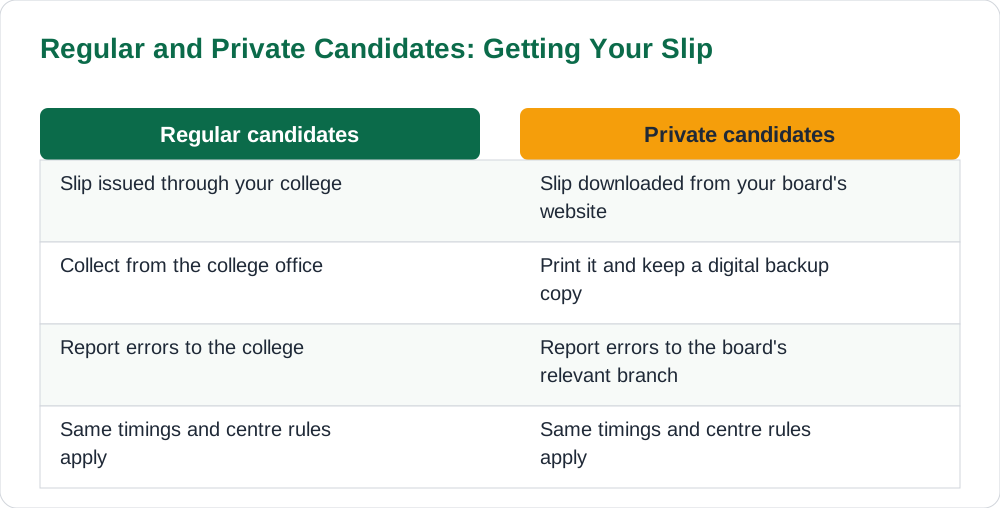
Regular candidates normally receive their roll number slips from their college, while private candidates obtain theirs from their board's website. That distinction is the first thing to get right, because a private candidate waiting for a college to hand over a slip, or a regular candidate hunting a website for a slip the college already holds, both waste the final days before the examination. If you are a regular candidate and your college has not issued slips yet, ask the college office directly and promptly; if you are a private candidate, download your slip from your own board's official website, print it, and keep a digital copy as backup. Do not rely on a slip forwarded by a friend or a screenshot from a group chat, since only your own slip, checked against your identity details, is reliable.
The moment you hold your slip, check it line by line: your full name and its spelling, your father's name if printed, your registration or roll number, your subjects, your examination centre and its address, and the date and session of every paper. Errors are rare but real, and they are correctable only if found early. If anything is wrong, report it to your college or to your board's relevant branch immediately, and keep a written record of whom you spoke to and what was promised. A candidate who discovers a wrong subject or a wrong centre on the morning of the paper has almost no remedy; a candidate who finds it a week early usually has a simple one. The blog carries more examination-day guides.
How Examination Centres Work
Your centre is assigned by the board, not chosen by you, and it may be a different school or college from your own. Visit the centre in advance if you possibly can, so that you know the route, the travel time, and the entrance you will use; candidates who arrive at an unfamiliar centre for the first time on examination morning commonly lose ten to twenty minutes to confusion that a single advance visit would have prevented. On the day, follow the centre staff's directions for seating and identity checks without argument, even if the arrangements differ from what you expected, because the centre superintendent's authority in the hall is final for practical purposes.
Centre rules are strict on a few points that candidates sometimes underestimate. You must sit in your allotted seat, not wherever you prefer; you must not carry a mobile phone or other electronic device into the hall unless the centre's rules explicitly provide a deposit arrangement; and you must not exchange anything with another candidate during the paper. Breach of these rules can lead to an unfair-means case, which is a far heavier consequence than the loss of a single paper. If you are unwell on an examination day, inform the centre staff at once rather than struggling silently, since centres have procedures for illness that are far better than a paper abandoned without explanation. For revision material to take into the final days, see the book collection and the solved notes.
Exact Timings: Morning, Evening, and Friday
The province-wide timings for the second annual examinations are fixed and worth memorising. Morning papers: report at 8:30 AM, paper begins at 9:00 AM. Evening papers: report at 1:30 PM, paper begins at 2:00 PM. Fridays only: evening reporting moves to 2:00 PM and the paper begins at 2:30 PM, the adjustment being for Jummah prayers. These timings apply to the theory papers in the Part-II window of 3 to 16 November 2026 and the Part-I window of 17 to 28 November 2026. Write them on your personal timetable, and mark every Friday evening paper separately, because the Friday change is the timing error that catches candidates most often.
Reporting time is not a suggestion; it is the time by which you should be present for checking and seating, and candidates who arrive after the paper has begun may be refused entry or admitted only at the centre's discretion, with lost time not restored. Treat the reporting time as your deadline and aim earlier: 30 to 45 minutes before reporting time for your first paper at a new centre, and at least 15 to 30 minutes early thereafter. If your journey involves public transport, add a margin for delays, and on your first paper, travel the route the day before if you can. Punctuality is the cheapest insurance in the whole examination, and it costs nothing but a slightly earlier alarm.
The Multan Practicals: A Local Schedule, Not a Provincial One
One schedule in the second annual season is frequently misread as province-wide, and it deserves a clear warning. The practical examinations scheduled from 1 to 11 December 2026 are the Multan board's schedule, as read from the Multan date sheet, and they should be presented and understood as Multan's schedule only until other boards confirm their own practical dates. A candidate under another board who plans around the Multan dates risks missing their own board's practicals entirely, or revising practical work weeks too early. The safe rule is simple: practical dates come from your own board's date sheet and your own roll number slip, and no other board's dates substitute for them.
The same caution applies to the theory date sheets. Rawalpindi board's published second-annual sheet confirms the province-wide windows with its own subject dates, but each board publishes its own subject order, and BISE Lahore had not posted its second-annual intermediate date sheet as of 24 October 2026. Candidates under any board should therefore confirm that their own board's sheet is available and read their personal paper order from it. General schedules tell you the windows; only your board's sheet and your slip tell you your papers. If either document is missing or unclear, raise it with your college or board now, while correction is still possible.
Exam-Day Routine That Removes Risk
Build a simple exam-day routine and repeat it for every paper. The night before, lay out your slip, identity card, pens, and instruments, and check the next day's paper, centre, and reporting time against your slip one final time. In the morning, eat normally, leave early, and reach the centre with time to spare. In the hall, read the whole question paper first, allocate time to each question before writing, and keep the last ten minutes for checking rather than starting a new answer you cannot finish. After the paper, do not spend hours dissecting it with friends; note any lesson for the next paper, then move on to revising the next subject.
Two final cautions complete the routine. First, the second annual admission windows of 24 September to 17 October are closed, so ignore anyone offering a late entry route; your only task is the papers you have entered. Second, the second annual result is expected around 12 January 2027 according to the reported schedule, but that is a reported expectation rather than a board guarantee, so do not plan admissions or commitments as if it were fixed. Between the last paper and the result, the most useful thing a candidate can do is rest properly and then return to regular study, because the next academic step will arrive whether or not the result date moves. The [home page](/) links to further guides for Punjab board students.
AI Help: Muse AI
Muse AI is Meta's personal AI assistant. You can ask it to explain a concept in simple words, summarise a lesson, or make practice questions for revision.
Before an examination, you can ask Muse AI to help you build a simple exam-day checklist for your centre, timings, and documents, so nothing important is left to memory on the morning of the paper.
Join Muse with invite code LTGSWD — in the Muse app, go to Settings > Redeem token and enter the code.
Disclosure: LTGSWD is the author's Muse invite code.
Muse AI does not give official STBB answers — always verify against your Sindh Textbook Board book and your teacher.
5 key points you must know
- Regular candidates get slips from their college; private candidates from their board's website.
- Check name, subjects, centre, and paper dates on your slip the day you receive it.
- Morning: report 8:30 AM, paper 9:00 AM; evening: report 1:30 PM, paper 2:00 PM.
- Friday evenings only: report 2:00 PM, paper 2:30 PM.
- Multan practicals 1–11 December are Multan's schedule only, not province-wide.
Frequently asked questions
Where do private candidates get their roll number slip?
Private candidates obtain their roll number slip from their board's official website, print it, and keep a digital backup. Regular candidates normally collect theirs from their college.
What time must I report for a morning paper?
Morning papers require reporting at 8:30 AM, with the paper beginning at 9:00 AM. Aim to arrive 30 to 45 minutes before reporting time at an unfamiliar centre.
What is the Friday evening timing?
On Fridays only, evening papers require reporting at 2:00 PM and begin at 2:30 PM, adjusted for Jummah prayers. On other days, evening reporting is 1:30 PM and the paper begins at 2:00 PM.
Are the 1–11 December practicals for all Punjab boards?
No. The 1–11 December 2026 practical schedule is the Multan board's schedule. Other boards' practical dates must be confirmed from their own date sheets and roll number slips.
What should I do if my slip has an error?
Report it to your college if you are a regular candidate, or to your board's relevant branch if you are a private candidate, immediately. Errors found early can usually be corrected; errors found on examination morning usually cannot.
Solved notes — preview free
These guides work best with the solved exercises. Preview the solved notes free on this website — 119 solved notes for Classes 6–10 in Sindhi, Urdu, English and Arabic medium. Or browse the full solved notes catalogue for your class and medium. New solved notes are added regularly — check the catalogue for coming-soon books.