Punjab Second Annual Exams 2026: Your 4-Day Countdown Checklist
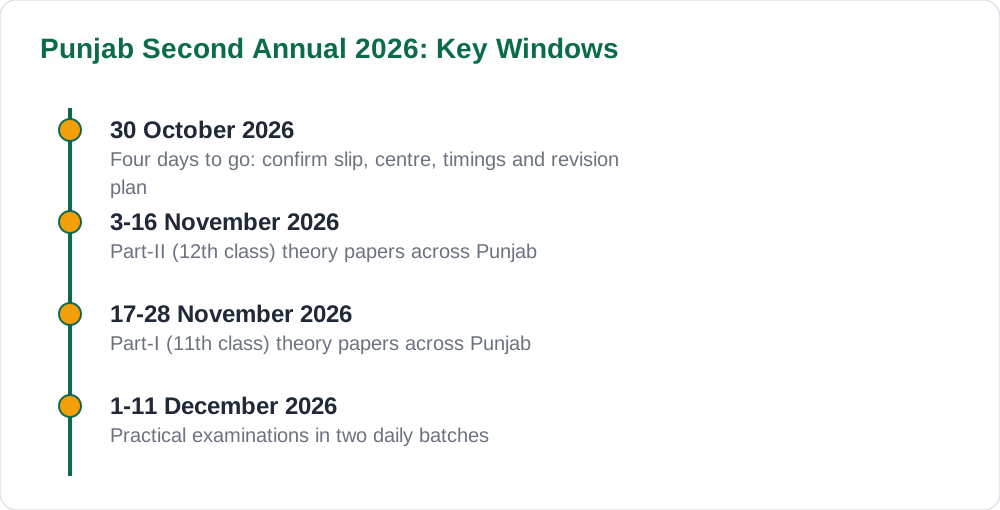
Punjab's HSSC second annual, or supplementary, examinations begin on 3 November 2026, four days away, and for students across the province's nine boards this is the final stretch. The province-wide schedule set by the Punjab Boards Committee of Chairmen runs Part-II, or 12th class, theory papers from 3 to 16 November 2026, followed by Part-I, or 11th class, theory papers from 17 to 28 November 2026, with practical examinations from 1 to 11 December 2026. This checklist covers everything a student should confirm in the next four days: timings, roll number slip and centre, documents to carry, and the honest limits of what is already closed. Admission windows for these examinations are closed, so this guide does not present them as open.
The Schedule at a Glance: What Starts When
The first fact to fix in your mind is the order of the examinations. Part-II theory papers come first, running from 3 to 16 November 2026, and Part-I theory papers follow from 17 to 28 November 2026, with practical examinations scheduled from 1 to 11 December 2026. That order matters for revision planning, because 12th class students have four days left while 11th class students have a longer runway, and each group should plan differently: 12th class students should now be in final revision and past-paper practice, while 11th class students can still use the gap during the Part-II window for structured revision, provided they do not let it drift into idle waiting. All nine Punjab boards share the 3 November start, but students must confirm their own board's subject-wise date sheet, because subject dates can differ between boards even when the overall window is shared.
Timings are fixed across the province and worth memorising now. Morning papers begin at 9:00 AM and evening papers at 2:00 PM, with Friday evening papers starting at 2:30 PM. Practical examinations run in two batches, from 9:00 AM to 12:00 PM and from 1:00 PM to 4:00 PM, with the Friday second batch adjusted to a 2:30 PM start. Arrive early for every paper, because centres close their gates before the paper begins and late arrival is the most preventable way to lose an examination. Set two alarms for each paper day, keep your transport plan ready the night before, and check whether your paper is a morning or evening session so you do not turn up at the wrong time. For general study help in these final days, see the book collection and the solved notes.
Roll Number Slip and Centre: Confirm These First
Your roll number slip is the single most important document for these examinations, and confirming it is the first item on the four-day checklist. Check that your name, photograph, subjects, centre name and centre address are all correct, and confirm the centre's location in advance rather than discovering it on the morning of the paper. If any detail on the slip looks wrong, contact your board or your institution immediately, because corrections made on the day of the paper are difficult and stressful, and in some cases impossible. Students appearing through an institution should collect the slip from their school or college, while private candidates should follow their board's official instructions for obtaining it, and every student should keep a photocopy or photograph of the slip separate from the original.
Visit or at least map your centre before the first paper if you possibly can, noting the travel time, the route, and a backup route in case of traffic or road closures. On the day, aim to reach the centre at least thirty minutes before the paper begins, because that buffer absorbs transport delays and gives you time to find your room and settle. Keep your board's official website and helpline details saved on your phone, and confirm your own board's subject-wise date sheet rather than relying on another board's sheet, since the Multan subject dates quoted in news coverage are examples from one board's sheet, not a guarantee for every board. The blog carries further examination-day guides for Punjab board students.
What to Carry, and What to Leave at Home
Pack your examination bag the night before each paper, not on the morning of it. The essentials are your original roll number slip, your national identity card or the board's accepted identity document, pens in blue or black as your board directs, and the subject-specific items your paper allows, such as a geometry box for mathematics or an approved calculator where the board permits one. Carry water if your centre allows it, and keep your bag simple so that checking at the gate is quick. Do not carry a mobile phone into the examination hall, because boards treat possession of a phone or any unfair-means material as a serious offence with consequences that can extend far beyond one paper, and the safest approach is to leave the phone at home or with a trusted person outside the centre.
Dress and behaviour matter too, in ways students sometimes underestimate. Follow your centre's instructions about seating, keep your slip visible for invigilators, and read the instructions on the question paper before writing anything, because a few minutes spent understanding the paper's structure saves far more time than it costs. If a question is unclear, ask the invigilator rather than guessing at the instruction, and manage your time by allocating minutes per question before you start writing. Students who have prepared with past papers will find this easier, because they already know how long each question type takes, and the final four days are best spent on timed practice rather than on reading new material for the first time.
Admission Windows Are Closed: What That Means
An important honesty note for this checklist: the admission windows for the second annual examinations, which ran from 24 September to 17 October 2026 across single, double and triple fee stages, are now closed, and this guide does not present them as open. Students who are already admitted should focus entirely on the checklist above, while students who missed admission should contact their board directly for advice about the next available opportunity rather than trusting agents or social media posts that claim late admission is still possible. No unofficial channel can create an admission that the board has closed, and money paid to such a channel is money lost, so the only safe advice for a missed admission is the board's own guidance.
The same caution applies to every other claim about these examinations. Subject dates quoted from the Multan date sheet, such as 12th class English on 4 November or Physics on 16 November, are examples from one board's sheet, and your own board's sheet is the document that governs your papers. Rechecking information from the earlier Part-I result, where all nine boards announced on 22 October 2026 at 10:00 AM with a rechecking window of about fifteen days, is a separate process from the second annual examinations and should not be confused with them. When in doubt, check your board's official website, ask your institution, and treat any claim that cannot be confirmed officially as unverified.
Final Four Days: A Revision Plan That Works
With four days left, the best revision plan is narrow, timed and honest. List your papers in order, identify the chapters that carry the most marks in each, and give each paper a fixed daily slot, with the heaviest weight on the paper that comes first. Work through past papers under timed conditions, mark your own answers strictly, and spend the remaining time only on the chapters where marks were lost, rather than re-reading chapters you already know. Sleep properly the night before each paper, because a tired mind loses more marks than a missed chapter, and eat and travel on a plan made the night before so that the morning of the paper holds no surprises.
For 11th class students, whose papers begin on 17 November, the same discipline applies over a longer period, with one extra warning: do not waste the Part-II window. Use those two weeks for structured revision, chapter by chapter, with weekly self-tests, and resist the temptation to treat the gap as a holiday that will somehow be recovered later. For both groups, the about page explains how this site's study guides are organised, and the contact page explains how to reach us with questions. Four days, or two weeks, is enough time to turn preparation into performance, provided the plan is followed daily and the official date sheet, not rumour, governs every decision.
AI Help: Muse AI
Muse AI is Meta's personal AI assistant, and it can help you study by explaining a concept in simple words or by making short practice questions for revision. For this topic, you can ask Muse AI to turn your four-day checklist into a daily timetable, with timed practice slots for your first paper, then check the timetable against your own board's date sheet.
Join Muse with invite code LTGSWD — in the Muse app, go to Settings > Redeem token and enter the code.
Disclosure: LTGSWD is the author's Muse invite code.
Muse AI does not give official STBB answers — always verify against your STBB book and your teacher. In other words, always verify against your Sindh Textbook Board book before trusting any answer in an exam.
5 key points you must know
- Punjab HSSC second annual exams start 3 November 2026, four days from 30 October 2026.
- Part-II theory runs 3-16 November 2026; Part-I theory runs 17-28 November 2026.
- Morning papers start at 9:00 AM, evening papers at 2:00 PM, Friday evening papers at 2:30 PM.
- Practicals run 1-11 December 2026 in two batches each day.
- Admission windows (24 September-17 October 2026) are CLOSED; do not trust claims of late admission.
Frequently asked questions
When do the Punjab second annual exams start?
The province-wide schedule begins on 3 November 2026. Part-II (12th class) theory papers run from 3 to 16 November 2026, Part-I (11th class) theory papers from 17 to 28 November 2026, and practical examinations from 1 to 11 December 2026.
What time do the papers start?
Morning papers begin at 9:00 AM and evening papers at 2:00 PM, with Friday evening papers starting at 2:30 PM. Practical examinations run in two batches, 9:00 AM to 12:00 PM and 1:00 PM to 4:00 PM, with the Friday second batch adjusted to a 2:30 PM start.
Can I still apply for the second annual exams?
No. The admission windows ran from 24 September to 17 October 2026 across single, double and triple fee stages and are now closed. Students who missed admission should contact their board directly for advice about the next available opportunity.
Do all Punjab boards follow the same subject dates?
All nine boards share the 3 November start and the overall windows, but subject-wise dates can differ between boards. The subject dates quoted from the Multan sheet are examples from one board; always confirm your own board's subject-wise date sheet.
What should I carry to the examination centre?
Your original roll number slip, your accepted identity document, pens as your board directs, and any subject-specific items your paper allows. Do not carry a mobile phone into the examination hall, and arrive at least thirty minutes before the paper begins.
Solved notes — preview free
These guides work best with the solved exercises. Preview the solved notes free on this website — 119 solved notes for Classes 6–10 in Sindhi, Urdu, English and Arabic medium. Or browse the full solved notes catalogue for your class and medium. New solved notes are added regularly — check the catalogue for coming-soon books.