Punjab Second Annual Exams: The Final 72 Hours Before 3 November
Punjab's HSSC Second Annual (supplementary) examinations begin on 3 November 2026, which means students have just three days left, the final 72 hours, to turn preparation into performance. Part-II (12th class) theory papers run from 3 to 16 November 2026, followed by Part-I (11th class) theory from 17 to 28 November, with practical examinations from 1 to 11 December on the Multan schedule. This guide is a practical plan for the last three days: what to revise, what to stop doing, how the paper timings work, and how to walk into the hall calm and ready. It is written for students who have prepared through the year and now need to finish well, not for students starting from zero.
The Schedule You Are Working Towards
The province-wide picture, set by the Punjab Boards Committee of Chairpersons, is clear: Part-II theory from 3 to 16 November 2026, then Part-I theory from 17 to 28 November 2026. Morning papers begin at 9:00 AM, evening papers at 2:00 PM, and on Fridays the evening paper begins at 2:30 PM. The Multan date sheet gives subject examples that many students will recognise: for 12th class, English Compulsory on 4 November, Mathematics or Biology on 6 November, Computer Science on 10 November, Chemistry on 12 November, and Physics on 16 November; for 11th class, English Compulsory on 18 November, Computer Science on 23 November, Mathematics or Biology on 25 November, and Physics on 27 November. Other boards share the 3 November start, but every student must confirm their own board's subject-wise sheet, because subject dates can differ between boards.
Knowing the schedule matters for the final 72 hours because it tells you exactly which paper comes first and how much gap you have before the second. A 12th class student whose first paper is English Compulsory on 4 November should spend the largest share of the final three days on English, with lighter review of the next subject, rather than dividing time equally across all subjects. A student whose first paper is later in the window has more room, but the principle is the same: revise in the order of the papers, front-loading the first paper, and keep the later subjects warm with short daily review rather than full study sessions. The full picture for November is also covered in the wider boards calendar on Blog.
Day One: Audit Everything, Then Revise the First Paper
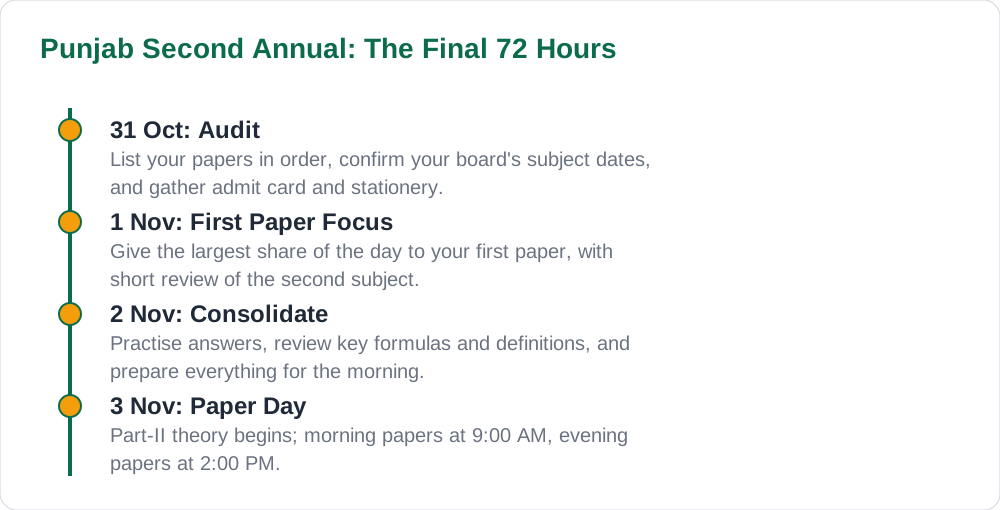
The first of the final three days should begin with an audit, not with opening a book at random. Check your own board's subject-wise date sheet, confirm the date, time, and centre for each of your papers, and make sure your admit card and stationery are ready. Confirm whether your first paper is a morning paper at 9:00 AM or an evening paper at 2:00 PM, because the two require different routines on the day. This audit takes less than an hour, but it removes the small uncertainties that cause the most anxiety on paper day, such as not knowing the centre or the shift.
After the audit, the rest of day one belongs to the first paper. Work through its most important chapters, practise writing full answers rather than only reading notes, and test yourself on the topics that carry the most marks. Avoid the temptation to start a new topic on day one; the final days are for consolidating what you know, not for learning what you never studied. If a chapter is genuinely unprepared, give it a single focused hour for its key points, then move on, because a weak chapter given three hours will still be weak, while a strong chapter given those hours becomes stronger.
Day Two: Practise Answers and Prepare for the Hall
Day two is for practice and preparation. Write at least one full answer for each major question type in your first paper, under timed conditions if possible, because writing under time pressure is a different skill from knowing the material. Check your answers for the common faults that cost marks: incomplete introductions, missing steps in numerical work, diagrams without labels, and answers that stop halfway. Correcting these faults in practice is worth more than learning another chapter, because presentation and completeness decide a large share of the marks in board papers.
Day two is also when the practical side should be finished: pack your bag with the admit card, pens, pencils, ruler, and any permitted instruments, confirm your transport and route to the centre, and decide what time you will leave. If your first paper is a morning paper at 9:00 AM, plan to arrive well before the reporting time, allowing for traffic. If it is an evening paper, plan a calm morning with light revision and an early departure. Students can find further revision support on Solved Notes and the book collection on Books for last-minute reference.
Day Three: Light Review, Early Rest, No New Material
The day before the first paper should be the lightest study day of the three, not the heaviest. A short review of key formulas, definitions, and important points in the morning, followed by a relaxed afternoon and an early night, will serve a student better than a late-night cramming session. Sleep is not wasted time in the final 24 hours; it is what turns revision into recall. A student who sleeps well will remember more in the hall than a student who studied until midnight and arrives exhausted, however many extra pages the tired student read.
The evening before the paper should be kept calm and free of new material. Re-reading a short summary, glancing at a diagram, or testing yourself with a few flashcards is enough, and anything that causes confusion at this stage should be set aside rather than chased. Families can help by keeping the house quiet, avoiding discussions about expected marks, and confirming the morning routine. The goal of day three is to arrive at the paper rested, organised, and confident, not to add one more chapter to an already full preparation.
One Warning: Admission Windows Are Closed
A point that needs stating plainly is that the admission windows for these examinations, which ran from 24 September to 17 October, are closed, and they must not be presented or understood as open. Students who are already registered and hold admit cards are the ones sitting from 3 November, and anyone who missed the window cannot join at this stage through these examinations. This matters because rumours sometimes suggest that late admission is still possible, which wastes the time of students who should instead be planning their next available opportunity through the proper channel.
For registered students, the closed window is simply background: your place is secured, your papers are scheduled, and the only task left is to sit them well. For students who missed registration, the constructive step is to ask their school, college, or board office about the next examination opportunity and to use the intervening time to prepare properly, rather than chasing a closed window. Either way, the final 72 hours belong to preparation and calm, not to paperwork that can no longer change. More board examination guides are available on Blog for students planning their next step.
AI Help: Muse AI
Muse AI is Meta's personal AI assistant, and it can help you plan your final 72 hours by turning your paper dates into a three-day revision schedule. You can ask it to quiz you on your first paper's key topics, to summarise a chapter in simple words, or to help you draft a paper-day checklist of what to carry and when to leave. Muse AI does not give official STBB answers — always verify against your STBB book and your teacher. Always verify against your Sindh Textbook Board book and your teacher before using anything in classwork.
Join Muse with invite code LTGSWD — in the Muse app, go to Settings > Redeem token and enter the code. Disclosure: LTGSWD is the author's Muse invite code.
5 key points you must know
- Punjab HSSC Second Annual exams begin 3 November 2026: Part-II theory 3–16 November, Part-I theory 17–28 November.
- Morning papers at 9:00 AM, evening papers at 2:00 PM, Friday evening papers at 2:30 PM.
- Revise in paper order, front-loading the first paper, and stop learning new topics in the final days.
- Practise full written answers under time pressure on day two, and pack everything the night before.
- Admission windows (24 September–17 October) are closed — do not treat them as open.
Frequently asked questions
When do Punjab second annual exams start?
The HSSC Second Annual (supplementary) examinations begin on 3 November 2026 across Punjab boards. Part-II (12th class) theory runs from 3 to 16 November 2026, and Part-I (11th class) theory runs from 17 to 28 November 2026. Practical examinations follow from 1 to 11 December on the Multan schedule.
What are the paper timings?
Morning papers begin at 9:00 AM and evening papers at 2:00 PM, except on Fridays when the evening paper begins at 2:30 PM. Students should confirm their own board's subject-wise sheet, since subject dates can differ between boards even though all share the 3 November start.
What should I study in the final 72 hours?
Revise in the order of your papers, giving the largest share of time to the first paper and keeping later subjects warm with short review. Consolidate what you already know rather than starting new topics, and practise writing full answers under timed conditions. The day before the paper should be light review and early rest, not late-night cramming.
Can I still apply for admission to the second annual exams?
No, the admission windows ran from 24 September to 17 October and are now closed. Only students who are already registered and hold admit cards will sit from 3 November. Students who missed registration should ask their institution or board office about the next available opportunity.
Are the subject dates the same for every Punjab board?
No, the subject examples given, such as 12th English Compulsory on 4 November and Physics on 16 November, come from the Multan date sheet. All Punjab boards share the 3 November start, but students must confirm their own board's subject-wise sheet for their exact subject dates and centres.
Solved notes — preview free
These guides work best with the solved exercises. Preview the solved notes free on this website — 119 solved notes for Classes 6–10 in Sindhi, Urdu, English and Arabic medium. Or browse the full solved notes catalogue for your class and medium. New solved notes are added regularly — check the catalogue for coming-soon books.