Punjab Second Annual Exams Begin Tomorrow: Day-Before Checklist
Tomorrow, Tuesday 3 November 2026, Punjab boards begin the HSSC second annual examinations across the province, starting with Part-II theory papers that run from 3 to 16 November 2026. If you are a Part-II student, today is not the day for new chapters or panic revision. It is the day to confirm your own board date sheet, pack everything you need, plan your journey, and protect your sleep. Morning papers begin at 9:00 AM and evening papers at 2:00 PM, with Friday evening papers at 2:30 PM, so your plan must match your own paper timing. This guide gives you a simple, practical checklist for the day before the exam, so you can walk into the hall calm, prepared, and ready to focus on the paper in front of you.
Pack Your Bag Tonight, Not Tomorrow Morning
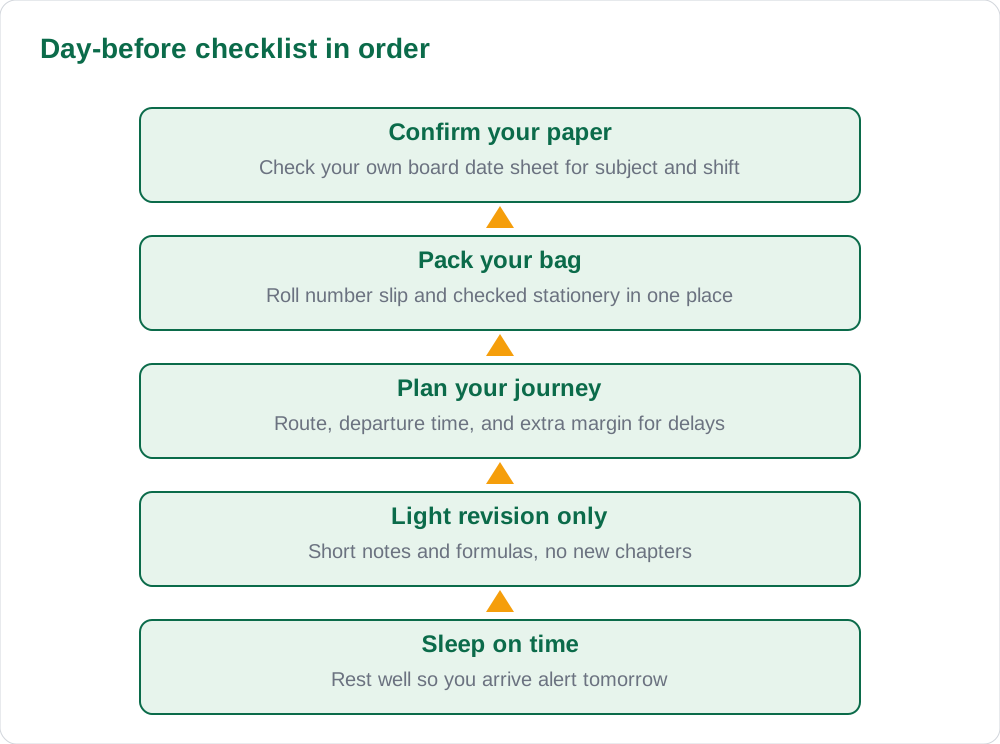
Packing tonight removes the most common morning stress. Put your roll number slip, pens, pencils, geometry instruments if your subject needs them, and any other item your admit card allows into one bag, and keep that bag by the door. Check each pen, sharpen pencils, and carry a spare pen so a single faulty pen cannot disturb your paper. Do not pack anything the hall does not allow, and do not leave important items to a last-minute search. A quiet five minutes tonight can save a rushed and anxious morning tomorrow, and it lets you start the day with a clear mind instead of a frantic hunt for missing things.
Also keep your journey plan with your bag. Know the centre address, the route, and how long the journey normally takes, then add extra time for traffic or delays. If you travel with family or friends, agree the departure time tonight so nobody is waiting or rushing in the morning. Eat a normal dinner, avoid heavy or unfamiliar food late at night, and set an alarm with enough margin to reach the centre early. For more general study help, browse the solved notes and the blog for revision guides that explain steady preparation without last-minute cramming.
- Roll number slip and permitted stationery packed in one bag tonight
- Spare pen, sharpened pencils, and subject instruments checked in advance
- Journey route, departure time, and centre address confirmed with family
Match Your Plan to Morning and Evening Timings
The Punjab second annual schedule uses two daily timings, and mixing them up is an avoidable mistake. Morning papers begin at 9:00 AM, while evening papers begin at 2:00 PM, and on Fridays the evening paper begins at 2:30 PM. Your day-before checklist must therefore start from your own paper, not from a friend's paper or a general timetable. Write down tomorrow's subject, your shift, and your reporting plan on a small card, and keep it with your bag. When you wake up, you should not need to guess anything about timing or travel.
Plan backwards from the paper start time rather than forwards from waking up. Allow time for waking, eating, travel, and reaching the centre with a comfortable margin, and keep breakfast simple and familiar. If your paper is in the evening, use the morning for light revision only, rest properly, and leave home early enough to avoid the afternoon rush. Students who plan around the exact shift tend to arrive calmer, and a calm arrival helps concentration far more than an extra hour of tense, rushed revision at home. Keep this point in mind as you plan your week, because a calm, organised, and steady approach usually protects both your time and your marks across every paper.
- Morning papers: 9:00 AM start, so leave home with a comfortable margin
- Evening papers: 2:00 PM start, and 2:30 PM on Fridays
- Your own board date sheet decides your subject and shift, not a friend's sheet
Know the Part-II Window and Your Own Subjects
Part-II theory papers run from 3 to 16 November 2026, while Part-I theory papers follow from 17 to 28 November 2026, so Part-II students must focus only on their own window for now. The Multan board schedule gives useful subject examples, such as English Compulsory on 4 November, Mathematics or Biology on 6 November, Computer Science on 10 November, Chemistry on 12 November, and Physics on 16 November. These examples help you understand the shape of the first two weeks, but they do not replace your own board sheet, and students under other Punjab boards must confirm every date separately.
Use today to list your own papers in order, with dates and shifts, and mark the gaps between them. A longer gap is a chance for deeper revision, while a short gap calls for a lighter, focused plan that protects sleep. Do not copy another board's subject order into your plan, and do not assume that a date you saw online applies to you. The textbooks pages and the blog can help you organise revision, but only your own board's date sheet can tell you when each of your papers actually falls.
Admission Windows Are Closed: What That Means
The admission windows for these examinations, which ran from 24 September to 17 October, are now closed, so today is not the time to seek a new admission or to expect a late entry. If you already hold a roll number slip, your task is simply to protect it and to follow the instructions printed on it. If anything on your slip looks unclear, raise it through your school or board channel as early as possible today, calmly and with your documents ready, rather than leaving the question until tomorrow morning at the centre gate.
Closed admission windows also mean that rumours about fresh entries should not distract you. Focus on the papers you are actually registered for, and use your energy for revision and rest. Keep a copy of your important details somewhere safe at home, separate from the original slip, so a misplaced paper does not become a crisis. A steady, practical approach today protects tomorrow far better than chasing unverified claims online, and it keeps your attention where it belongs: on the paper you will actually sit. Use this idea in your own plan, and check it against your own date sheet and admit card, so that nothing important is left to guesswork on the day itself.
- Admission windows from 24 September to 17 October are closed
- Protect your roll number slip and follow its printed instructions
- Raise any genuine slip problem early today through the proper channel
A Calm First-Paper Routine
On the first paper, a calm routine matters as much as knowledge. Arrive early, find your room without rushing, sit down, and breathe for a minute before the paper begins. Read the whole question paper carefully, mark the questions you know best, and start with confidence rather than with the hardest question. Manage your time across the paper, leave a few minutes at the end to check your work, and do not let one difficult question consume the time meant for the rest of the paper. Remember this as you move to the next step, because steady preparation, clear documents, and enough rest together make a real difference on examination day.
After the paper, avoid long post-paper debates that drain energy for the next subject. Note briefly what went well and what needs attention, then move on to the next paper's plan. Practical examinations follow later, from 1 to 11 December 2026 on the Multan schedule, so theory papers come first and practical preparation should not crowd out theory revision now. Keep each day simple: one paper at a time, one plan at a time, and enough rest to stay sharp through the whole Part-II window. Keep this point in mind as you plan your week, because a calm, organised, and steady approach usually protects both your time and your marks across every paper.
- Arrive early, read the full paper, and start with confident questions
- Keep time aside at the end to check your answers
- After each paper, move calmly to the next subject instead of long debates
AI Help: Muse AI
Muse AI is Meta's personal AI assistant, and it can help you build a calm day-before checklist for your Punjab papers. You can ask it to turn your own subject list into a short revision plan and a simple packing list for tomorrow morning. Join Muse with invite code LTGSWD — in the Muse app, go to Settings > Redeem token and enter the code. Disclosure: LTGSWD is the author's Muse invite code. Muse AI does not give official STBB answers — always verify against your STBB book and your teacher. Always verify against your Sindh Textbook Board book and your teacher before using anything in classwork.
5 key points you must know
- Part-II theory papers run from 3 to 16 November 2026, with Part-I following from 17 to 28 November.
- Morning papers start at 9:00 AM and evening papers at 2:00 PM, with Friday evening papers at 2:30 PM.
- Pack your bag tonight, confirm your own board date sheet, and plan your journey with extra time.
- Admission windows are closed, so focus on the papers you are already registered for.
- Practicals follow later, from 1 to 11 December 2026 on the Multan schedule, so theory comes first.
Frequently asked questions
When do Punjab second annual Part-II papers begin?
Part-II theory papers begin on Tuesday 3 November 2026 and run to 16 November 2026 across Punjab boards. Part-I theory papers follow from 17 to 28 November 2026. Always confirm your own board date sheet, because subject dates can differ between boards even within the same province-wide window.
What time do morning and evening papers start?
Morning papers begin at 9:00 AM and evening papers begin at 2:00 PM. On Fridays, the evening paper begins at 2:30 PM. Check your own paper shift before you plan travel, because arriving for the wrong shift is an avoidable mistake that adds stress on exam day.
Can I still apply for admission today?
No. The admission windows, which ran from 24 September to 17 October, are now closed. If you already hold a roll number slip, protect it and follow its instructions. Any genuine slip problem should be raised early through your school or board channel today.
Should I study new chapters the day before the paper?
No. The day before is for light revision, short notes, and familiar formulas, not new chapters. New material late at night usually increases anxiety without improving recall. Pack your bag, confirm your timing, revise briefly, and sleep well so you arrive alert.
When are the practical examinations?
On the Multan schedule, practical examinations run from 1 to 11 December 2026, after the theory papers. Confirm your own board practical schedule separately, and keep theory revision as your priority until the theory window ends. Ask your teacher or school office if anything still looks unclear after checking the official source.
Solved notes — preview free
These guides work best with the solved exercises. Preview the solved notes free on this website — 119 solved notes for Classes 6–10 in Sindhi, Urdu, English and Arabic medium. Or browse the full solved notes catalogue for your class and medium. New solved notes are added regularly — check the catalogue for coming-soon books.