Punjab Second Annual Exams Start 3 November 2026: Final 5-Day Checklist
Punjab's HSSC second annual (supplementary) examinations begin on 3 November 2026, just five days from today, and the province-wide schedule set by the Punjab Boards Committee of Chairpersons is now the document every candidate should be working from. Part-II (12th class) theory papers run from 3 to 16 November 2026, and Part-I (11th class) theory papers follow from 17 to 28 November 2026. With so little time left, the difference between a calm candidate and a panicked one is rarely knowledge; it is preparation — knowing your timings, having your documents ready, and spending the remaining days on the revision that actually earns marks. This checklist covers all three, in the order you should deal with them.
Know Your Dates: Part-II First, Then Part-I
The first thing to fix in your mind is which window you belong to. If you are a Part-II candidate, your theory papers run from 3 to 16 November 2026; if you are a Part-I candidate, yours run from 17 to 28 November 2026. Part-I candidates therefore have about two extra weeks, but that is not a reason to relax: the Part-I window is just as compressed once it starts, and the same daily discipline applies. Do not confuse the two windows, and do not rely on a friend's timetable if your class differs from theirs. Your own board's date sheet and your roll number slip are the final authority for your subjects, and where they differ from any general schedule, your own documents win.
One published example shows how specific the date sheets are: Rawalpindi board's second-annual sheet lists 3 November with Psychology and Commercial Geography in the morning and History in the evening, 4 November with English compulsory in two groups, and 16 November with Physics in first and second groups. Your board's sheet will have its own subject order, so read it paper by paper and write your personal timetable from it, not from a summary. Note that BISE Lahore had not posted its second-annual intermediate date sheet as of 24 October 2026, so Lahore candidates in particular should confirm that their board's sheet is now available and work from it directly. The blog has further examination guides for Punjab board students.
Timings: Morning, Evening, and the Friday Change
Morning papers follow a fixed pattern across the province: report at 8:30 AM and the paper begins at 9:00 AM. Evening papers normally require reporting at 1:30 PM with the paper at 2:00 PM, but Fridays are different: on Fridays only, reporting is at 2:00 PM and the paper begins at 2:30 PM, allowing for Jummah prayers. That Friday change is the single most common timing mistake in the second annual examinations, because a candidate who arrives at the normal evening time on a Friday will still be in time, while a candidate who confuses the two patterns and arrives late risks missing the paper entirely. Write the Friday timing separately on your personal timetable so it stands out.
Plan your travel around the reporting time, not the paper time. Reporting half an hour before the paper leaves room for identity checks, seat allocation, and the unexpected — a traffic delay, a wrong turn to an unfamiliar centre, or a queue at the gate. Aim to reach the centre at least 45 minutes before reporting time on your first paper, and at least 30 minutes early on later papers once you know the route. Candidates who arrive exactly at paper time start the examination already stressed, and stress is the enemy of clear answers. A calm arrival is part of the examination, not a luxury before it. For study material to revise in these final days, see the book collection and the solved notes.
Documents to Have Ready Today
Gather your documents now, not on the morning of 3 November. You need your roll number slip, your original national identity card or B-Form as applicable, and your previous result or registration documents if your board asks for them. Regular candidates normally collect their roll number slips from their college, while private candidates obtain them from their board's website, and you should confirm which route applies to you today so there is still time to fix a problem. Check every detail on the slip the moment you receive it: your name's spelling, your subjects, your centre, and your paper dates. An error found today can be corrected; an error found at the centre gate usually cannot.
Keep a small examination kit ready beside the documents: pens that you have already tested, a geometry box if your subjects need one, a transparent pouch, and a bottle of water if your centre allows it. Do not carry a mobile phone into the examination hall unless your centre's rules explicitly permit it in a designated place, because possession of a phone in the hall can lead to an unfair-means case even if you never use it. Photocopy or photograph your roll number slip and keep the copy at home, so that losing the original does not leave you with nothing to show. These are small tasks, but each one removes a risk that has genuinely cost candidates their papers in past sessions.
Revision Priorities for the Last Five Days
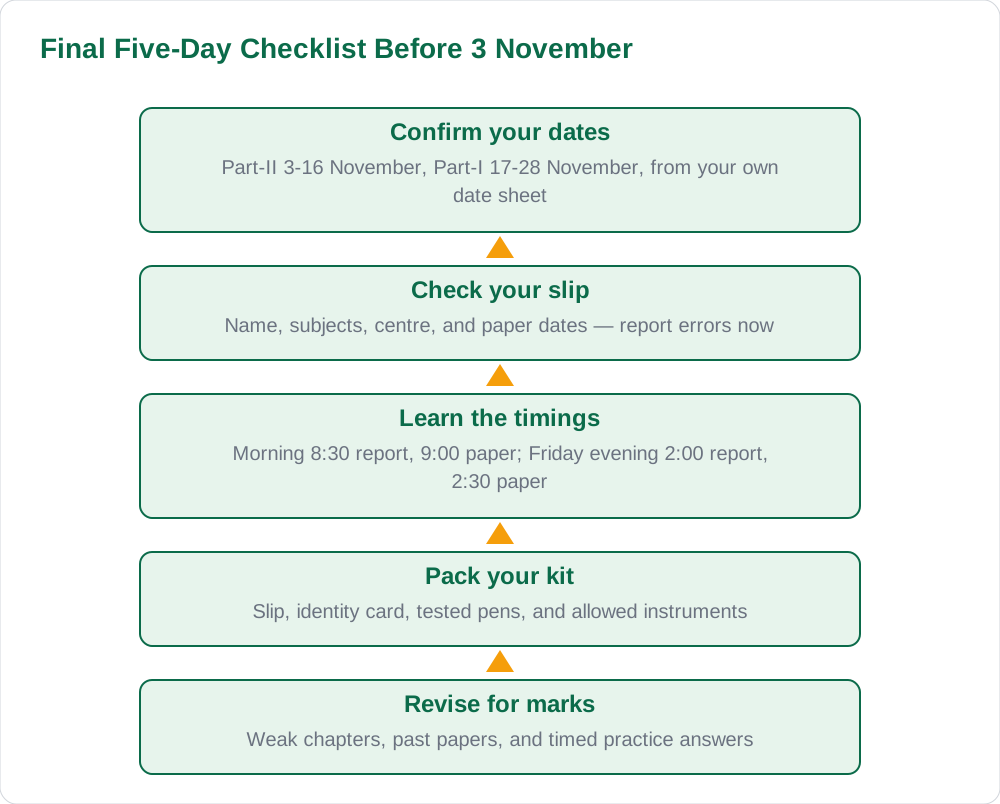
Five days is enough time to raise your marks significantly, provided you spend it on the right things. First, stop starting new topics; new material learned now is rarely retained well enough to earn marks, and it steals time from the topics you can actually strengthen. Instead, list the chapters in each paper where you lost marks last time, or where your preparation is thinnest, and work through those chapters from the textbook, making short notes as you go. Second, practise writing full answers under time, because second annual candidates most often lose marks through incomplete answers and poor time allocation rather than through total ignorance.
Third, use past papers as your main practice tool. Work through at least one past paper per subject under examination conditions, mark it honestly, and spend the next session only on the questions you got wrong or left incomplete. Fourth, protect your sleep and your health: a candidate who revises until 3 AM the night before a 9 AM paper will perform worse than a candidate who stopped at a reasonable hour and slept properly. Eat normally, avoid heavy unfamiliar food on examination days, and keep one evening hour free for rest so that revision does not become exhaustion. The examination rewards steady preparation, not heroic last nights.
What Not to Do in the Final Days
Do not spend the final days chasing rumours about leaked papers, changed dates, or grace marks. Second annual examinations attract exactly these rumours, and every hour spent forwarding or worrying about them is an hour stolen from revision that genuinely earns marks. If a date or centre changes, your board will announce it through official channels and your college will pass it on; anything else should be treated as unverified. Similarly, do not pay anyone who promises a pass, a leaked paper, or a changed result — these are frauds, and involvement in them can end a candidate's examination career far more surely than a failed paper.
Also note what is already closed: the second annual admission windows, which ran from 24 September to 17 October with single, double, and triple fee stages, are now closed, so do not waste time looking for a late admission route that does not exist. Your task now is to sit the papers you are already entered for, and to sit them as well as you can. Candidates who entered for the second annual examination have already taken the hardest step, which is deciding to improve their result rather than accepting it; the remaining step is simply to prepare calmly, arrive on time, and write the best answers they can. The [home page](/) gathers further examination preparation guides.
AI Help: Muse AI
Muse AI is Meta's personal AI assistant. You can ask it to explain a concept in simple words, summarise a lesson, or make practice questions for revision.
In the final days before an examination, you can ask Muse AI to make a short revision timetable for your remaining days or to quiz you with quick practice questions on a weak chapter, then check the answers against your textbook.
Join Muse with invite code LTGSWD — in the Muse app, go to Settings > Redeem token and enter the code.
Disclosure: LTGSWD is the author's Muse invite code.
Muse AI does not give official STBB answers — always verify against your Sindh Textbook Board book and your teacher.
5 key points you must know
- Part-II theory runs 3–16 November 2026; Part-I theory runs 17–28 November 2026.
- Morning papers: report 8:30 AM, paper 9:00 AM; evening papers: report 1:30 PM, paper 2:00 PM.
- Fridays only: evening reporting 2:00 PM, paper 2:30 PM — do not mix this up.
- Check your roll number slip today for name, subjects, centre, and dates.
- Second annual admission windows (24 Sep–17 Oct) are closed; focus on the papers you entered.
Frequently asked questions
When do Punjab's second annual exams start?
Part-II (12th class) theory papers run from 3 to 16 November 2026, and Part-I (11th class) theory papers run from 17 to 28 November 2026, under the province-wide PBCC schedule.
What are the morning and evening paper timings?
Morning papers require reporting at 8:30 AM with the paper at 9:00 AM. Evening papers normally require reporting at 1:30 PM with the paper at 2:00 PM, except on Fridays, when reporting is at 2:00 PM and the paper is at 2:30 PM.
Why is the Friday evening timing different?
The Friday evening schedule is adjusted for Jummah prayers: reporting at 2:00 PM and the paper at 2:30 PM, half an hour later than the normal evening pattern.
Can I still apply for the second annual exams?
No. The admission windows ran from 24 September to 17 October 2026 with single, double and triple fee stages, and they are now closed. Candidates should focus on the papers they have already entered for.
What should I check on my roll number slip?
Check your name's spelling, your subjects, your examination centre, and your paper dates as soon as you receive the slip. Report any error to your college or board immediately, while there is still time to correct it.
Solved notes — preview free
These guides work best with the solved exercises. Preview the solved notes free on this website — 119 solved notes for Classes 6–10 in Sindhi, Urdu, English and Arabic medium. Or browse the full solved notes catalogue for your class and medium. New solved notes are added regularly — check the catalogue for coming-soon books.