Punjab Second Annual Exams 2026: Exam-Day Guide as Papers Begin 3 November
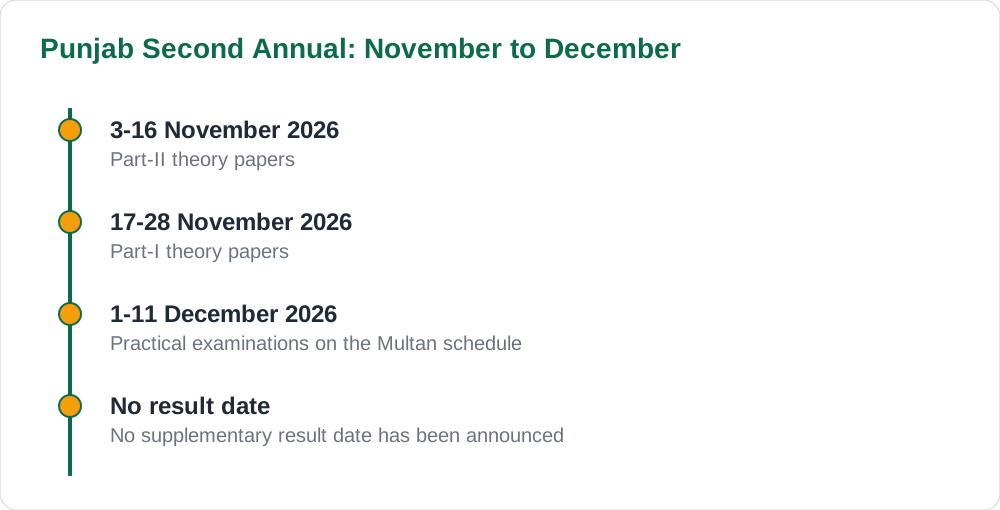
For Punjab students sitting second annual, or supplementary, examinations, the waiting is over and the exam hall is next: Part-II theory papers run from 3 to 16 November 2026, followed by Part-I theory papers from 17 to 28 November 2026, under the province-wide schedule of the Punjab Boards Committee of Chairmen. This guide is an exam-day guide, not a revision plan and not a date-sheet, because the most useful help in the final hours is practical: when to arrive, what to check, how the day is timed, and how to stay calm when a paper feels difficult. Morning papers begin at 9:00 AM, evening papers at 2:00 PM, and on Fridays the evening paper begins at 2:30 PM, so timing discipline starts before you leave home. Practical examinations follow later, from 1 to 11 December 2026 on the Multan schedule, but the immediate focus is the theory papers beginning on 3 November. Students can find general study help through [solved notes](/solved.html), but your own board's date-sheet is the final authority for your papers. A calm exam day is built the night before, not improvised at the centre gate.
The November Timetable at a Glance
The province-wide pattern is straightforward to remember: Part-II, or 12th class, theory papers come first, from 3 to 16 November 2026, and Part-I, or 11th class, theory papers follow, from 17 to 28 November 2026. That order matters for families with students in both classes, and for students who are sitting papers in only one part, because it prevents the common confusion of turning up on the wrong week's dates. Within each part, your individual papers fall on specific days according to your board's date-sheet, so the province-wide window tells you the overall period, while your board's sheet tells you your personal timetable. Do not rely on a friend's date-sheet from another board, because boards can differ in subject order even within the same province-wide window. Check your own board's sheet, write your own paper dates in order, and keep that list where you will see it every morning.
Practical examinations are scheduled separately, from 1 to 11 December 2026 on the Multan schedule, so theory preparation and practical preparation should not be confused. Students with practical papers should confirm their own board's practical schedule when it is published, rather than assuming the Multan practical window applies identically to every board. For now, the priority is theory: know your theory dates, know your timings, and keep practical preparation as a secondary routine until theory papers are done. A clear written timetable, with paper, date, and session, is worth more than a memorised timetable that can be misremembered under stress. The books page can help with revision material, but it cannot replace your board's date-sheet.
Timings: Morning, Evening, and Fridays
Morning papers begin at 9:00 AM and evening papers at 2:00 PM, with Friday evening papers beginning at 2:30 PM. Those three times are easy to state and easy to get wrong under pressure, especially the Friday adjustment, so write them on your timetable and set your travel plan around them. Arrive early enough to find your room, settle, and read instructions without rushing, because a rushed arrival raises stress before the paper even begins. Plan your journey with a margin for traffic or transport delay, and if your centre is unfamiliar, visit the route in advance or confirm it with someone who knows it. A student who arrives calm has already improved their performance, because exam performance depends on clear thinking as well as knowledge.
On the day itself, manage the hours before the paper deliberately. Eat normally, avoid a heavy last-minute cramming session that creates confusion, and glance only at short summaries or formulae you already know. For a morning paper, set out the night before and wake with time to spare; for an evening paper, use the morning for light revision and rest, not for a full new topic. On Fridays, remember the 2:30 PM evening start specifically, because arriving at 2:00 PM for a Friday evening paper is early but harmless, while arriving at 2:30 PM expecting a 2:00 PM start would be a serious problem. Timings are the simplest part of exam day, and they are also the part most worth getting exactly right.
Subject Examples: Use Them, Then Confirm Your Own Board
The verified snapshot gives Multan date-sheet subject examples that help students picture the timetable, but they come with an essential warning: students must confirm their own board's sheet. For Part-II, the Multan examples include 12th English Compulsory on 4 November, Mathematics and Biology on 6 November, Computer Science on 10 November, Chemistry on 12 November, and Physics on 16 November. For Part-I, the examples include 11th English Compulsory on 18 November, Computer Science on 23 November, Mathematics and Biology on 25 November, and Physics on 27 November. These examples are useful for understanding the rhythm of the papers, with English early in each part and science papers spread across the window, but they are Multan examples, not a universal Punjab timetable for every board.
The confirm-your-own-board warning is not a formality; it is the most important sentence in this section. Boards in Punjab publish their own date-sheets, and subject order can differ, so a student in another board who follows the Multan examples blindly could prepare for the wrong paper on the wrong day. Find your board's official date-sheet, check each of your subjects against it, and if there is any difference between a forwarded timetable and your board's sheet, trust your board's sheet. Keep a printed or saved copy of your board's sheet, highlight your papers, and check it again the night before each paper. That habit takes two minutes and prevents the most avoidable exam-day disaster. General exam guidance is available through study guides for students who want broader tips.
- Multan Part-II examples: English 4 Nov, Maths/Biology 6 Nov, Computer Science 10 Nov, Chemistry 12 Nov, Physics 16 Nov.
- Multan Part-I examples: English 18 Nov, Computer Science 23 Nov, Maths/Biology 25 Nov, Physics 27 Nov.
- Always confirm your OWN board's date-sheet; Multan examples do not replace it.
Admission Windows Are Closed: Do Not Be Misled
The admission windows for these second annual examinations, running from 24 September to 17 October, are now closed, and this guide states that plainly so that no student wastes time or money chasing an open window that no longer exists. If you are sitting papers in November, your admission is already settled, and your task is to attend the papers on your date-sheet. If you missed the admission window, this November series is not open to new admission through the closed window, and you should seek guidance from your board or institution about the next available opportunity rather than following agents who promise late admission. The closed-window fact is also a useful test for rumours: any message claiming that admissions for this series have reopened should be checked against your board's official notice before it is believed.
For students already admitted, the closed window is actually reassuring, because it means the cohort and centres are fixed and the timetable can be followed without further administrative uncertainty. Focus on what remains within your control: your preparation, your timings, your centre, and your exam-day routine. Do not spend exam week chasing administrative rumours, and do not let a classmate's anxiety about admission distract you from your own papers. If you have a genuine administrative query, such as a roll number slip issue, raise it with your institution or board office promptly and through official channels, and keep a record of the response. Administrative clarity, like exam timing, is best settled early and then set aside.
In the Hall: A Calm Paper Routine
Inside the examination hall, a calm routine beats a frantic one. Read the paper fully before writing, mark the questions you feel most confident about, and begin with a question that builds confidence rather than the hardest question on the page. Manage your time by keeping an eye on the clock and leaving time to attempt every question, because a blank answer earns nothing while a partial attempt can earn marks. If a question feels unfamiliar, move on and return to it later with a clearer mind, rather than spending half the paper on a single question. Write legibly, label your work clearly, and check your paper number and roll number details before you hand in the script, because administrative accuracy matters as much as academic content.
After the paper, resist the urge to dissect every answer with classmates, because post-paper discussion rarely changes the outcome and often damages confidence for the next paper. Note briefly what felt difficult, so that you can adjust revision for the next paper if the same topic area recurs, and then move on to the next subject on your timetable. Rest, eat, and sleep normally between papers, because second annual series are marathons across November, not single-paper sprints. Students who protect their sleep and routine across the whole series perform more consistently than students who exhaust themselves after the first paper. When the theory series ends, practical papers follow in December, so keep some energy in reserve for that final stage, and remember that no supplementary result date has been announced, so do not guess one or trust a rumoured date.
AI Help: Muse AI
Muse AI is Meta's personal AI assistant, and it can help you prepare calmly for exam day. For example, you can ask it to help you make a simple exam-day checklist from your own board's date-sheet, with paper, date, and session for each paper. Join Muse with invite code LTGSWD — in the Muse app, go to Settings > Redeem token and enter the code. Disclosure: LTGSWD is the author's Muse invite code. Muse AI does not give official STBB answers — always verify against your STBB book and your teacher. Always verify against your Sindh Textbook Board book and your teacher before using anything in classwork.
5 key points you must know
- Part-II theory papers run 3-16 November 2026, and Part-I theory papers run 17-28 November 2026.
- Morning papers start at 9:00 AM, evening papers at 2:00 PM, and Friday evening papers at 2:30 PM.
- Multan subject examples are given for guidance only; every student must confirm their own board's date-sheet.
- Admission windows from 24 September to 17 October are CLOSED and must not be presented as open.
- Practical examinations run 1-11 December 2026 on the Multan schedule, and no supplementary result date has been announced.
Frequently asked questions
When do Punjab second annual theory papers start?
Part-II theory papers run from 3 to 16 November 2026, followed by Part-I theory papers from 17 to 28 November 2026, under the province-wide Punjab schedule.
What time do the papers start?
Morning papers begin at 9:00 AM and evening papers at 2:00 PM, except on Fridays, when evening papers begin at 2:30 PM.
Can I follow the Multan date-sheet if I am in another Punjab board?
No, not blindly. The Multan subject examples in this guide are examples only. Every student must confirm their own board's official date-sheet, because subject order can differ between boards.
Are admissions still open for the second annual exams?
No. The admission windows from 24 September to 17 October are closed. Students sitting in November should focus on their papers, and anyone who missed admission should seek official guidance about the next opportunity.
When are the practical examinations and the result?
Practical examinations run from 1 to 11 December 2026 on the Multan schedule, with your own board's practical schedule to be confirmed. No supplementary result date has been announced, so none should be guessed.
Solved notes — preview free
These guides work best with the solved exercises. Preview the solved notes free on this website — 119 solved notes for Classes 6–10 in Sindhi, Urdu, English and Arabic medium. Or browse the full solved notes catalogue for your class and medium. New solved notes are added regularly — check the catalogue for coming-soon books.