Punjab Second Annual 12th Class 2026: Subject Dates Guide and Warnings
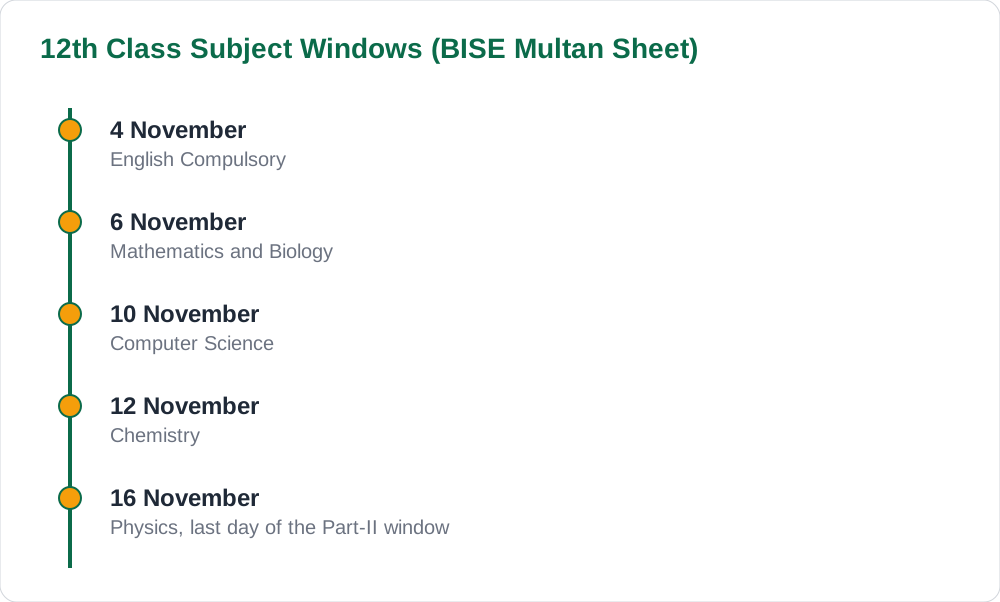
For 12th class students in Punjab, the second annual examinations are now only days away, with Part-II theory papers running from 3 to 16 November 2026 under the province-wide schedule. Subject-wise planning matters enormously in such a short window, because the gap between two papers decides how much revision each subject gets, and students who know their subject dates can plan backwards from each paper instead of revising blindly. This guide sets out the subject windows from the BISE Multan date sheet, including English Compulsory on 4 November, Mathematics and Biology on 6 November, Computer Science on 10 November, Chemistry on 12 November and Physics on 16 November, with a warning to confirm your own board's sheet.
The Multan Sheet: 12th Class Subject Windows
The BISE Multan date sheet gives 12th class students a concrete sequence to plan around. English Compulsory falls on 4 November, very early in the window, which means English revision must be finished before the examinations begin rather than fitted in afterwards. Mathematics and Biology fall on 6 November, giving students two days after English to switch subjects and revise, while Computer Science follows on 10 November, Chemistry on 12 November, and Physics on 16 November, which is the last day of the Part-II window. That sequence is the backbone of a revision plan: work backwards from each date, giving the earliest papers the most attention now, and letting later papers take a lighter daily slot until their turn approaches.
It is worth noting what this sequence implies about workload. A student taking Mathematics, Chemistry and Physics faces papers on 6, 12 and 16 November, with gaps of six and four days between them, which is workable if revision is already underway but punishing if it starts from scratch. A student taking Biology instead of Mathematics faces Biology on 6 November and then a longer run to Chemistry and Physics, which changes the balance of the plan. Whatever your combination, write your own subject dates on a single page, mark the gaps between papers, and assign revision hours in proportion to both the gap and your weakness in each subject. For subject-wise study help, see the book collection and the solved notes.
The Warning That Matters Most: Confirm Your Own Board's Sheet
Every subject date in this guide comes from the BISE Multan date sheet, and that fact must be stated plainly, because Punjab has nine boards and subject-wise dates can differ between them. All nine boards share the 3 November start and the overall Part-II window of 3 to 16 November 2026, but a student under BISE Lahore, Rawalpindi, Gujranwala or any other board cannot safely assume that English falls on 4 November or Physics on 16 November for their board. Using another board's sheet as if it were your own is one of the most expensive mistakes a student can make, because it can mean revising the wrong subject for a paper, or worse, missing a paper entirely through a wrong date.
Confirming your own sheet takes ten minutes and should be done today. Check your board's official website, collect the date sheet from your school or college, and compare it paper by paper with the Multan windows given here, noting every difference on your own revision page. If your board's sheet shows a different date for any subject, your board's sheet governs, full stop, and the Multan dates become irrelevant for you. Save a copy of your own sheet on your phone and keep a printed copy with your roll number slip, so that both are checked together the night before each paper. The blog carries further examination guides, but no guide can replace your own board's official date sheet.
Planning Backwards From Each Paper
With the subject dates known, the most effective planning method is to work backwards. Take the first paper, English on 4 November in the Multan sheet, and ask what must be finished by 3 November: essay and precis practice, grammar revision, and at least one timed past paper. Then do the same for 6 November, whether your subject is Mathematics or Biology, assigning the days after English to that subject's heaviest chapters and to timed numerical or diagram practice. Repeat the process for Computer Science on 10 November, Chemistry on 12 November and Physics on 16 November, so that every paper has a defined finish line and no subject is left to chance. This method works because it forces decisions about priority, and priority is exactly what a short examination window demands.
Within each subject's slot, follow a simple pattern: revise the highest-mark chapters first, practise past-paper questions under timed conditions, mark your answers strictly, and spend the remaining time only on the chapters where marks were lost. Do not start new, low-weight chapters in the final days, and do not re-read chapters you already know well, because both habits feel productive while adding few marks. Sleep properly before each paper, travel on a plan made the night before, and arrive at the centre at least thirty minutes early, since morning papers begin at 9:00 AM and evening papers at 2:00 PM, with Friday evening papers at 2:30 PM. A plan followed daily beats a perfect plan followed once.
Subject Tips for the Five Key Papers
English Compulsory rewards practice over reading, so spend the remaining days writing essays, precis and comprehension answers under time limits, and revising grammar rules through examples rather than through rules alone. Mathematics rewards worked examples, so solve past-paper numericals by hand, check each step, and keep a short list of formulas you tend to forget, revising that list every evening. Biology rewards labelled diagrams and precise definitions, so practise drawing and labelling diagrams from memory and writing definitions in the textbook's language, because examiners award marks for accuracy in both. Computer Science rewards logic practice, so trace programs by hand, practise short questions on data and networks, and revise definitions until they can be written without hesitation.
Chemistry rewards balanced equations and numerical practice, so work through reaction types, practise mole and concentration calculations, and revise the chapters that carry the most marks first. Physics rewards numerical method, so practise past-paper numericals with units and significant figures, revise derivations by writing them out rather than reading them, and keep a formula sheet that you test yourself on daily. In every subject, the same principle holds: marks come from answers written under timed conditions, not from hours spent reading. If a chapter is weak, study it from the textbook, attempt its questions, and move on, because the examination rewards coverage of the whole syllabus more than perfection in one chapter.
After the Last Paper: Practicals and Results Thinking
Physics on 16 November closes the Part-II theory window in the Multan sheet, but the examination season is not over, because practical examinations follow from 1 to 11 December 2026 in two batches each day, from 9:00 AM to 12:00 PM and from 1:00 PM to 4:00 PM, with the Friday second batch adjusted to a 2:30 PM start. Students should therefore keep their practical notebooks, apparatus familiarity and viva preparation ready during the theory window, rather than treating practicals as an afterthought once theory ends. Confirm your practical date, batch and centre from your own board's sheet as soon as it is published, and keep your practical record complete and signed, because an incomplete record is a preventable loss of marks.
Once the examinations end, resist the urge to chase rumours about results, marking or expected dates, and instead keep your roll number slip, admit card and date sheet safe until the result process is complete. If you later feel a paper was marked incorrectly, your board will publish a formal rechecking process, and the earlier Part-I result context, where all nine boards announced on 22 October 2026 at 10:00 AM with a rechecking window of about fifteen days, shows how such processes normally work, though the second annual rechecking notice must be checked on its own terms. The about page explains how this site's guides are organised, and the contact page explains how to reach us with questions about study material.
AI Help: Muse AI
Muse AI is Meta's personal AI assistant, and it can help you study by explaining a concept in simple words or by making short practice questions for revision. For this topic, you can ask Muse AI to build a backwards revision plan from your subject dates, starting with your earliest paper, then check every date against your own board's sheet.
Join Muse with invite code LTGSWD — in the Muse app, go to Settings > Redeem token and enter the code.
Disclosure: LTGSWD is the author's Muse invite code.
Muse AI does not give official STBB answers — always verify against your STBB book and your teacher. In other words, always verify against your Sindh Textbook Board book before trusting any answer in an exam.
5 key points you must know
- Part-II theory papers run 3-16 November 2026 across Punjab's nine boards.
- Multan sheet: English 4 November, Mathematics/Biology 6 November, Computer Science 10 November.
- Multan sheet: Chemistry 12 November, Physics 16 November, the last day of the window.
- Subject dates can differ between boards; your own board's sheet governs your papers.
- Practicals follow from 1-11 December 2026 in two daily batches.
Frequently asked questions
When is 12th class English Compulsory in the second annual exams?
On the BISE Multan date sheet, English Compulsory falls on 4 November 2026. Students under other boards must confirm their own board's sheet, because subject dates can differ between boards even though all boards share the 3 November start.
What are the Multan-sheet dates for Maths, Biology, Computer Science, Chemistry and Physics?
Mathematics and Biology fall on 6 November, Computer Science on 10 November, Chemistry on 12 November, and Physics on 16 November 2026. These are Multan-sheet dates; always confirm your own board's subject-wise sheet before planning.
What time do the papers start?
Morning papers begin at 9:00 AM and evening papers at 2:00 PM, with Friday evening papers starting at 2:30 PM. Arrive at least thirty minutes early so transport delays do not cost you a paper.
When are the practical examinations?
Practical examinations are scheduled from 1 to 11 December 2026 in two batches each day, 9:00 AM to 12:00 PM and 1:00 PM to 4:00 PM, with the Friday second batch adjusted to a 2:30 PM start. Confirm your practical date and batch from your own board's sheet.
My board's sheet shows a different date from the Multan sheet. Which one do I follow?
Your own board's sheet, without exception. The Multan dates in this guide are examples from one board's sheet, and your board's official date sheet is the document that governs your papers.
Solved notes — preview free
These guides work best with the solved exercises. Preview the solved notes free on this website — 119 solved notes for Classes 6–10 in Sindhi, Urdu, English and Arabic medium. Or browse the full solved notes catalogue for your class and medium. New solved notes are added regularly — check the catalogue for coming-soon books.