Punjab Second Annual 11th Class 2026: After the 12th Papers, Your Turn
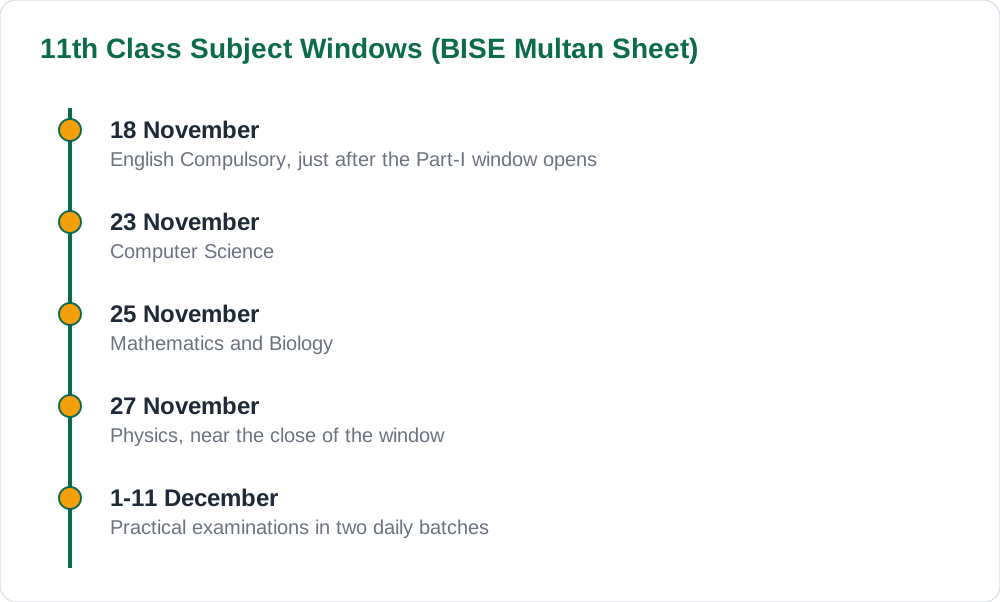
While 12th class students sit their second annual papers from 3 to 16 November 2026, 11th class students across Punjab have a different challenge: a waiting period that must be used, not wasted. Part-I, or 11th class, theory papers run from 17 to 28 November 2026 under the province-wide schedule, followed by practical examinations from 1 to 11 December 2026, and the gap before the first paper must be used well. This guide sets out the 11th class subject windows from the BISE Multan date sheet, including English Compulsory on 18 November, Computer Science on 23 November, Mathematics and Biology on 25 November, and Physics on 27 November, with a revision plan for the gap and a warning to confirm your own board's sheet.
Your Window: 17 to 28 November, After the 12th Papers
The order of the second annual examinations is deliberate: Part-II papers come first, from 3 to 16 November 2026, and Part-I papers follow from 17 to 28 November 2026, so that centres, invigilators and marking can move from one group to the next in an orderly way. For 11th class students, this order creates both an opportunity and a trap. The opportunity is nearly three weeks of revision time from today, 30 October 2026, before the first paper, which is enough to cover a syllabus properly if it is used daily. The trap is that a long runway feels comfortable, so revision drifts, days slip, and the first paper arrives with chapters still unrevised. Treat the gap as a working period from today, not as a holiday that ends on 16 November, and the window becomes an advantage rather than a risk.
Timings for the Part-I papers follow the same province-wide pattern as Part-II: morning papers begin at 9:00 AM and evening papers at 2:00 PM, with Friday evening papers starting at 2:30 PM. Practical examinations follow from 1 to 11 December 2026 in two batches, from 9:00 AM to 12:00 PM and from 1:00 PM to 4:00 PM, with the Friday second batch adjusted to a 2:30 PM start. Write your own papers, timings and centre details on a single page as soon as your board's sheet is confirmed, and keep that page with your roll number slip, because a plan written down is far harder to drift away from than a plan kept only in your head. For subject-wise study help during the gap, see the book collection and the solved notes.
The Multan Sheet: 11th Class Subject Windows
The BISE Multan date sheet gives 11th class students a concrete sequence to plan around. English Compulsory falls on 18 November, the day after the Part-I window opens, which means English revision must be complete before the window begins, not fitted in during it. Computer Science follows on 23 November, giving five days after English to switch subjects, while Mathematics and Biology fall on 25 November, and Physics on 27 November, one day before the window closes on 28 November. That sequence shapes the whole revision plan: English first and finished early, then a focused block for Computer Science, then the science subjects in the final stretch, with the gaps between papers used for the next subject rather than for rest.
As with the 12th class guide, the warning about boards must be stated plainly: these dates come from the Multan sheet, and all nine Punjab boards share the overall windows but can differ on subject-wise dates. A student under any other board must confirm their own board's sheet and follow it wherever it differs from the Multan dates, because your board's sheet is the document that governs your papers. Check your board's official website, collect the sheet from your school or college, and mark every difference on your own revision page before you plan a single day. The blog carries further examination guides, but no guide can replace your own board's official date sheet.
Using the Gap: A Revision Plan From 30 October to 17 November
The gap from 30 October to 17 November should be divided into three phases. In the first phase, from now until about 10 November, cover the full syllabus chapter by chapter, working from the textbook, making short notes, and attempting solved exercises to check your method. In the second phase, from about 11 to 16 November, switch to timed past papers, marking your answers strictly and spending the remaining time only on chapters where marks were lost. In the third phase, the examination window itself, revise one subject at a time in the order of your papers, using the gaps between papers for the next subject and keeping each day's work narrow and timed. This structure works because it separates learning from testing, and testing from final polishing, instead of mixing all three into a confused final week.
Within each phase, keep the daily pattern simple and repeatable: a fixed number of study hours, a chapter list for the day, timed practice, and a short evening review of what was actually completed. Track completion on paper, not in your head, because a checklist reveals slippage while there is still time to correct it, while memory hides it until the paper arrives. English deserves early attention, since it falls on 18 November and cannot be crammed in a single day, while Mathematics, Biology and Physics reward daily numerical and diagram practice that should run through the whole gap rather than starting in the final week. Sleep properly throughout, because a tired mind in the examination hall loses more marks than a missed chapter.
Subject Tips for the 11th Class Papers
English Compulsory rewards writing practice, so write essays, precis and comprehension answers under time limits through the gap, and revise grammar through examples rather than through rules alone. Computer Science rewards logic and definitions, so trace programs by hand, practise short questions, and revise definitions until they can be written without hesitation. Mathematics rewards worked examples, so solve past-paper numericals by hand, check each step, and keep a short list of formulas you tend to forget, revising that list every evening. Biology rewards labelled diagrams and precise definitions, so practise drawing diagrams from memory and writing definitions in the textbook's language.
Physics rewards numerical method, so practise past-paper numericals with units and significant figures, revise derivations by writing them out rather than reading them, and test yourself on a formula sheet daily. In every subject, marks come from answers written under timed conditions, not from hours spent reading, so the gap should be filled with practice, not with re-reading. If a chapter is weak, study it from the textbook, attempt its questions, and move on, because the examination rewards coverage of the whole syllabus more than perfection in one chapter. Ask your teachers which chapters carried the most marks in past papers, and give those chapters the heaviest weight in your plan.
After Theory: Practicals, and Keeping Documents Safe
Practical examinations follow the theory window, running from 1 to 11 December 2026 in two batches each day, and 11th class students should keep practical preparation running alongside theory revision rather than leaving it until theory ends. Keep your practical notebook complete and signed, revise the experiments for your subjects, and practise viva answers, because practical marks are often the easiest marks to secure and the easiest to lose through an incomplete record. Confirm your practical date, batch and centre from your own board's sheet as soon as it is published, and arrive with the same punctuality as for theory papers, since the batch timings are fixed and late arrival disrupts the whole batch.
Once the examinations end, keep your roll number slip, admit card, date sheet and practical record safe until the result process is complete, and resist chasing rumours about results or marking. If you later feel a paper was marked incorrectly, your board will publish a formal rechecking process, and you should follow that notice on its own terms rather than trusting social media claims. The earlier Part-I result context, where all nine boards announced on 22 October 2026 at 10:00 AM with a rechecking window of about fifteen days, shows how such processes normally work, but each notice must be checked separately. The about page explains how this site's guides are organised, and the contact page explains how to reach us with questions.
AI Help: Muse AI
Muse AI is Meta's personal AI assistant, and it can help you study by explaining a concept in simple words or by making short practice questions for revision. For this topic, you can ask Muse AI to turn the gap before 17 November into a three-phase revision plan for your subjects, then check the plan against your own board's date sheet.
Join Muse with invite code LTGSWD — in the Muse app, go to Settings > Redeem token and enter the code.
Disclosure: LTGSWD is the author's Muse invite code.
Muse AI does not give official STBB answers — always verify against your STBB book and your teacher. In other words, always verify against your Sindh Textbook Board book before trusting any answer in an exam.
5 key points you must know
- Part-I theory papers run 17-28 November 2026, after the Part-II window of 3-16 November.
- Multan sheet: English 18 November, Computer Science 23 November, Mathematics/Biology 25 November.
- Multan sheet: Physics 27 November, near the close of the Part-I window.
- Use the gap in three phases: syllabus coverage, timed past papers, then paper-by-paper polishing.
- Practicals follow from 1-11 December 2026; keep your practical record complete and signed.
Frequently asked questions
When do 11th class second annual papers start?
Part-I theory papers run from 17 to 28 November 2026, after the Part-II papers of 3 to 16 November 2026. Practical examinations follow from 1 to 11 December 2026 in two batches each day.
What are the Multan-sheet dates for 11th class subjects?
English Compulsory falls on 18 November, Computer Science on 23 November, Mathematics and Biology on 25 November, and Physics on 27 November 2026. These are Multan-sheet dates; confirm your own board's sheet, since subject dates can differ between boards.
How should I use the gap before 17 November?
Divide it into three phases: syllabus coverage from now until about 10 November, timed past papers from about 11 to 16 November, and paper-by-paper polishing during the examination window itself, using the gaps between papers for the next subject.
What time do the papers start?
Morning papers begin at 9:00 AM and evening papers at 2:00 PM, with Friday evening papers starting at 2:30 PM. Practical batches run from 9:00 AM to 12:00 PM and from 1:00 PM to 4:00 PM, with the Friday second batch adjusted to a 2:30 PM start.
My board's sheet differs from the Multan sheet. Which do I follow?
Your own board's sheet, without exception. The Multan dates are examples from one board's sheet, and your board's official date sheet is the document that governs your papers.
Solved notes — preview free
These guides work best with the solved exercises. Preview the solved notes free on this website — 119 solved notes for Classes 6–10 in Sindhi, Urdu, English and Arabic medium. Or browse the full solved notes catalogue for your class and medium. New solved notes are added regularly — check the catalogue for coming-soon books.