Storytelling That Builds Comprehension in Primary Classes
Primary storytelling comprehension grows when children are asked to think during a story, not only after it. Most classroom stories are told from start to finish and then followed by questions, by which time half the class has stopped listening. A better way is to pause in the middle and ask: what do you think will happen next? That one question turns listeners into thinkers. This guide shows how pause-and-predict questions, simple retelling, and a few well-chosen discussion moments build understanding long before a written comprehension exercise appears.
Why Children Must Think During the Story
Comprehension is not something that happens after a story; it happens while the story is being heard. A child who listens passively hears words. A child who is asked to predict, to guess a character's feelings, or to explain why something happened, builds meaning as the story unfolds. That is the difference between hearing a story and understanding it — and it is a skill that transfers directly to reading, where there is no storyteller to help.
Pause-and-predict questions work because they give the child a reason to listen. When a child has guessed what will happen next, they want to hear whether they were right. The story becomes a puzzle they are solving, not a speech they are enduring. Teachers who use this technique find that even restless classes settle, because every child wants to know if their prediction comes true.
The Pause-and-Predict Technique
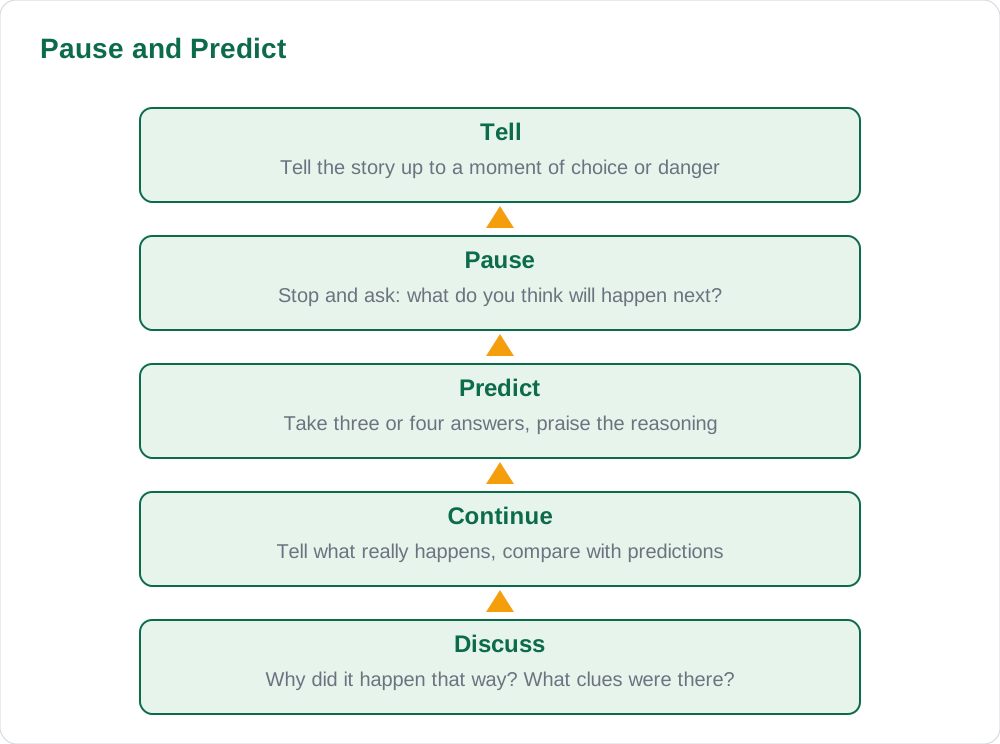
Choose two or three pause points in advance — never more, or the story falls apart. A good pause point is a moment of choice or danger: the character stands before a dark forest, a stranger knocks at the door, a boat begins to leak. Stop, and ask: what do you think will happen next? Take three or four answers without judging any of them. Then continue the story and let the children compare their predictions with what really happened.
There are no wrong predictions. A prediction that does not come true is still good thinking, because the child used clues from the story to make it. Praise the reasoning, not just the correct guess: you thought that because the clouds were dark — good thinking. This praise teaches children that comprehension means using clues, not guessing blindly. For more on building study skills, see how to make notes from Sindh Textbook Board books.
- Plan two or three pause points at moments of choice or danger.
- Ask: what do you think will happen next? Take several answers without judging.
- After the story, compare predictions with what really happened.
- Praise the reasoning behind a prediction, not only correct guesses.
Questions That Build Understanding
Different questions build different kinds of understanding. What happened questions check memory. Why questions build reasoning: why did the farmer share his bread? How questions build feeling: how did the child feel when the bird flew away? What would you do questions build judgement: what would you do if you found the lost bag? A good storytelling session mixes all four, with why and how questions getting the most time, because those are the questions written exercises struggle to teach.
Keep the language simple and the wait time generous. After asking a question, count silently to five before accepting an answer. Children need time to think, and the first hand up is not always the deepest thinker. If a child cannot answer, offer a choice: did the farmer feel happy or angry? A choice is a gentler question, and it still requires the child to think about the story.
- What happened — checks memory of the story.
- Why did it happen — builds reasoning.
- How did they feel — builds empathy and vocabulary for feelings.
- What would you do — builds judgement and personal connection.
Retelling: The Child Becomes the Storyteller
After a story, ask a child to retell it in their own words. Retelling is the strongest test of comprehension there is: a child who can retell a story has understood it, sequenced it, and made it their own. Start with retelling in pairs — one child tells, the other listens and adds what was missed. Then invite volunteers to retell to the class. Keep retellings short and praise every part remembered in the right order.
Picture cards help younger children retell. Four or five simple drawings — one per part of the story — give the child a path to follow. The child points to each picture and tells that part. As children grow confident, remove the cards and let them retell from memory. A class that retells stories regularly will find written comprehension exercises far easier, because they have already practised the skill out loud many times.
From Story to Written Comprehension
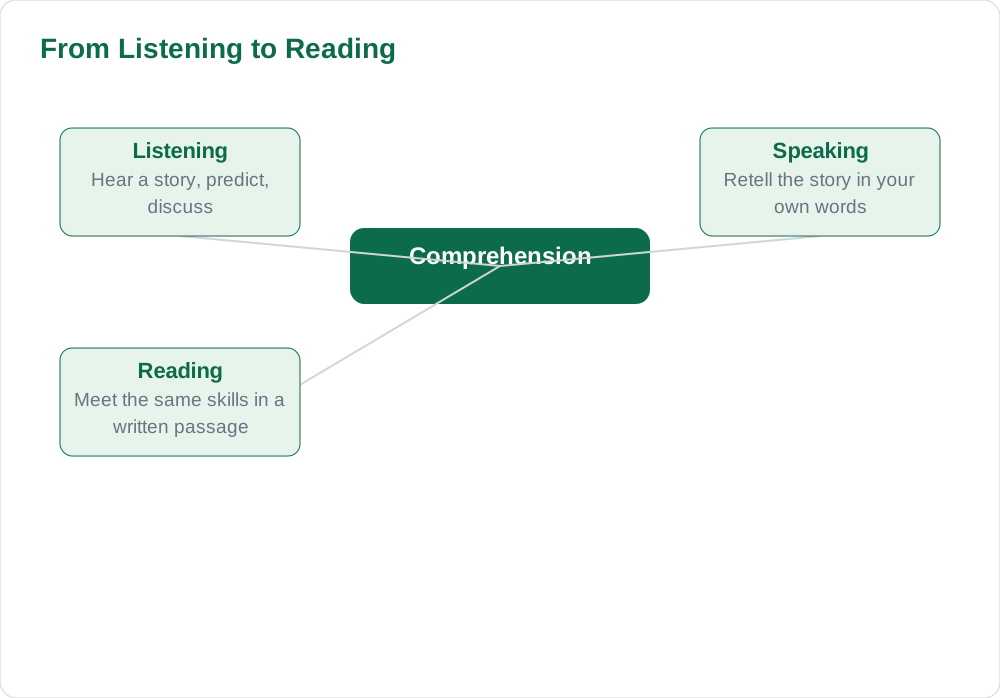
Storytelling prepares children for written exercises by teaching the same skills out loud first: finding the main idea, noticing sequence, explaining why things happened, and guessing what a word means from context. When a child later meets a written passage, those skills are already in place — only the reading itself is new. Teachers can make the bridge explicit: remember how we predicted during the story? Now predict what this paragraph will say.
Start written comprehension with very short passages — three or four sentences — and the same kinds of questions used in storytelling. Let children discuss answers in pairs before writing anything. Discussion first, writing second: a child who has said the answer can usually write it, but a child forced to write before speaking often freezes. More reading strategies are on the blog and in our solved notes.
AI Help: Muse AI
Muse AI is Meta's personal AI assistant. It can explain concepts simply, summarise a lesson, or make practice questions for your child's level.
For storytelling, you can ask Muse AI to suggest three pause-and-predict questions for a story your class is reading, or to turn a short story into four picture-card retelling prompts.
Join Muse with invite code LTGSWD — in the Muse app, go to Settings > Redeem token and enter the code.
Disclosure: LTGSWD is the author's Muse invite code.
Muse AI does not give official Sindh Textbook Board answers — always verify against your Sindh Textbook Board book and your teacher.
5 key points you must know
- Ask pause-and-predict questions during the story, not only after it.
- Plan two or three pause points at moments of choice or danger.
- Mix what, why, how, and what-would-you-do questions for full understanding.
- Retelling in pairs is the strongest test and builder of comprehension.
- Discuss answers aloud before asking children to write them.
Frequently asked questions
How long should a storytelling session be for primary classes?
Ten to fifteen minutes is enough for Classes 1 and 2, and up to twenty minutes for Classes 3 and 4. A short story told with pauses teaches more than a long story told straight through.
What if children give silly predictions?
Welcome them. A silly prediction still shows the child is thinking about the story. Praise the imagination, then gently ask: what clue in the story made you think that? The question guides them back to evidence without shutting them down.
Should storytelling be in English, Urdu, or Sindhi?
Tell the story in the language the children understand best, then use the same story to teach words in the target language. Understanding comes first; the new language grows on top of it.
How does storytelling help children who cannot read yet?
Listening comprehension comes before reading comprehension. A child who understands stories by listening already has the thinking skills reading will need — they only need to add the skill of decoding print.
Can parents use pause-and-predict at home?
Yes, easily. Pause during a bedtime story or a story in the reader and ask what happens next. Two minutes of prediction at home doubles the benefit of the classroom story.
Solved notes — preview free
These guides work best with the solved exercises. Preview the solved notes free on this website — 119 solved notes for Classes 6–10 in Sindhi, Urdu, English and Arabic medium. Or browse the full solved notes catalogue for your class and medium. New solved notes are added regularly — check the catalogue for coming-soon books.