Teaching Primary Science Through Observation and Nature Walks
Primary science observation nature walk lessons teach more science in twenty minutes outdoors than an hour of copying from a book ever could. Young children are natural observers — they notice ants, puddles, clouds, and shadows without being asked. A teacher or parent who guides that noticing turns it into science: looking carefully, comparing, asking why, and recording what was seen. This guide shows how leaves, shadows, weather, and small creatures become observation lessons that match early science books, with no extra worksheets and no special equipment.
Observation Is the First Science Skill
Before children can do experiments or memorise facts, they need to learn to look carefully. Observation is the foundation of all science: noticing what is there, comparing one thing with another, and describing what you see. A child who can describe the difference between two leaves — this one is smooth, that one is rough; this one is round, that one is pointed — is already doing science, even without the word for it.
Observation also builds the vocabulary of science. Words like rough, smooth, tall, short, wet, dry, heavy, and light mean something when a child holds, compares, and describes real objects. In a classroom, these words stay abstract. Outdoors, they become real. That is why a short walk with a clear looking-task teaches more than a long lesson about the same topic indoors.
The Nature Walk: Simple Rules, Big Learning
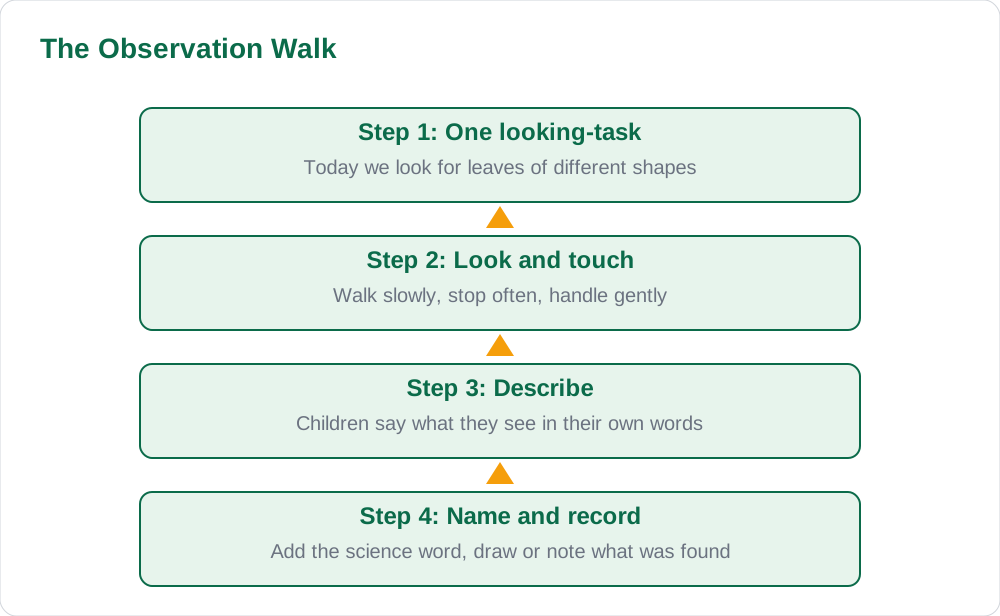
A nature walk does not need a forest or a field trip. A schoolyard, a street with trees, or a courtyard with plants is enough. The rules are simple: walk slowly, look carefully, and collect nothing living. Give the children one looking-task per walk — today we look for leaves, tomorrow we look for shadows, next week we look for insects. One task keeps the walk focused; ten tasks turn it into a race.
Walk in a small group and stop often. At each stop, ask the children to describe what they see before anyone explains it. What shape is this leaf? Is the soil wet or dry? Which shadow is longer — yours or the tree's? Let children answer in their own words first, then add the science word for what they described. This order — see it, say it, then name it — is what makes the word stick.
- One looking-task per walk: leaves, shadows, clouds, insects, or soil.
- Walk slowly and stop often — looking beats covering distance.
- Collect nothing living; look, describe, and leave things where they are.
Leaves: A Whole Lesson in One Handful
Leaves are the best first observation lesson because they are everywhere and endlessly varied. Ask children to collect five fallen leaves that look different. Then sort them together: by size, by shape, by edge — smooth or jagged — by colour, by feel. Sorting is classification, one of the core skills of science, and children learn it by doing it, not by reading a definition of it.
After sorting, ask why. Why do some leaves have jagged edges? Why are some leaves thick and some thin? You do not need to give a full answer — the question itself is the lesson. A child who wonders why leaves differ is thinking like a scientist. Back in class, the children can draw their favourite leaf and label its parts in simple words: stalk, leaf, edge, veins. That drawing connects the walk to the science book without a single extra worksheet. For ideas on keeping a simple study notebook, see how to make notes from Sindh Textbook Board books.
Shadows, Weather, and Small Creatures
Shadows teach children that the sun moves and that light makes patterns. Stand in the same spot in the morning and again near midday, and mark where your shadow falls. The shadow changes — shorter, longer, pointing a different way. Ask the children why, and let them guess before you explain. A shadow experiment needs no equipment beyond a sunny patch and a piece of chalk, and it is remembered for years.
Weather observation is a daily habit, not a one-off lesson. A simple class weather chart — sunny, cloudy, windy, rainy — filled in each morning teaches data recording without anyone noticing it is data. Small creatures — ants, butterflies, earthworms — teach care and patience: watch quietly, do not disturb, and describe what the creature does. A child who watches ants carry crumbs for five minutes has learned more about living things than a child who copies a paragraph about them.
- Shadow marks: chalk your shadow's position in the morning and again at midday.
- Weather chart: record sunny, cloudy, windy, or rainy every morning.
- Creature watch: observe quietly for five minutes, describe what the creature does.
From Walk to Notebook Without Worksheets
After every walk, give children five minutes to record what they found — a drawing, three words, or one sentence. A drawing of a leaf with the words smooth and pointed beside it is a complete science record for a primary pupil. The record matters because it turns looking into learning: the child must choose what was important and put it into words or pictures. It also gives the teacher something real to praise and display.
Display the records on a wall or in a class science corner. A wall of leaf drawings, shadow charts, and weather records tells children that their observations are real science. It also gives parents something to ask about at home — what did you see today — which is a far better question than did you finish your work. For more ideas on building steady study habits, visit the blog or the solved notes.
AI Help: Muse AI
Muse AI is Meta's personal AI assistant. It can explain concepts simply, summarise a lesson, or make practice questions for your child's level.
For nature walks, you can ask Muse AI to suggest five observation questions about leaves, shadows, or weather that suit a primary class, or to explain in simple words why shadows change during the day.
Join Muse with invite code LTGSWD — in the Muse app, go to Settings > Redeem token and enter the code.
Disclosure: LTGSWD is the author's Muse invite code.
Muse AI does not give official Sindh Textbook Board answers — always verify against your Sindh Textbook Board book and your teacher.
5 key points you must know
- Observation — looking carefully, comparing, describing — is the first science skill.
- One looking-task per walk keeps children focused; a schoolyard is enough.
- Leaves teach sorting and classification by size, shape, edge, colour, and feel.
- Shadow marks and a daily weather chart teach patterns and data recording.
- A short drawing or sentence after each walk turns looking into learning.
Frequently asked questions
Do we need special equipment for primary science walks?
No. A schoolyard, a few fallen leaves, chalk for shadow marks, and a notebook are enough. Observation at this age needs eyes, hands, and good questions, not equipment.
How long should a nature walk be for primary pupils?
Fifteen to twenty minutes is plenty, including the stop-and-look time. A short walk with one clear task teaches far more than a long walk with no focus.
What if our school has no garden or trees?
Use the sky, shadows, and weather — clouds, wind, sunlight, and the school building's shadow all work. Potted plants, a single tree on the street, or even cracks where small plants grow can carry a whole lesson.
How do nature walks connect to the science textbook?
After the walk, open the book to the matching topic and let children point to what they saw. The book then explains what they already noticed, instead of asking them to memorise what they never saw.
Is it safe to let children touch leaves and soil?
Fallen leaves and ordinary soil are safe to handle; just set two rules: do not put anything in the mouth, and wash hands afterwards. Avoid unknown berries, thorny plants, and any creature that could sting — look at those from a little distance.
Solved notes — preview free
These guides work best with the solved exercises. Preview the solved notes free on this website — 119 solved notes for Classes 6–10 in Sindhi, Urdu, English and Arabic medium. Or browse the full solved notes catalogue for your class and medium. New solved notes are added regularly — check the catalogue for coming-soon books.