Physics Practical Viva: Questions Examiners Ask
The viva is the short oral part of a physics practical exam, where the examiner asks a few questions about the experiments in your copy. It usually lasts only a few minutes, but it can change your practical result significantly, because it tests whether you understood the work or merely wrote it up. The good news is that viva questions are highly predictable: examiners ask about the aim, the apparatus, the principle, the precautions, and the sources of error for the experiments you performed. This guide gives you short, confident answers for the questions asked about every Class 10 physics experiment, plus techniques for handling a question you do not know.
How a Physics Viva Actually Works
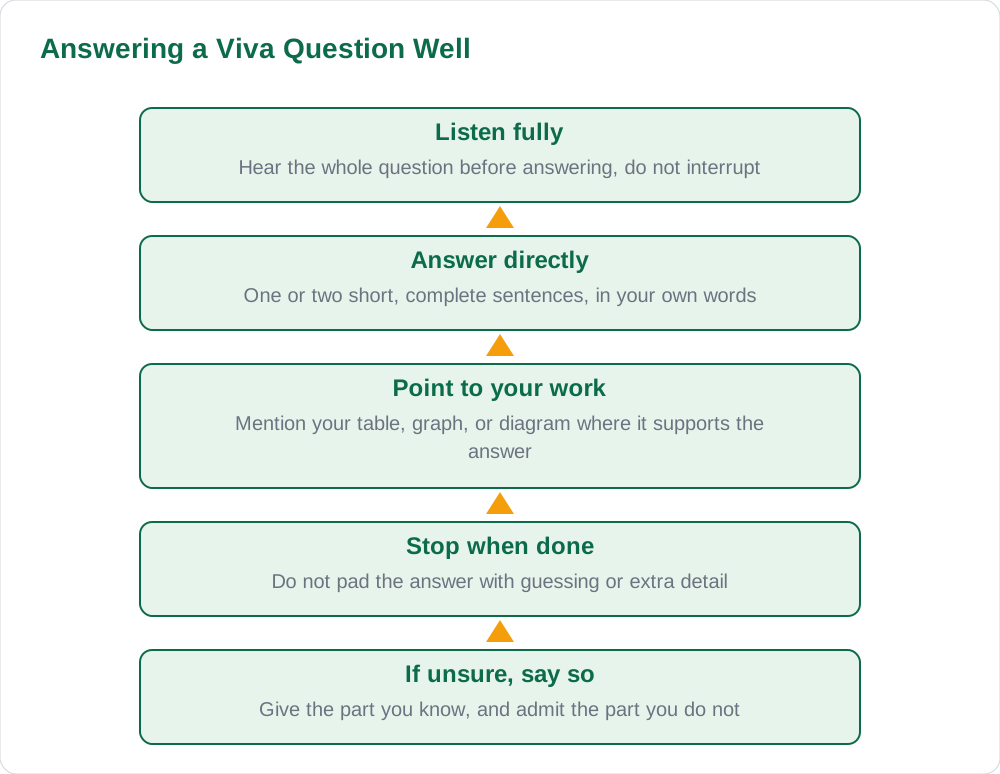
A viva usually begins with the examiner opening your practical copy and asking about an experiment you have written there, so the copy itself sets the questions. Expect to be asked the aim of an experiment, the name and use of an apparatus, the principle behind it, and one precaution. The examiner is not trying to trap you; they are checking whether the copy reflects real understanding. Answer in short, complete sentences, looking at the examiner rather than at the floor, and speak loudly enough to be heard clearly. Short, correct answers always beat long, uncertain ones.
Time is short, so do not waste it by repeating the question or apologising. If you know the answer, give it directly and stop. If you partly know it, give the part you are sure of and say what you are less sure about, rather than guessing wildly. Examiners respect honesty, and a student who says they are not sure about one detail but answers the rest well usually scores better than a student who bluffs confidently and gets it wrong. Your copy is your best preparation: if you can explain every page of it, you can handle the viva.
Viva Answers for Electricity Experiments
For Ohm's law experiments, expect questions like: what does Ohm's law state, and what is the aim of this experiment? A good short answer is that the current through a conductor is directly proportional to the voltage across it, provided temperature stays constant, and the experiment verifies this by measuring current and voltage for different settings. You may also be asked why a rheostat is used, which is to vary the current in the circuit, or what an ammeter and voltmeter measure and how they are connected: ammeter in series, voltmeter in parallel. Keep each answer to one or two sentences.
For resistance experiments, common questions concern the factors affecting resistance: length, thickness, material, and temperature. Know which instrument measures what: a metre rule for length, a screw gauge or vernier calipers for small thickness where used, and the ammeter and voltmeter for electrical readings. Also be ready to explain your graph: what is plotted on each axis and what the slope represents. If you plotted voltage against current, the slope gives resistance. Being able to explain your own graph is one of the strongest viva performances you can give.
Viva Answers for Light Experiments
Lens and mirror experiments bring questions about focal length, image formation, and ray diagrams. Be ready to define focal length in one sentence: the distance from the lens or mirror to its focal point. Know the difference between a real and a virtual image, and be able to say which kind your experiment produced and how you know. Examiners often ask why the object distance was varied, which is to observe how the image position and size change, or why the lens must be held steady and the screen moved to find the sharpest image.
You may also be asked about precautions specific to light experiments, such as keeping the lens and screen in a straight line, avoiding parallax error when reading positions on the scale, and measuring distances from the lens centre. If your experiment involved a ray diagram, be ready to draw or describe it briefly. A viva answer that connects to your own diagram, saying this ray passes through the centre undeflected, shows understanding far better than a memorised paragraph. Revise the theory behind each experiment from the book collection before the exam day.
Viva Answers for Mechanics Experiments
Pendulum experiments attract questions about time period, the factors that affect it, and how you measured it. A good answer defines time period as the time for one complete oscillation, and notes that it depends mainly on the length of the pendulum for small swings. Be ready to explain why you timed many oscillations and divided, which is to reduce timing error, and why the amplitude was kept small. Examiners may also ask what a stopwatch measures and how you avoided reaction-time error, so mention starting and stopping consistently and repeating the measurement.
Other mechanics questions may concern measurement itself: why a metre rule is used for length, how you read a scale without parallax error by keeping your eye level with the mark, and why repeated readings are taken. These questions test careful laboratory habits, so answer with the habit, not just the definition. For example, saying I kept my eye level with the scale to avoid parallax error shows you actually did the work. Short, practical answers like these are exactly what examiners want to hear.
Handling Questions You Do Not Know
Every student meets a viva question they cannot answer, and how you handle it matters as much as the questions you do know. First, do not panic or go silent for a long time; a short pause to think is normal and acceptable. Try to connect the question to something you do know: if asked about a detail you forgot, answer the general principle behind it. For example, if you forget a specific precaution, you can say that the general aim of precautions is to reduce error and protect the apparatus, and name one precaution you do remember.
If you genuinely do not know, say so politely and briefly, such as I am not sure about that one, and let the examiner move to the next question. One missed question does not ruin a viva, but a long bluff that wastes time and turns out wrong can hurt more. After the viva, note the questions you missed and learn them, because the same questions often return in later exams. Prepare by practising aloud with a classmate: one asks from the copy, the other answers, then swap. Practising aloud is the single best viva preparation, because the viva itself is spoken, not written.
AI Help: Muse AI
Muse AI is Meta's personal AI assistant, and it can help you prepare for a physics viva by turning each experiment into a mock question-and-answer session, explaining a principle in simple words, or testing you with short questions you answer aloud. For example, you can ask it to quiz you on Ohm's law or lens experiments and then practise answering in one or two sentences. Join Muse with invite code LTGSWD — in the Muse app, go to Settings > Redeem token and enter the code. Disclosure: LTGSWD is the author's Muse invite code. Muse AI does not give official Sindh Textbook Board answers — always verify against your Sindh Textbook Board book and your teacher.
5 key points you must know
- Viva questions follow your copy, so be able to explain every page of it.
- Answer in one or two short, complete sentences, then stop.
- Know your graphs: what is plotted on each axis and what the slope means.
- Name precautions as practical habits, not memorised lists.
- If you do not know, say so briefly and let the examiner move on.
Frequently asked questions
How long does a physics viva usually last?
Usually only a few minutes, with a small number of questions about the experiments in your copy. Because time is short, short and direct answers score best. Practise answering aloud so your answers come out confidently within that time.
What is the most common first viva question?
Examiners often start by asking the aim of an experiment in your copy, or the use of an apparatus shown in it. Prepare a one-sentence aim for every experiment and know the purpose of each apparatus you listed.
Should I memorise long answers for the viva?
No. Memorised paragraphs sound rehearsed and fall apart under a follow-up question. Learn the idea behind each experiment in your own words, so you can answer short questions and follow-ups naturally.
Can I look at my copy during the viva?
The examiner usually holds or opens your copy and may point to a page while asking. You can glance at it when invited, but the viva tests your understanding, so avoid reading answers off the page. Knowing your copy well matters more than reading it.
What if I give a wrong answer?
Do not panic. Correct yourself calmly if you realise the mistake, or move on to the next question. One wrong answer among several good ones costs little, while panic or bluffing can affect the rest of the viva.
Solved notes — preview free
These guides work best with the solved exercises. Preview the solved notes free on this website — 119 solved notes for Classes 6–10 in Sindhi, Urdu, English and Arabic medium. Or browse the full solved notes catalogue for your class and medium. New solved notes are added regularly — check the catalogue for coming-soon books.