Chemistry Practical Viva: Questions Examiners Ask
A chemistry viva tests whether you understood the experiments in your copy, not whether you can recite the textbook. Examiners typically ask about the tests you performed, the observations you recorded, the reasons behind a procedure, and the safety steps you took. Because chemistry practical work centres on salt analysis and titrations, most viva questions come from those two areas, with a few general questions about apparatus and safety. This guide gives short, confident answers for the questions examiners ask most, so you can walk into the viva prepared for whatever page of your copy the examiner opens.
How a Chemistry Viva Works
The examiner usually opens your copy at an experiment and asks about what is written there: why you performed a particular test, what you observed, and what you concluded from it. Expect questions in plain language, such as what test confirms this ion, or why did you add the reagent in excess. The examiner wants to hear that you know the reason behind each step, not just the step itself. Answer briefly, in your own words, and point to your observation table when it helps, because a viva answer that matches your written record looks consistent and honest.
Chemistry vivas also test safety awareness, so expect at least one question about safe practice, such as why eye protection matters when heating, or why a test tube is pointed away from people. Keep answers practical and specific to the experiment being discussed. As with any viva, short correct answers beat long uncertain ones, and admitting you do not know a detail is better than inventing one. If you can explain every test and every result in your copy, you are ready.
Viva Answers for Salt Analysis
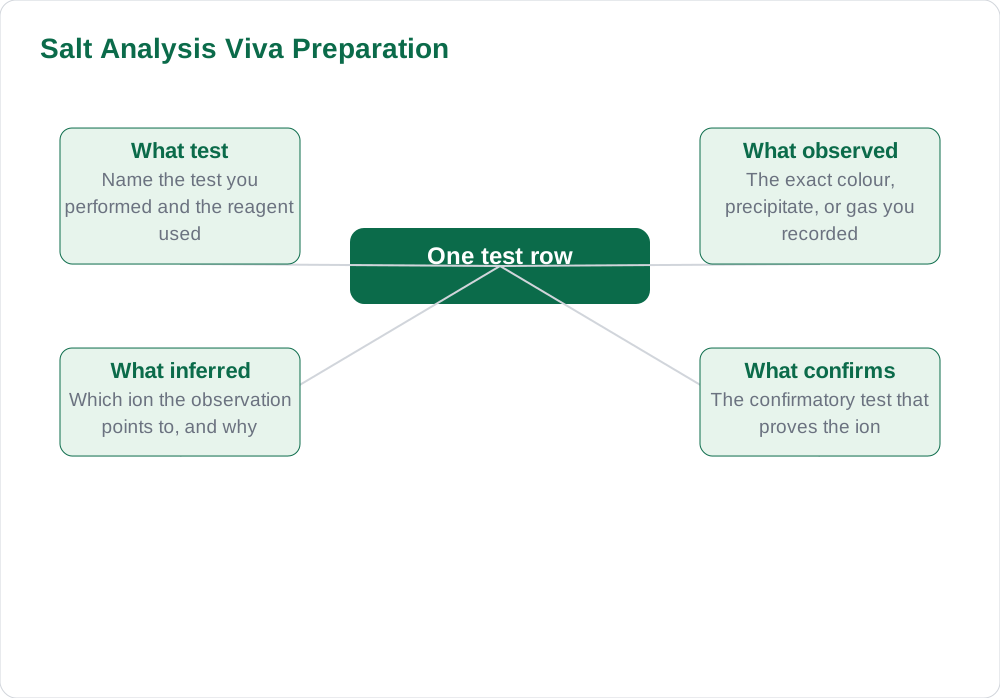
Salt analysis questions usually start with the tests themselves: which test identifies a particular cation or anion, and what observation confirms it. Be ready to name the test and the observation together, for example that a particular confirmatory test gives a characteristic coloured precipitate or a gas with a recognisable effect. Examiners often ask why tests are done in a particular order, and a good answer is that preliminary tests narrow down the possibilities before confirmatory tests prove the ion. Knowing the order and the reason for it shows real understanding of the analysis scheme.
You may also be asked what a negative result means, which is that the ion tested for is absent, or why a precipitate dissolves in excess reagent, which points to a particular ion's behaviour. Another common question is how you distinguished two similar observations, such as two white precipitates, and the answer is the confirmatory test that separates them. Prepare by going through your own salt analysis table and asking yourself, for each row, what test, what observation, and what inference. If you can answer those three for every row, the viva holds no surprises.
Viva Answers for Titrations
Titration questions focus on the apparatus, the end point, and the calculation. Be ready to explain what a burette, pipette, and conical flask are used for, and why the burette reading is taken at eye level to avoid parallax error. A favourite question is how you knew the end point had been reached, and the answer is the permanent colour change of the indicator, which you should be able to describe for your titration. Examiners also ask why the titration is repeated, which is to obtain concordant readings that agree closely, giving a reliable mean.
Calculation questions are common too: be ready to explain, in general terms, how you went from the mean titre value to the unknown concentration, mentioning the balanced equation and the mole relationship without reciting every number. You may be asked why the conical flask is swirled during titration, which is to mix the solutions evenly, or why the pipette is rinsed with the solution it will measure. These are practical questions with practical answers, and they reward students who actually performed the titration rather than copied a table.
Viva Answers for General Experiments and Safety
General chemistry experiments bring questions about the purpose of the experiment, the chemicals used, and the observations recorded. Be ready to name each chemical properly and state its role, rather than calling everything a solution. If an experiment involved heating, expect questions about why the mixture was heated and what change heating produced. If it involved a gas, know how the gas was identified and what safety care was taken. Linking each answer to your own observation table keeps your answers consistent with your copy.
Safety questions deserve special preparation because they are almost always asked. Know why eye protection is worn, why test tubes are pointed away from people, why acid is added to water when diluting, and why small quantities are used. A good safety answer names the risk and the protection together, such as that heating can cause spitting, so the tube is pointed away and eye protection is worn. Practise these answers aloud with a classmate, taking turns as examiner and student, and you will find the real viva far less stressful.
Mistakes to Avoid in a Chemistry Viva
The biggest mistake is answering from a memorised guide instead of from your own copy, which produces answers that contradict what you wrote. If your copy says a precipitate was white, do not describe it as yellow in the viva. Always check your answers against your own record before the exam, and revise from your copy, not from a generic list. A second mistake is over-answering: giving a long speech when a short answer was asked, which invites follow-up questions you may not be ready for. Answer the question asked, then stop.
Another common error is guessing at an ion or a result when unsure, which can contradict your own observations and damage credibility. It is far better to say you are not sure about that detail and offer what you do know. Also avoid blaming apparatus or classmates for a poor result; instead, mention the sources of error honestly, such as a burette reading error or an overshot end point. Examiners appreciate a student who understands error, because that understanding is exactly what practical work is meant to teach.
AI Help: Muse AI
Muse AI is Meta's personal AI assistant, and it can help you prepare for a chemistry viva by quizzing you on salt analysis tests and titration steps, explaining a test in simple words, or turning your observation table into practice questions. For example, you can ask it to ask you one viva question at a time about your experiments and then practise short spoken answers. Join Muse with invite code LTGSWD — in the Muse app, go to Settings > Redeem token and enter the code. Disclosure: LTGSWD is the author's Muse invite code. Muse AI does not give official Sindh Textbook Board answers — always verify against your Sindh Textbook Board book and your teacher.
5 key points you must know
- Revise from your own copy, so viva answers never contradict your written record.
- For every salt test, know the test, the observation, and the inference together.
- For titrations, know the apparatus, the end point, and why readings are repeated.
- Prepare safety answers that name both the risk and the protection.
- Answer briefly, admit what you do not know, and never bluff about an ion or result.
Frequently asked questions
What is the most asked chemistry viva question?
Questions about salt analysis tests and titration end points are the most common, because those are the core Class 10 experiments. Prepare the test, observation, and inference for every row of your salt table, and the end point and calculation steps for your titration.
How do I answer a question about a test I forgot?
Give the general principle if you can, name one related test you do remember, and admit the forgotten detail honestly. A partial honest answer scores better than a confident guess that contradicts your copy.
Should I memorise chemical equations for the viva?
Know the key equations behind your experiments well enough to explain them, but understanding matters more than recitation. If asked, explain what the equation shows rather than rushing through symbols you do not understand.
Do examiners ask about safety in every chemistry viva?
Safety questions are very common, because safe practice is part of practical assessment. Prepare answers for eye protection, test tube direction, dilution order, and handling of hot apparatus before the exam day.
How can I practise for the viva at home?
Practise aloud with a classmate: one opens the copy at random, asks a question about that page, and the other answers in one or two sentences, then swap roles. Spoken practice is the closest rehearsal to the real viva.
Solved notes — preview free
These guides work best with the solved exercises. Preview the solved notes free on this website — 119 solved notes for Classes 6–10 in Sindhi, Urdu, English and Arabic medium. Or browse the full solved notes catalogue for your class and medium. New solved notes are added regularly — check the catalogue for coming-soon books.