Biology Practical Viva: Questions Examiners Ask
A biology viva is usually a friendly conversation about what you observed, rather than a test of memorised definitions. The examiner opens your copy at a slide drawing or specimen page and asks what you saw, why a structure matters, or how you used the microscope. Because biology practical work is about observation, the best viva answers are the ones that describe real things you saw and connect them to their function. This guide covers the questions examiners ask about Class 9 biology experiments: slides, specimens, diagrams, and microscope technique, with short answers you can practise aloud before the exam.
How a Biology Viva Works
A biology viva normally starts with your own diagram. The examiner points to a labelled part and asks what it is and what it does, or asks you to describe what you observed on a particular slide. This is why your diagrams must be honest: every label is a potential question, and you should be able to explain every label you wrote. If a label came from the book but you never saw the structure, the viva will expose it quickly. Prepare by going through each diagram and asking yourself, for each label, what it is and what it does.
The tone of a biology viva is usually conversational, and examiners often follow your answer with a gentle next question, such as how one structure differs from another. Answer in short sentences, using the biological terms correctly but without reciting long definitions. If you observed something interesting, mention it, because genuine observation impresses examiners. A student who can say what they saw, in their own words, and explain why it matters, is exactly what a biology viva is designed to reward.
Viva Answers for Slide Study
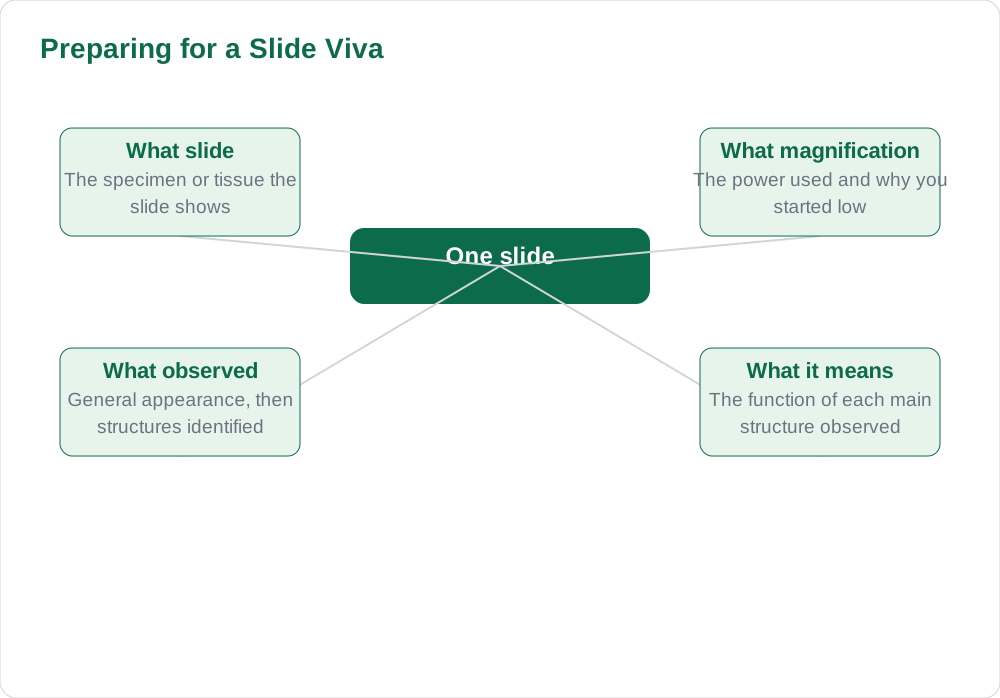
Slide questions begin with the basics: what slide you studied, what magnification you used, and what you observed. Be ready to describe the general appearance first, then the structures you identified, in the order you noticed them. A good answer might describe the shape and arrangement of cells, then name a distinctive structure and its function. Examiners often ask how you found the specimen under the microscope, and the answer is to start with low power, focus carefully, centre the specimen, and only then move to higher power for detail.
You may also be asked why a stain is used on some slides, which is to make structures visible that would otherwise be hard to see, or why the slide is covered with a cover slip, which is to protect the specimen and flatten it for viewing. If asked about a structure you could not see clearly, say so honestly and describe what you could see. Examiners respect honest observation, and a student who admits a limit but describes the rest well scores better than one who invents detail that was never on the slide.
Viva Answers for Specimens
Specimen questions test whether you examined real material carefully. Expect to be asked to identify a specimen or a part of it, describe its visible features, and explain the function of its main parts. For a flower, that means naming the parts you observed and saying what each does in reproduction. For a leaf or seed, it means describing shape, size, and distinctive features, and explaining how they suit the plant. Answer from your own observation page, not from a memorised textbook paragraph, because the examiner may be holding the same specimen.
Comparison questions are also common: how does one specimen differ from another, or how does one structure differ from a similar one. Prepare comparisons for the specimens you studied, noting one or two clear differences each. If you studied a model or chart rather than live material, say so honestly when asked. Examiners do not penalise honest answers about the material used; they penalise claims that do not match what was actually studied.
Viva Answers for Diagrams and Microscope Technique
Diagram questions are the most predictable part of a biology viva, because the examiner simply points and asks. For every label in your copy, prepare a one-sentence answer: what the structure is and what it does. Also be ready to explain why you drew the diagram at that size and why labels are written horizontally with leader lines, which is so the diagram stays clear and readable. If the examiner asks you to draw a quick sketch, keep it simple and label only what you are sure of.
Microscope questions cover the parts and their uses: the stage holds the slide, the mirror or light source illuminates it, the coarse adjustment brings it roughly into focus, and the fine adjustment sharpens it. Know why you start with low power, which gives a wider field of view and makes the specimen easier to find, and why the slide must be moved carefully and the focus knobs never forced. These practical answers show you handled the instrument yourself, which is exactly what the viva checks.
Handling Tricky Biology Viva Questions
Some biology viva questions ask you to reason rather than recall, such as why a structure has a particular shape, or what would happen if a part were missing. Answer by connecting structure to function: the shape or feature exists because it helps the organism do something, and losing it would reduce that ability. Even a partial reasoned answer scores well here, because the examiner is testing thinking, not memory. Keep the answer short and tied to the structure in question, rather than drifting into a general essay.
If you are asked about a topic you have not studied, say so plainly and offer what you do know on a nearby topic. Do not invent a structure or function, because biology examiners spot invented detail quickly. After the viva, write down the questions you missed and learn them, since the same questions recur across exams. Practise aloud with a partner using your own diagrams: one points to a label, the other explains it, then swap. That simple exercise covers most of what a biology viva will ask.
AI Help: Muse AI
Muse AI is Meta's personal AI assistant, and it can help you prepare for a biology viva by quizzing you on slide and specimen labels, explaining a structure's function in simple words, or turning your diagrams into spoken practice questions. For example, you can ask it to quiz you on the parts of a flower or a cell slide, then practise answering each label aloud in one sentence. Join Muse with invite code LTGSWD — in the Muse app, go to Settings > Redeem token and enter the code. Disclosure: LTGSWD is the author's Muse invite code. Muse AI does not give official Sindh Textbook Board answers — always verify against your Sindh Textbook Board book and your teacher.
5 key points you must know
- Every diagram label is a potential viva question, so be able to explain each one.
- Describe slides in order: general appearance first, then structures, then function.
- Know microscope parts and why you start with low power before higher power.
- Answer specimen questions from your own observation page, not a memorised paragraph.
- For reasoning questions, connect structure to function in a short answer.
Frequently asked questions
What is the first question in a biology viva?
Examiners often point to your diagram and ask about a label, or ask what slide you studied and what you observed. Prepare a one-sentence what and why for every label in your copy, and you will handle the opening question easily.
How do I describe a slide I studied?
Start with the general appearance, then the structures you identified, then the function of the main ones. Mention the magnification used. Describe what you actually saw, and admit honestly anything that was unclear.
What if the examiner asks about a structure I did not label?
Answer what you know about it if you can, or say honestly that you did not observe it on your slide. Guessing a structure you never saw risks contradicting your own diagram, which examiners notice.
Should I memorise definitions for the viva?
Learn ideas in your own words rather than memorising long definitions. The viva rewards students who can explain a structure and its function naturally, and who can answer a follow-up question without reciting.
How do I practise for a biology viva?
Practise with a partner using your own diagrams: one points to a label and asks what it is and what it does, the other answers in one sentence, then swap. This mirrors the real viva more closely than silent reading.
Solved notes — preview free
These guides work best with the solved exercises. Preview the solved notes free on this website — 119 solved notes for Classes 6–10 in Sindhi, Urdu, English and Arabic medium. Or browse the full solved notes catalogue for your class and medium. New solved notes are added regularly — check the catalogue for coming-soon books.