Practical Copy Precautions: The Lines That Earn Marks
Precautions are the shortest section in most practical copies, yet they are one of the most marked. A good precautions section proves that you understood the experiment well enough to know what could go wrong and how you guarded against it. Too many students treat precautions as an afterthought, copying the same generic list into every experiment, and they lose marks that were easily available. This guide explains how to write precautions that earn marks: what makes a precaution specific and believable, the precautions that fit each subject, and how to write honestly about sources of error without undermining your result.
Why Precautions Earn Marks
Examiners mark precautions because they reveal understanding. Anyone can copy a procedure, but only a student who understood the experiment can say which errors it was vulnerable to and what was done to prevent them. A precaution like keeping the eye level with the scale shows you know about parallax error; a precaution like repeating readings shows you know about random error. Each specific precaution is evidence of thinking, and that is why the section carries marks out of proportion to its length. A few well-chosen lines can earn what a page of copied theory cannot.
Precautions also show safe and careful working, which is part of practical assessment in every subject. In chemistry, they show you handled chemicals safely; in physics, that you protected delicate instruments; in biology, that you handled specimens and microscopes correctly. A precautions section that is clearly written for the experiment in front of you, naming its real risks and error sources, tells the examiner that the work was done thoughtfully. That impression carries beyond the section itself and lifts the whole experiment's mark.
What Makes a Precaution Good
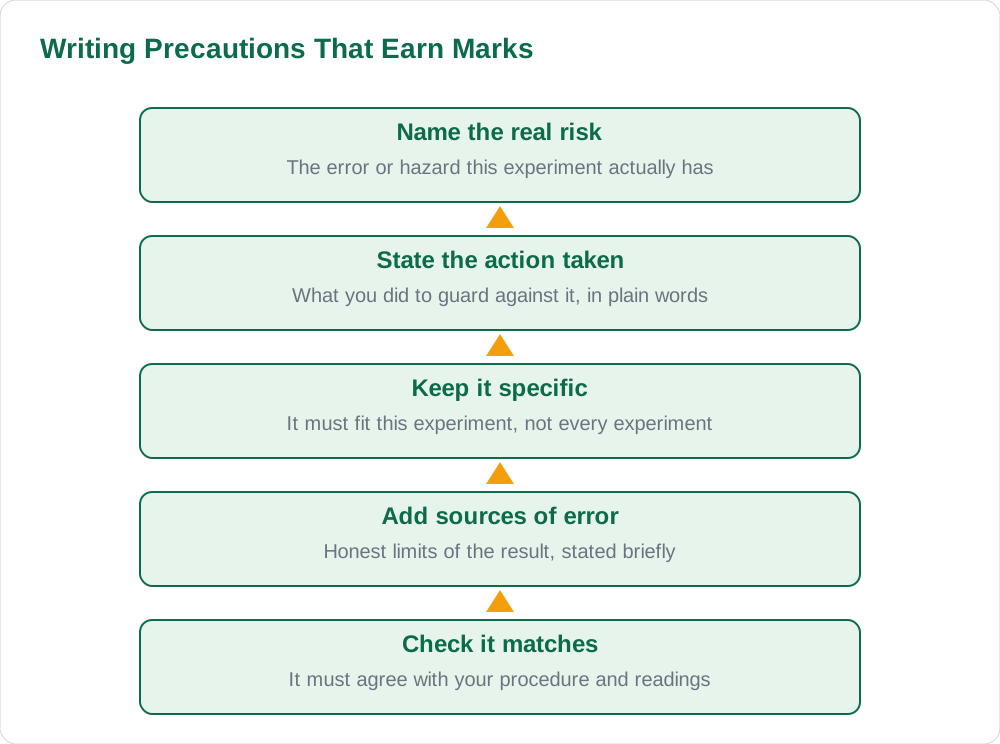
A good precaution is specific, practical, and tied to the experiment. Specific means it names the actual risk or error, such as parallax error when reading a burette, rather than a vague instruction to be careful. Practical means it describes an action you actually took, such as reading the burette at eye level, rather than a wish like getting accurate results. Tied to the experiment means it could not be copied unchanged into a different experiment: a lens precaution about keeping the lens and screen aligned belongs to a light experiment, not to a titration.
Write three to five precautions per experiment, each in its own short line or numbered point, and phrase them as actions: the reading was taken at eye level, the experiment was repeated, the apparatus was kept steady. Avoid the copied generic list that appears identically in every experiment, because examiners recognise it instantly and mark it down. Also avoid precautions that contradict your procedure: if you claim the lens was kept steady but your procedure never mentions it, the claim looks invented. Precautions must match the work you actually did.
Precautions for Physics Experiments
Physics precautions usually concern measurement accuracy and instrument care. Common ones include reading scales at eye level to avoid parallax error, keeping connections tight in electrical circuits to avoid fluctuating readings, and taking repeated readings and using the mean to reduce random error. For light experiments, add keeping the lens, object, and screen in a straight line and moving the screen slowly to find the sharpest image. For pendulum work, add keeping the swing small and timing several oscillations before dividing.
Also mention instrument care where relevant: handling lenses by their edges, not forcing microscope or meter adjustments, and zero-checking meters before use. Each precaution should name the error it prevents, because that is what shows understanding. A line like readings were repeated and the mean was taken to reduce random error earns more than a line like care was taken, because it names both the action and the reason. Choose the precautions that fit your experiment and leave out the rest.
Precautions for Chemistry and Biology Experiments
Chemistry precautions centre on safety and measurement accuracy together. Safety lines include wearing eye protection when heating or handling acids, pointing test tubes away from people, adding acid to water when diluting, and using small quantities of chemicals. Accuracy lines include reading the burette at eye level, swirling the flask during titration, and rinsing the pipette with the solution it will measure. Pick the lines that fit the experiment: a titration needs burette care, while a heating experiment needs tube direction and eye protection.
Biology precautions concern handling and observation: handling slides and specimens gently, focusing the microscope carefully without forcing the knobs, avoiding contact with stains and washing hands afterwards, and cleaning and returning apparatus after use. For specimen work, add observing before drawing, so the diagram records what was seen rather than what was expected. In both subjects, a short honest note about sources of error strengthens the section: for example, that a colour change end point is judged by eye, or that a slide structure was faint and hard to identify. Honest limits show scientific thinking.
Sources of Error: How to Write Them Honestly
Sources of error are the honest limits of your result, and writing them well is a mark of a good scientist. State them briefly, in one or two lines, naming the likely cause and its probable effect: for example, that slight heat loss may have lowered a temperature reading, or that reaction time may have affected a stopwatch measurement. Do not list every imaginable error; name the two or three most plausible ones for your experiment. A short, plausible error note adds credibility, while a long list of unlikely errors looks copied.
Importantly, sources of error do not undermine your result when written honestly. Examiners expect real experiments to have small errors, and a student who identifies them shows understanding of measurement itself. What undermines a result is claiming perfect accuracy while the readings show variation, or hiding an obvious problem. If a reading was clearly off, say that it was repeated or noted, and explain why. End the precautions section with that honest balance: the care taken, plus the limits acknowledged. That is the combination that earns full marks for the section.
AI Help: Muse AI
Muse AI is Meta's personal AI assistant, and it can help with practical precautions by suggesting the likely errors for a given experiment, explaining a source of error in simple words, or checking that your precautions fit the experiment you performed. For example, you can ask it what precautions suit a titration or a lens experiment, then choose the ones that match your actual work. Join Muse with invite code LTGSWD — in the Muse app, go to Settings > Redeem token and enter the code. Disclosure: LTGSWD is the author's Muse invite code. Muse AI does not give official Sindh Textbook Board answers — always verify against your Sindh Textbook Board book and your teacher.
5 key points you must know
- Write three to five precautions per experiment, each naming a real risk and the action taken.
- Make every precaution specific to the experiment, never a copied generic list.
- Name the error a precaution prevents, such as parallax or random error.
- Add one or two honest sources of error, briefly, with their likely effect.
- Check that precautions match your procedure and readings before finishing.
Frequently asked questions
How many precautions should I write per experiment?
Three to five specific precautions are usually enough, plus a brief note on sources of error. Quality matters more than quantity: five specific, relevant precautions earn more than ten generic ones copied into every experiment.
Should precautions be the same for every experiment?
No. Some habits repeat, like reading at eye level, but each experiment has its own risks and error sources. Write precautions that fit the experiment in front of you, and examiners will mark them as evidence of understanding.
Do sources of error reduce my marks?
No, honest sources of error usually help, because they show you understand measurement. Examiners expect small errors in real work. What costs marks is claiming impossible accuracy or hiding an obvious problem in your readings.
What is the difference between a precaution and a source of error?
A precaution is an action you took to prevent an error, such as reading at eye level. A source of error is a remaining limit of the result despite that care, such as judgment of a colour change by eye. Good copies include both.
Can I write precautions in bullet points?
Yes, short numbered or bulleted lines work well for precautions, since each one is a separate action. Keep each line to one precaution and one reason, so the section stays clear and easy to mark.
Solved notes — preview free
These guides work best with the solved exercises. Preview the solved notes free on this website — 119 solved notes for Classes 6–10 in Sindhi, Urdu, English and Arabic medium. Or browse the full solved notes catalogue for your class and medium. New solved notes are added regularly — check the catalogue for coming-soon books.