Practical Copy Index and Format: First Page to Last

The first pages of a practical copy are examined before any experiment is read, and they create the impression that colours the whole marking. A copy with a tidy certificate page, a complete index, numbered pages, and a consistent experiment layout looks like the work of an organised student, while a copy that starts in disorder suggests the experiments inside are disordered too. This guide covers the complete format of a practical copy from the first page to the last: the certificate, the index, the experiment layout, page numbering, and the final checks that make a copy exam-ready in every subject.
The First Pages: Cover and Certificate
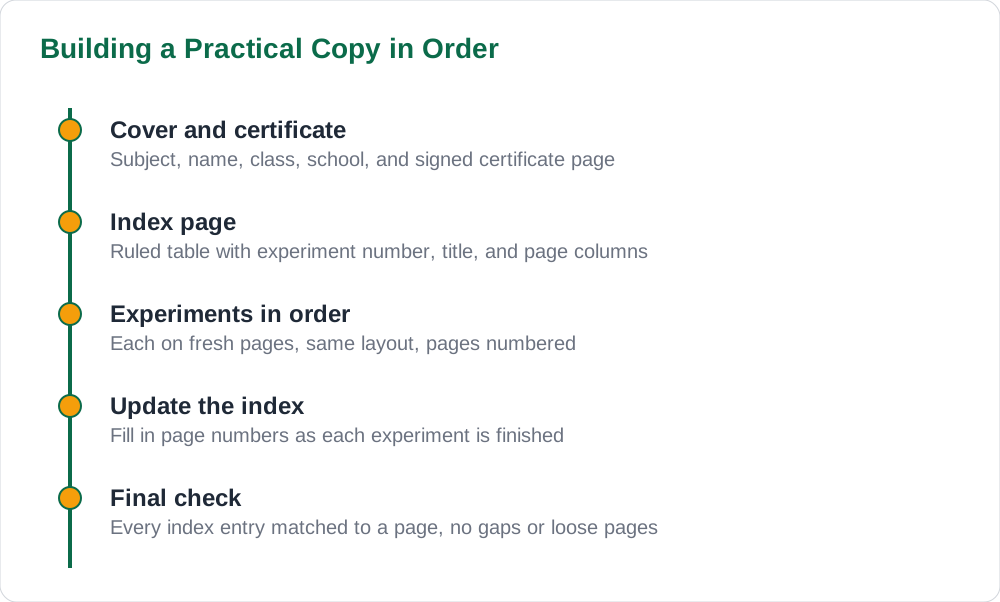
The cover page should carry the subject, your name, class, roll number, school, and session, written neatly and centred, with no decoration that distracts from the information. Some schools provide a printed cover or certificate format, and where one is given, follow it exactly rather than inventing your own. The certificate page usually states that the experiments in the copy were performed by you in the school laboratory, with spaces for your signature, your teacher's signature, and the date. Fill it in completely and carefully, because an incomplete certificate page is an easy mark lost before the experiments begin.
Keep the first pages clean: no rough work, no crossed-out writing, and no doodles. If your school does not provide a printed certificate, write a simple one in neat handwriting with the same information: a declaration that the work is yours, your details, and signature lines. Check the spelling of your name, class, and school carefully, since these pages are also used to identify the copy. A tidy opening tells the examiner, before any science is read, that this copy was prepared with care.
The Index Page: How to Set It Out
The index is a table listing every experiment in the copy, in the order performed, with columns for the experiment number, the experiment title, the page number, and usually a column for the teacher's remarks or signature. Draw it with a ruler, keep the columns straight, and write titles exactly as they appear on the experiment pages. Leave the page numbers blank until the experiments are written, then fill them in from the finished copy, because page numbers guessed in advance are almost always wrong. If an experiment is added later, add it to the index in its proper place rather than squeezing it at the end out of order.
The index serves two purposes: it helps the examiner find any experiment quickly, and it proves the copy is complete. An index that lists every experiment, with correct page numbers and no gaps, is itself a mark of organisation. Update it every time you finish an experiment, not at the end of the term, when page numbers are hard to reconstruct. For help finding the books and notes behind your experiments, see the book collection and the solved notes.
The Experiment Layout, Page by Page
Start each experiment on a fresh page, with the experiment number and title at the top in a consistent style. Follow the standard order for your subject: aim, apparatus and materials, theory, procedure, observations or tables, diagrams or graphs, calculation or inference, result or conclusion, and precautions. Keep the same order and the same headings in every experiment, because consistency is what makes a copy easy to mark. Leave margins on every page, write in a readable size, and keep the left margin clear for binding.
Number every page, including the index and experiment pages, in one continuous sequence, and write the numbers in the same corner throughout. Page numbers are what connect the index to the experiments, so a missing or duplicated number breaks that connection. If you make a serious mistake on a page, it is better to rewrite the page cleanly than to leave heavy crossing out, but keep the page numbering correct after any rewrite. A copy with consistent layout and correct numbering reads as a single organised document, not a pile of loose work.
Presentation Rules for the Whole Copy
Presentation rules apply across the whole copy, not just single pages. Write the main text in pen, draw diagrams and graphs in pencil, and keep handwriting consistent and readable throughout. Use headings to separate parts of each experiment, underline titles, and keep tables ruled and aligned. Avoid different ink colours for decoration; a single pen colour for text, with pencil for diagrams, looks the most professional. Keep the copy free of loose sheets tucked inside, because loose pages get lost and cannot be marked.
Also keep the copy clean physically: no torn pages, no stains, no folded corners, and no rough calculations in the margins. Rough work belongs on separate paper, and only the finished write-up goes in the copy. Store the copy flat and protected between lessons, since a damaged copy is hard to present well however good the content. These habits cost nothing but attention, yet they shape the examiner's impression of every page that follows.
The Final Check Before Submission
Before submitting, work through a final checklist for the whole copy. First, check the index against the experiments: every experiment listed, every page number correct, no gaps. Second, check each experiment against its skeleton: aim, apparatus, procedure, observations, result, precautions, and diagram or graph where needed. Third, check page numbers run continuously and every page is in order. Fourth, check the certificate page is complete and signed where required. This check takes fifteen minutes and catches the errors that cost the most marks.
Also read through two or three experiments as the examiner would, asking whether the steps could be followed and the results understood without being present at the experiment. Fix anything unclear, add any missing part, and correct any spelling of apparatus or chemical names. Finally, confirm the copy is complete for the experiments your class performed, and ask your teacher if anything is missing before the submission date. A copy that passes this final check is ready to submit with confidence.
AI Help: Muse AI
Muse AI is Meta's personal AI assistant, and it can help with practical copy format by suggesting a clean index layout, listing the parts each experiment write-up should contain, or turning your rough checklist into a tidy final check for submission. For example, you can ask it to outline a certificate page or an index table, then adapt the layout neatly in your own copy. Join Muse with invite code LTGSWD — in the Muse app, go to Settings > Redeem token and enter the code. Disclosure: LTGSWD is the author's Muse invite code. Muse AI does not give official Sindh Textbook Board answers — always verify against your Sindh Textbook Board book and your teacher.
5 key points you must know
- Follow your school's printed cover or certificate format exactly where one is given.
- Draw the index as a ruled table and fill in page numbers only after experiments are written.
- Start each experiment on a fresh page with the same headings in the same order.
- Number every page continuously, in the same corner, and keep the index matched to it.
- Run a full final check: index, experiment skeletons, numbering, and certificate, before submission.
Frequently asked questions
What goes on the certificate page?
A declaration that the experiments were performed by you in the school laboratory, with your name, class, school, session, your signature, your teacher's signature, and the date. Follow your school's printed format exactly where one is provided.
What columns should the index have?
Experiment number, experiment title, page number, and usually a remarks or signature column for the teacher. Write titles exactly as they appear on the experiment pages, and fill in page numbers after the experiments are finished.
Should each experiment start on a new page?
Yes. Starting each experiment on a fresh page keeps the copy organised, makes page numbering meaningful, and lets the examiner find and mark each experiment separately. Never run two experiments together on one page.
What if I need to add an experiment late?
Add it in its proper place in the copy and update the index accordingly, renumbering pages if needed. Squeezing it at the end out of order breaks the index and looks disorganised.
How do I fix a badly written page?
Rewrite the page cleanly rather than leaving heavy crossing out, and keep the page numbering correct afterwards. A single rewritten page is far better for presentation than a page full of corrections.
Solved notes — preview free
These guides work best with the solved exercises. Preview the solved notes free on this website — 119 solved notes for Classes 6–10 in Sindhi, Urdu, English and Arabic medium. Or browse the full solved notes catalogue for your class and medium. New solved notes are added regularly — check the catalogue for coming-soon books.