Chemistry Practical Copy Class 10: Complete Guide
A chemistry practical copy is the record of what you did at the bench, and it is marked on how clearly it shows your method, your observations, and your conclusions. Chemistry experiments have their own habits: colour changes, gases, precipitates, and careful titration readings all need to be recorded in words that an examiner can follow without being in the room. This guide covers the full format for a Class 10 chemistry practical copy, including salt analysis, titrations, and general experiments, with the observation style, safety notes, and result writing that examiners expect. Follow the format here and every experiment becomes a tidy, believable report instead of a rushed jumble of notes.
The Chemistry Copy Format, Step by Step
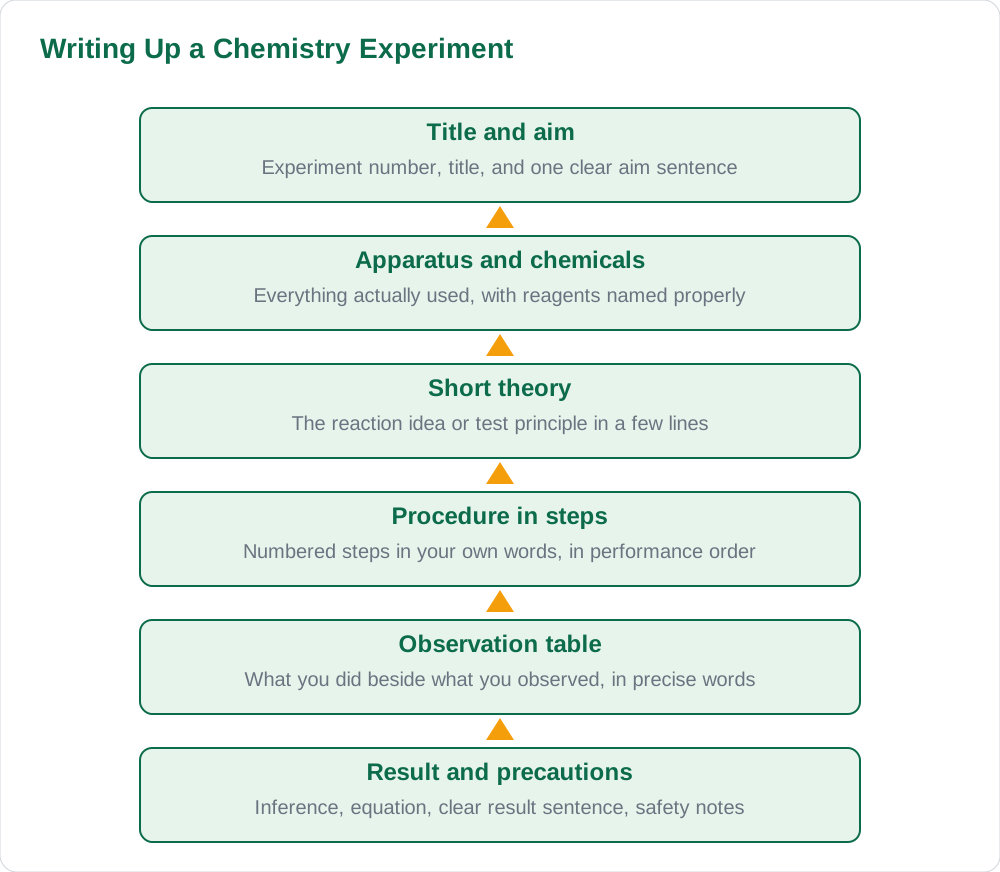
Every chemistry experiment in your copy should open with the experiment number and title, then the aim in one sentence, followed by the apparatus and chemicals you actually used. In chemistry, the chemicals list matters as much as the apparatus, so name reagents properly, for example dilute hydrochloric acid rather than just acid. Then write a short theory or principle in a few lines: the reaction idea or the test you are using, without copying pages of textbook. The procedure follows as numbered steps in your own words, written in the order you performed them, using past tense for work already done.
After the procedure comes the heart of a chemistry copy: the observation table. Record what you did in one column and what you observed in the next, using precise words for colour, state, smell where safe to note, gas evolution, and precipitate formation. Then write the inference or conclusion, the chemical equation where one applies, the result in a clear sentence, and finally the precautions. Keep this order identical for every experiment, because a consistent format helps the examiner follow your work quickly, and a copy that is easy to follow is a copy that earns its marks.
Salt Analysis: Recording Tests and Inferences
Salt analysis is the experiment students find hardest to write up, because it is a chain of small tests rather than one single measurement. The trick is to record it as a table with three columns: the test performed, the observation, and the inference. Work through the tests in a sensible order, usually starting with physical appearance and solubility, then flame or preliminary tests, then confirmatory tests for the cation and the anion. Write each observation the moment you see it, because colours and precipitates are easy to forget or confuse once you move to the next test.
Use exact observation language. Write the precise colour of a precipitate, whether it dissolves on heating or in excess reagent, and whether a gas turned a test paper or produced an effect you can describe. Vague words like changed or reacted tell the examiner nothing, while a sentence like a white precipitate formed and dissolved on adding excess reagent gives real evidence. End with a conclusion that names the salt only when your tests genuinely support it, and show the confirmatory test that proves it. A salt analysis that shows its working, test by test, earns marks even if the final identification is uncertain.
Titrations: Tables, Readings, and Calculations
Titration write-ups stand or fall on the reading table. Draw a table with columns for each titration run, rows for initial reading, final reading, and volume used, and record burette readings to the precision your apparatus allows, keeping the same decimal places throughout. Run the titration until you have at least two readings that agree closely, and show clearly which readings you used for the mean. Never invent a concordant set at home: the table must reflect what the burette actually showed, including a first rough run that overshot the end point.
Show the calculation step by step, starting from the mean titre value, then the balanced equation, then the mole relationship, and finally the unknown concentration or quantity. Write units at every stage and underline or box the final answer. If your result seems off, check the common slips first: a misread burette, a wrong indicator colour change, or a calculation that mixed up volumes. Note such points honestly in the precautions. A titration page with a clean table, a visible mean, and a step-by-step calculation is one of the strongest pages a chemistry copy can contain.
Safety Notes Belong in Every Write-Up
Safety is not a separate chapter in chemistry practical work; it belongs inside every experiment you write. In the precautions section, mention the specific safety steps for that experiment: wearing eye protection when heating or handling acids, pointing test tubes away from yourself and others, adding acid to water rather than the reverse when diluting, and handling hot apparatus with a holder. These lines show the examiner that you worked safely, and they also help you remember the habits for the exam itself, where safe practice is observed as well as written.
Safety notes also cover sensible handling of chemicals and apparatus: using small quantities, not tasting or directly smelling chemicals, cleaning spills immediately, and disposing of waste as your teacher directs. Do not copy a generic safety list into every experiment; instead, pick the two or three precautions that genuinely fit the experiment in front of you. A short, specific safety note beats a long, copied list, because it proves you thought about the actual risks of the work you did. If your teacher gives particular safety rules for your laboratory, follow those first.
Mistakes That Spoil a Chemistry Copy
The biggest mistake is writing observations after the lesson from memory, which produces vague descriptions and missing details that an examiner spots immediately. Write observations during the experiment, even in short phrases, and turn them into full sentences when you write up the copy properly. Another common error is skipping the inference column in salt analysis, leaving a list of tests with no conclusion, or writing the conclusion first and inventing observations to fit it. The order must be observation first, inference second, because that is how real laboratory work proceeds.
Other errors include missing units, unbalanced or missing equations, titration tables without a mean, and precautions copied identically into every experiment. Also avoid the temptation to make every result look perfect: a titration that needed four runs or a salt test that was repeated is normal laboratory work, and recording it honestly is a strength. Finish each experiment with a quick check: title, aim, chemicals, procedure, observations, inference or calculation, result, and precautions. If all are present and readable, the page is ready.
AI Help: Muse AI
Muse AI is Meta's personal AI assistant, and it can help with a chemistry practical copy by explaining a test in plain words, suggesting the right observation table layout for salt analysis or a titration, or checking that a chemical equation is balanced before you write it in. For example, you can ask it to explain what a confirmatory test shows or how to set out a titration calculation step by step, then write the answer in your own words. Join Muse with invite code LTGSWD — in the Muse app, go to Settings > Redeem token and enter the code. Disclosure: LTGSWD is the author's Muse invite code. Muse AI does not give official Sindh Textbook Board answers — always verify against your Sindh Textbook Board book and your teacher.
5 key points you must know
- Name reagents properly in the chemicals list, not just acid or solution.
- Record salt analysis as test, observation, and inference in a three-column table.
- Show titration readings, the concordant mean, and a step-by-step calculation with units.
- Write safety precautions specific to each experiment, not a copied generic list.
- Record observations during the experiment, never afterwards from memory.
Frequently asked questions
How do I write a salt analysis conclusion?
State the cation and anion only when your tests support them, and name the confirmatory test that proves each one. If one ion is uncertain, say so honestly and show the tests you did. A conclusion that follows from the recorded observations earns marks even when it is incomplete.
How many titration readings should I record?
Record every run you performed, including the first rough titration, and mark clearly which concordant readings you used for the mean. Two or three readings that agree closely are the usual basis for the mean. Never hide an overshot run by leaving it out without explanation.
Should I write chemical equations in the copy?
Yes, where a reaction applies, write the balanced equation after the observation it explains, especially in salt analysis and titration calculations. A correct equation shows understanding and supports your inference or calculation, so include it rather than describing the reaction only in words.
What goes in the precautions for a heating experiment?
Mention eye protection, pointing the test tube away from people, heating gently and evenly, and using a holder for hot apparatus. Add anything specific to that experiment, such as fume care when a gas is evolved. Specific precautions always beat a copied general list.
Can I prepare the chemistry copy before the practical?
Yes, prepare the title, aim, chemicals, theory, procedure and blank tables at home, but fill observations, titration readings and results only during the experiment itself. Observations written in advance are not evidence of work you did.
Solved notes — preview free
These guides work best with the solved exercises. Preview the solved notes free on this website — 119 solved notes for Classes 6–10 in Sindhi, Urdu, English and Arabic medium. Or browse the full solved notes catalogue for your class and medium. New solved notes are added regularly — check the catalogue for coming-soon books.