Work, Energy and Power in Physics: Clear Meanings
In everyday speech, you work when you study, when you write homework, and when you hold a heavy bag. In physics, work, energy, and power have much narrower meanings: work is done only when a force moves an object in the direction of the force. Holding a heavy bag still, however tiring it feels, is not work in the physics sense, because nothing moves. This difference between the everyday word and the physics word confuses many pupils, and it is the first thing to clear up. This article separates the three ideas cleanly: work, energy, and power. Work is energy transferred by a force acting through a distance. Energy is the capacity to do work, and it appears in many forms, such as kinetic energy, potential energy, heat, and chemical energy. Power is how quickly work is done or energy is transferred. You will meet each idea through lifting, climbing stairs, and cycling, and you will learn the formulas with the correct units so that you can use them in numerical problems without mixing them up.
Work in Physics: Force Times Distance
Work is calculated as force multiplied by the distance moved in the direction of the force: W = F x d. Its unit is the joule (J), which is one newton-metre. If you push a box with a force of 50 N and it moves 4 metres in the direction of the push, you do 200 J of work. If the same push moves nothing, the work done is zero, no matter how hard you push. That is the rule that separates physics work from everyday effort.
Direction matters. Only the part of the force that acts along the direction of motion counts. If you pull a suitcase with a strap angled upward, only the horizontal part of your pull does work in moving it forward; the upward part holds some of its weight. And if you carry a bag horizontally across a room, gravity does no work on the bag, because the bag does not move in the direction of gravity. This is why a porter carrying luggage across a flat platform does no work against gravity, even though the porter feels tired: the muscles work to hold the load, but the load does not move vertically. In exam questions, always ask two things: did something move, and was the force along that movement?
Why Holding a Bag Is Not Physics Work
This is the classic trap, so it deserves its own section. A pupil holding a 10 kg bag still at shoulder height feels the effort in the arms, and the muscles burn energy, so it seems obvious that work is being done. But the bag does not move, so the distance in W = F x d is zero, and the work done on the bag is zero. The tiredness comes from biology: muscles consume energy to maintain tension even without movement. Physics does not deny the tiredness; it simply uses the word work for something narrower.
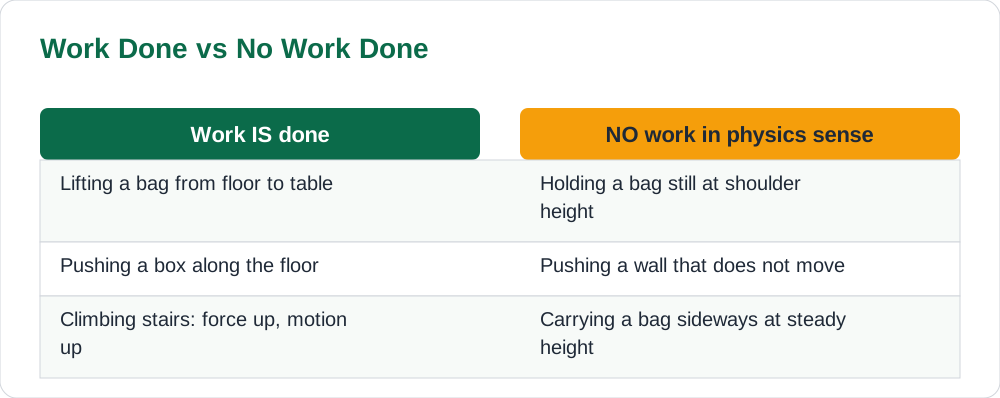
Compare three cases to fix the idea. A pupil lifting a bag from the floor to a table does work, because the force acts upward and the bag moves upward. A pupil holding the bag still on the table does no work, because there is no movement. A pupil carrying the bag horizontally at steady height does no work against gravity, because the movement is sideways while gravity pulls downward. If an exam question asks about work done by gravity, or work done by a porter, or work done by a waiter, draw the force arrow and the movement arrow, and check whether they point in the same direction. That one sketch answers the question. Solved notes and class material are listed on the solved notes page and the books page.
Energy: The Capacity to Do Work
Energy is the capacity to do work, and it is measured in joules, the same unit as work. Energy appears in many forms and changes from one form to another, but it is never created or destroyed. This is the law of conservation of energy. A moving cricket ball has kinetic energy, the energy of motion. A ball held high above the ground has gravitational potential energy, the energy of position. A stretched rubber band has elastic potential energy. Food has chemical energy, a battery stores chemical energy, and a hot cup of tea has thermal energy.
The two mechanical forms are the ones you will calculate most. Kinetic energy is KE = 1/2 mv squared, where m is mass and v is speed. A fast, heavy object has much more kinetic energy than a slow, light one, because the speed is squared: doubling the speed multiplies the kinetic energy by four. Gravitational potential energy is PE = mgh, where m is mass, g is the acceleration due to gravity, and h is height. Lifting a bag higher, or lifting a heavier bag, gives it more potential energy. When the bag falls, that potential energy changes into kinetic energy, and just before it lands, almost all of it is kinetic. Tracing these changes is the heart of energy questions.
Energy Changes in Everyday Scenes
Watch a child on a swing to see energy change in real time. At the highest point, the swing moves slowly and has maximum potential energy and minimum kinetic energy. At the lowest point, it moves fastest and has maximum kinetic energy and minimum potential energy. As the swing rises again, kinetic energy changes back into potential energy. The total energy stays the same, apart from a small amount lost to air resistance and friction as heat, which is why a swing gradually slows unless someone pushes it.
A cyclist riding down a hill shows the same pattern. At the top, the cyclist has potential energy. Rolling down, potential energy changes into kinetic energy, and the cyclist speeds up. A hydroelectric dam uses the same idea on a huge scale: water stored high behind the dam has potential energy, falling water gains kinetic energy, and turbines change that kinetic energy into electrical energy. In your own home, a torch changes chemical energy in the battery into electrical energy and then into light and heat. When you answer energy questions, name the starting form, the change, and the final form, in that order. That three-part sentence is what examiners look for.
Power: How Fast Work Is Done
Power is the rate of doing work, or the rate of transferring energy: P = W / t. Its unit is the watt (W), which is one joule per second. Two pupils can lift the same bags up the same stairs, doing the same work, but the pupil who finishes in half the time has twice the power. Power is about speed of work, not amount of work. A powerful car engine is one that can convert fuel energy into motion quickly, and a powerful bulb is one that converts electrical energy into light and heat quickly.
Everyday power ratings are a good way to practise. A 100 W bulb uses 100 joules of electrical energy every second. A 60 W bulb uses less energy per second and is dimmer. An electric motor rated 1000 W can do 1000 joules of work every second. When you see horsepower, remember that one horsepower is about 746 watts. In numerical problems, the common trap is to confuse energy and power: energy is the total amount, in joules, while power is the rate, in watts. If a question asks how much energy is used in 10 seconds, multiply power by time. If it asks for power, divide the work by the time. The solved notes page lists class material where these formulas are practised.
Climbing stairs is the best self-test. Weigh yourself in kilograms, measure the height of one flight of stairs in metres, count the steps, and time your climb. Your work is mgh, and your power is that work divided by the time. A pupil who climbs faster produces more power even though the work is the same. Try it twice, once slowly and once quickly, and the meaning of power becomes physical, not just a formula.
Solving Work, Energy and Power Problems
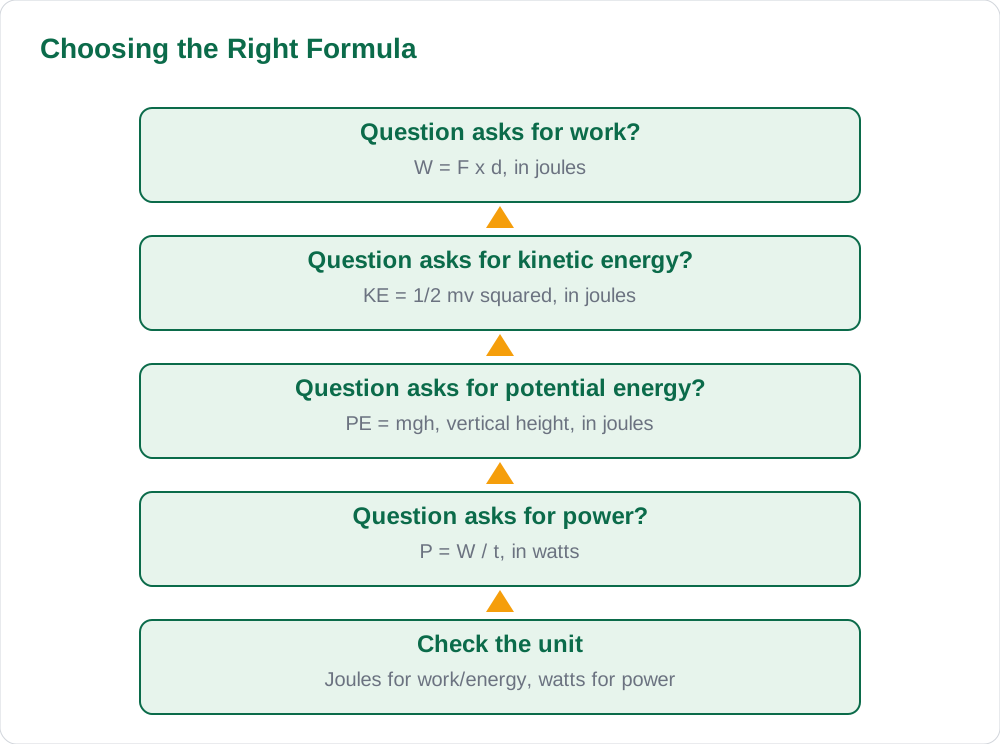
Use a fixed routine. First, identify which quantity the question asks for: work (joules), energy (joules), or power (watts). Second, write the formula in words and symbols. Third, convert units: mass to kilograms, distance to metres, time to seconds. Fourth, substitute and calculate. Fifth, check the unit of your answer: joules for work and energy, watts for power. If your power answer comes out in joules, you have divided the wrong way or forgotten the time.
Watch for three traps. Trap one: mass given in grams must be converted to kilograms before using KE or PE. Trap two: speed must be squared in kinetic energy, so a small error in speed becomes a large error in energy. Trap three: height in potential energy is the vertical height, not the length of a slope. A pupil pushed up a ramp 10 metres long but only 2 metres high gains mgh with h = 2 m, not 10 m. Drawing the height as a vertical arrow beside the slope prevents this mistake. A careful, labelled sketch is worth more than a memorised formula, as the same habit helps with diagrams and labelling.
AI Help: Muse AI
Muse AI is Meta's personal AI assistant, and it can help with this topic by checking your work, energy, and power calculations step by step, or by making practice questions from lifting, climbing, and cycling examples you know. You can ask it to explain why holding a bag still is not physics work, using your own words. Muse AI does not give official Sindh Textbook Board answers — always verify against your Sindh Textbook Board book and your teacher.
Join Muse with invite code LTGSWD — in the Muse app, go to Settings > Redeem token and enter the code.
Disclosure: LTGSWD is the author's Muse invite code.
5 key points you must know
- Work is done only when a force moves an object in the direction of the force: W = F x d, in joules.
- Holding a heavy bag still is not work in physics, because the distance moved is zero.
- Energy is the capacity to do work; it changes form but is never created or destroyed.
- Kinetic energy is 1/2 mv squared; gravitational potential energy is mgh with vertical height.
- Power is the rate of doing work: P = W / t, in watts; faster work means more power.
Frequently asked questions
Is holding a heavy bag work in physics?
No. The bag does not move, so the distance in W = F x d is zero and the work done on the bag is zero. Your muscles still use energy to maintain tension, which is why you feel tired, but physics reserves the word work for a force acting through a distance.
What is the difference between energy and power?
Energy is the total capacity to do work, measured in joules. Power is how quickly that energy is transferred or work is done, measured in watts (joules per second). The same work done in half the time means twice the power.
Why is speed squared in kinetic energy?
Because KE = 1/2 mv squared. Doubling the speed multiplies the kinetic energy by four, and tripling it multiplies the energy by nine. That is why a small increase in the speed of a vehicle makes a crash much more severe.
In PE = mgh, is h the length of the slope or the vertical height?
The vertical height only. A pupil pushed up a ramp 10 metres long but only 2 metres high gains potential energy mgh with h = 2 m. Drawing the height as a vertical arrow beside the slope prevents this common mistake.
What is one watt?
One watt is one joule of work done, or one joule of energy transferred, every second. A 100 W bulb uses 100 joules of electrical energy per second. Power in watts equals work in joules divided by time in seconds.
Solved notes — preview free
These guides work best with the solved exercises. Preview the solved notes free on this website — 119 solved notes for Classes 6–10 in Sindhi, Urdu, English and Arabic medium. Or browse the full solved notes catalogue for your class and medium. New solved notes are added regularly — check the catalogue for coming-soon books.