Class 10 Physics: Work, Energy and Power Numericals
Class 10 physics work energy power numericals test three linked ideas: work done, energy transferred, and the rate at which that transfer happens. The formulas are short, work equals force times distance, kinetic energy equals half mass times velocity squared, potential energy equals mass times gravity times height, and power equals work divided by time, but students still lose marks by mixing up the formulas, forgetting the half in kinetic energy, or using the wrong unit for time. This guide separates the three ideas clearly, works through original examples with full steps, and shows how joules and watts connect to everyday life, from lifting a school bag to running up stairs. Work in physics has a precise meaning: work is done when a force moves an object in the direction of the force, and it is measured in joules. Pushing a wall that does not move does no work in the physics sense, however tiring it feels. Energy is the capacity to do work, and it is also measured in joules, which is why work and energy share a unit and why the work-energy idea is so useful: the work done on an object equals its change in energy. Power is different again: it measures how fast the work is done, and its unit is the watt, where one watt is one joule per second.
Work: Force Times Distance
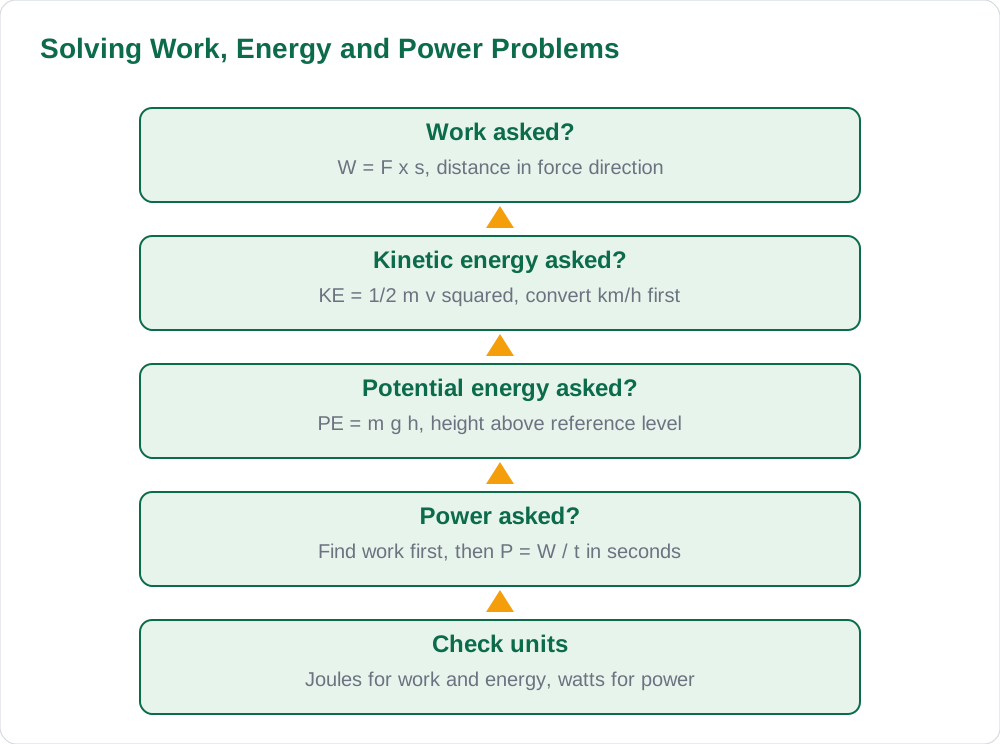
Work is calculated as W = F times s, where F is the force in newtons and s is the distance moved in the direction of the force, in metres. The unit is the joule, where one joule equals one newton times one metre. The direction condition matters: if you carry a bag horizontally while walking, the lifting force is vertical but the movement is horizontal, so that force does no work in the physics sense during the walk. Exam questions test this by giving a force at an angle or a movement perpendicular to the force, and the correct answer for that component is zero work. When the force and movement are in the same direction, as in pushing a box along the floor, the full formula applies directly.
Work can also be found from a force that is not stated directly. If a question gives mass and acceleration, first find force with F = ma, then find work with W = F times s. If it gives weight and height, as in lifting problems, the force is the weight, mass times gravity, and the distance is the height lifted. Lifting a 5 kg bag through 2 metres needs a force of about 50 N (5 times 10) and work of 50 times 2 = 100 J. Writing both stages separately keeps the method visible and earns marks at each stage, which is exactly how exam marking works.
- Work W = F x s, in joules (J).
- Distance must be in the direction of the force.
- No movement means no work, however hard you push.
- Lifting work uses weight as the force and height as the distance.
Kinetic and Potential Energy
Kinetic energy is the energy of a moving object, given by KE = half times m times v squared, where m is mass in kilograms and v is velocity in metres per second. The half is essential and is the most commonly forgotten part of this chapter: a 2 kg object moving at 4 m/s has kinetic energy of half times 2 times 16, which is 16 J, not 32 J. Because velocity is squared, doubling the speed multiplies kinetic energy by four, which is why fast vehicles need much longer stopping distances. If a question gives speed in km/h, convert to m/s first by multiplying by 5/18, or the squared term will magnify the error enormously.
Potential energy is stored energy due to position, and for height above the ground it is PE = m times g times h, where g is about 10 m/s squared and h is height in metres. A 2 kg book on a shelf 3 metres high has potential energy of 2 times 10 times 3 = 60 J relative to the floor. The reference level matters: the same book has zero potential energy relative to the shelf itself. Exam questions usually take the ground as the reference, but always check the wording. The link between work and energy is direct: lifting the book did 60 J of work against gravity, and that work is now stored as 60 J of potential energy.
Worked Example 1: Work and Energy Together
Example: A boy pushes a box with a force of 40 N over a distance of 5 m. Find the work done. Solution: W = F times s = 40 times 5 = 200 J. Example: A car of mass 1000 kg moves at 20 m/s. Find its kinetic energy. Solution: KE = half times 1000 times 20 squared = half times 1000 times 400 = 200,000 J, or 200 kJ. Note the size of the answer: moving vehicles carry large kinetic energies, which is why the kilojoule is often used. If your answer for a car came out as 200 J, you would know immediately that you had forgotten the square or the mass conversion.
Example: A 4 kg object is lifted to a height of 2.5 m. Find the work done against gravity and its potential energy at that height. Solution: weight = 4 times 10 = 40 N. Work = 40 times 2.5 = 100 J. Potential energy = m times g times h = 4 times 10 times 2.5 = 100 J. The two answers agree, as they must, because the work done lifting the object becomes its potential energy. Questions that ask for both are really asking one question twice, and recognising that saves time. For more solved study content, see the solved notes and books section.
Power: How Fast Work Is Done
Power is the rate of doing work, P = W / t, where W is work in joules and t is time in seconds. Its unit is the watt, where one watt equals one joule per second. A machine that does 1000 J of work in 10 seconds has a power of 100 W, while the same work done in 2 seconds needs 500 W. This is why power, not just energy, decides how strong an engine feels: two motors can deliver the same energy, but the one that delivers it faster has the higher power. Time must be in seconds: a time given in minutes must be multiplied by 60 before dividing, and this is the most common error in power numericals.
Example: A motor lifts 200 kg of water through 10 m in 20 s. Find its power. Solution: weight = 200 times 10 = 2000 N. Work = 2000 times 10 = 20,000 J. Power = 20,000 / 20 = 1000 W, or 1 kW. Example: A student of mass 50 kg runs up stairs 4 m high in 5 s. Find the power developed. Solution: work = 50 times 10 times 4 = 2000 J. Power = 2000 / 5 = 400 W. Notice how the same three-step pattern, weight, work, power, solves both questions. Learn the pattern, not individual answers.
Common Mistakes and Exam Tips
The most frequent mistakes are forgetting the half in kinetic energy, forgetting to square the velocity, using time in minutes instead of seconds for power, and using mass instead of weight when lifting work is asked. A second group of errors comes from unit mixing: mass in grams must be converted to kilograms, and speed in km/h to m/s, before either formula is used. A third trap is the perpendicular-force case: carrying an object horizontally does no work against gravity, and pushing a stationary wall does no work at all. Read the question for movement and direction before choosing a formula.
Write your working in stages: force or weight first, then work or energy, then power if asked. Each stage earns marks and makes errors easy to spot. End with a sense check: lifting a school bag a couple of metres is tens or hundreds of joules, a moving car is tens of thousands of joules, and a light bulb is tens of watts while a motor is hundreds or thousands. If your answer is wildly outside these ranges, recheck the conversions. The examples here are original practice problems for teaching the method. More help is on the blog and the about page.
- Never forget the half in KE = 1/2 m v squared.
- Square the velocity, and convert km/h to m/s first.
- Power needs time in seconds, not minutes.
- Lifting work uses weight (mass times gravity), not mass alone.
AI Help: Muse AI
Muse AI is Meta's personal AI assistant, and it can help you practise work, energy and power numericals by generating new lifting and motion problems, checking your joule and watt calculations step by step, and explaining why kinetic energy depends on velocity squared. Ask it to quiz you on mixed work and power problems until the three-step method feels natural. Join Muse with invite code LTGSWD — in the Muse app, go to Settings > Redeem token and enter the code. Disclosure: LTGSWD is the author's Muse invite code. Muse AI does not give official STBB answers — always verify against your STBB book and your teacher. Always verify against your Sindh Textbook Board book and your teacher before using anything in classwork.
5 key points you must know
- Work W = F x s, measured in joules; distance must be in the force direction.
- Kinetic energy KE = 1/2 m v squared; doubling speed quadruples KE.
- Potential energy PE = m g h, with height above the reference level.
- Power P = W / t, in watts; time must be in seconds.
- Lifting work equals the gain in potential energy.
Frequently asked questions
What is the difference between work and power?
Work is the energy transferred when a force moves an object, measured in joules. Power is how fast that work is done, measured in watts. The same work done in less time means higher power.
Why is there a half in the kinetic energy formula?
Kinetic energy equals half mass times velocity squared, KE = 1/2 m v squared. The half comes from the physics of accelerating an object from rest. Forgetting it doubles your answer, which is a common exam error.
Does carrying a bag horizontally do work against gravity?
No. The lifting force acts vertically while the movement is horizontal, so no work is done by that force in the direction of movement. Work needs movement in the direction of the force.
How do I convert watts to kilowatts?
Divide watts by 1000. So 1000 W is 1 kW. Large powers like motors are usually stated in kilowatts, while small devices use watts.
What value should I use for g?
Use g = 10 m/s squared unless the question gives another value. Some questions use 9.8, and then you should use 9.8 exactly as given.
Solved notes — preview free
These guides work best with the solved exercises. Preview the solved notes free on this website — 119 solved notes for Classes 6–10 in Sindhi, Urdu, English and Arabic medium. Or browse the full solved notes catalogue for your class and medium. New solved notes are added regularly — check the catalogue for coming-soon books.