Class 10 Physics: Waves, Frequency and Wavelength
Class 10 physics waves frequency numericals all rest on one wave equation: wave speed equals frequency times wavelength, written v = f times lambda. Frequency tells you how many waves pass a point per second, wavelength is the distance between two matching points on neighbouring waves, and wave speed is how fast the wave pattern travels. Students lose marks mainly by confusing frequency with time period, by using wavelength in centimetres instead of metres, and by mixing up wave speed with the speed of the vibrating source. This guide separates the three quantities clearly, works through sound and water wave examples, and gives you a routine that works for every question type. A wave transfers energy without transferring matter: water particles in a ripple bob up and down while the ripple pattern moves outward, and air particles in a sound wave vibrate back and forth while the sound travels forward. Frequency is measured in hertz, where one hertz is one wave per second. Time period is the time for one complete wave, measured in seconds, and it is the reciprocal of frequency: T = 1 / f. Wavelength is measured in metres. Wave speed in metres per second follows from these definitions: in one second, f waves pass, each of length lambda, so the pattern advances f times lambda metres, giving v = f times lambda.
Frequency, Time Period and Wavelength
Frequency, f, is the number of complete waves produced per second, measured in hertz (Hz). A source vibrating 50 times per second produces waves of frequency 50 Hz. Time period, T, is the time taken for one complete wave, measured in seconds, and the two are linked by f = 1 / T and T = 1 / f. So a frequency of 50 Hz means a time period of 1 / 50 = 0.02 s. Exam questions often give the time period and ask for frequency, or give the number of vibrations in a given time: if a source makes 200 vibrations in 4 seconds, the frequency is 200 / 4 = 50 Hz. Always convert the vibration count into a per-second rate before using the wave equation.
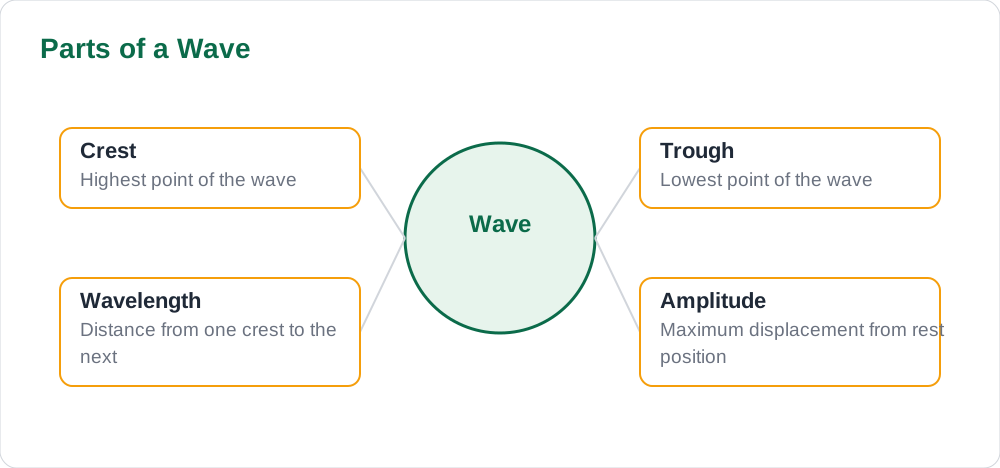
Wavelength, lambda, is the distance between two adjacent crests, two adjacent troughs, or any two matching points on neighbouring waves. It is a length, so it must be in metres for the wave equation: a wavelength given as 25 cm is 0.25 m. Amplitude is different again: it is the maximum displacement of a particle from its rest position, and it controls loudness for sound or brightness for light, not wave speed. Questions that mention amplitude are usually testing whether you know it does not enter v = f times lambda at all, so do not force it into the calculation.
- Frequency f in hertz: waves per second.
- Time period T = 1 / f, in seconds.
- Wavelength lambda in metres: crest to crest distance.
- Amplitude affects loudness, not wave speed.
The Wave Equation: v = f Times Lambda
The wave equation, v = f times lambda, links all three quantities, and it rearranges into f = v / lambda and lambda = v / f. Practise all three forms so you can answer whichever quantity is missing. Units must match: speed in m/s, frequency in Hz (which is per second), and wavelength in metres. A quick unit check confirms the equation: hertz times metres gives (1/s) times m, which is m/s, exactly the unit of speed. If your units do not combine to m/s, something is wrong before you even calculate.
Wave speed depends on the medium, not on frequency or wavelength alone. Sound travels at about 340 m/s in air but about 1500 m/s in water, so the same frequency has a much longer wavelength in water. In exam questions, wave speed is usually given or is a known value like the speed of sound in air, and you use it to find the missing quantity. When a wave moves from one medium to another, its frequency stays the same because it is set by the source, while its speed and wavelength change together. That fact answers many theory questions and prevents a common error: never change the frequency when a wave changes medium.
Worked Example 1: Sound Wave Numericals
Example: A sound wave of frequency 500 Hz travels at 340 m/s in air. Find its wavelength. Solution: lambda = v / f = 340 / 500 = 0.68 m. Example: A tuning fork vibrates at 256 Hz and produces waves of wavelength 1.33 m. Find the speed of sound. Solution: v = f times lambda = 256 times 1.33 = 340.5 m/s, approximately the known speed of sound in air, which confirms the calculation. Notice how the known speed of sound acts as a built-in sense check for sound questions: answers near 340 m/s in air are plausible, while answers like 34 m/s or 3400 m/s signal a unit error.
Example: A source makes 120 vibrations in 3 seconds and produces waves of wavelength 2 m. Find the wave speed. Solution: frequency = 120 / 3 = 40 Hz. Speed = 40 times 2 = 80 m/s. This two-stage pattern, frequency first, then speed, is very common. Students who multiply 120 directly by 2 get 240, which is wrong because 120 is a count, not a frequency. Always convert counts to per-second rates first. For more solved study material, see the solved notes and the books section.
Worked Example 2: Water Waves and Time Period
Example: Water waves have a wavelength of 0.5 m and a time period of 0.25 s. Find their frequency and speed. Solution: frequency = 1 / T = 1 / 0.25 = 4 Hz. Speed = 4 times 0.5 = 2 m/s. Example: A wave has a speed of 12 m/s and a frequency of 6 Hz. Find its wavelength and time period. Solution: wavelength = 12 / 6 = 2 m. Time period = 1 / 6 = 0.167 s. Working through both parts shows how the three formulas connect: frequency and time period are reciprocals, and the wave equation links them to speed and wavelength.
Example: A boy counts 20 water waves passing a point in 10 seconds. The distance between two adjacent crests is 40 cm. Find the wave speed. Solution: frequency = 20 / 10 = 2 Hz. Wavelength = 40 cm = 0.4 m. Speed = 2 times 0.4 = 0.8 m/s. This question combines all three traps: count to frequency, centimetres to metres, and then the wave equation. Questions that combine traps are exactly where a written routine pays off: convert first, then substitute, then calculate.
Common Mistakes and Exam Tips
The most common mistakes are using time period instead of frequency in the wave equation, using wavelength in centimetres, and using a vibration count as if it were frequency. A fourth mistake is changing frequency when a wave enters a new medium: frequency is set by the source and stays constant, while speed and wavelength change. A fifth is confusing wave speed with particle speed: particles vibrate in place, while the wave pattern travels at v. Exam theory questions often test exactly this distinction, so state it clearly in words when asked.
Follow this routine: list f, T, lambda, and v with units, convert counts to frequency and centimetres to metres, pick the rearrangement for the missing quantity, substitute, and sense-check. For sound in air, expect speeds near 340 m/s; for water ripples in a tank, expect speeds well under 1 m/s. The examples here are original practice problems for teaching the method. More guidance is on the blog and the about page.
- Convert vibration counts to frequency per second first.
- Convert wavelength to metres before using v = f times lambda.
- Frequency stays constant when a wave changes medium.
- Do not confuse wave speed with particle vibration speed.
AI Help: Muse AI
Muse AI is Meta's personal AI assistant, and it can help you practise wave numericals by generating fresh sound and water wave problems, checking your frequency and wavelength conversions, and explaining the wave equation with everyday examples like ripples and echoes. Ask it to quiz you on all three rearrangements of v = f times lambda. Join Muse with invite code LTGSWD — in the Muse app, go to Settings > Redeem token and enter the code. Disclosure: LTGSWD is the author's Muse invite code. Muse AI does not give official STBB answers — always verify against your STBB book and your teacher. Always verify against your Sindh Textbook Board book and your teacher before using anything in classwork.
5 key points you must know
- Wave equation: v = f times lambda, with m/s, Hz, and metres.
- Frequency f = 1 / T; time period T = 1 / f.
- Convert vibration counts to per-second frequency before calculating.
- Wavelength must be in metres; convert centimetres by dividing by 100.
- Frequency stays constant when a wave changes medium.
Frequently asked questions
What is the difference between frequency and time period?
Frequency is the number of waves per second, measured in hertz. Time period is the time for one complete wave, measured in seconds. They are reciprocals: f = 1 / T.
How do I find frequency from a vibration count?
Divide the number of vibrations by the time in seconds. For example, 200 vibrations in 4 seconds gives 200 / 4 = 50 Hz.
Does wave speed change when frequency changes?
In the same medium, wave speed stays constant, so changing frequency changes wavelength instead. Speed changes only when the medium changes, and then frequency stays constant while wavelength changes.
What is wavelength, exactly?
Wavelength is the distance between two matching points on neighbouring waves, such as crest to crest or trough to trough, measured in metres.
Why does sound travel faster in water than in air?
Wave speed depends on the medium. Particles in water transmit vibrations more efficiently than air particles, so sound travels at about 1500 m/s in water compared with about 340 m/s in air.
Solved notes — preview free
These guides work best with the solved exercises. Preview the solved notes free on this website — 119 solved notes for Classes 6–10 in Sindhi, Urdu, English and Arabic medium. Or browse the full solved notes catalogue for your class and medium. New solved notes are added regularly — check the catalogue for coming-soon books.