Class 10 Physics: Speed and Velocity Numericals
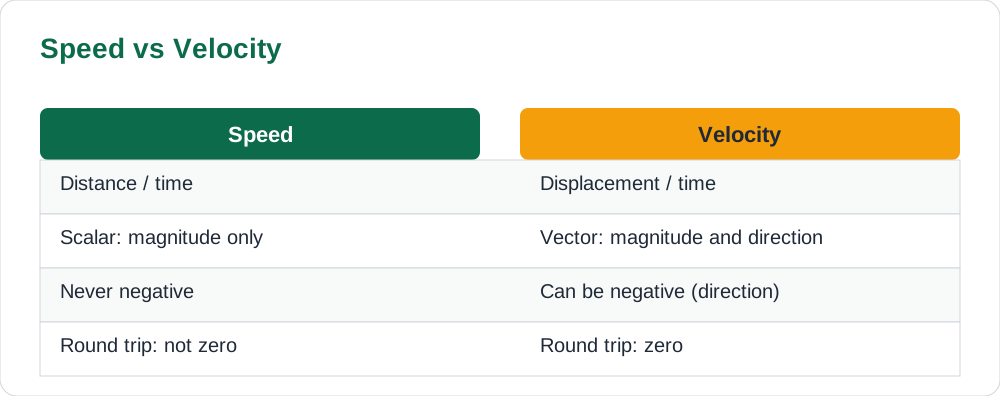
Class 10 physics speed velocity numericals appear in almost every test on motion, and they are also some of the easiest marks available if you handle the basics correctly. Most students lose marks not because the physics is hard, but because they mix up distance with displacement, forget to convert minutes to seconds or kilometres per hour to metres per second, or write an answer without a unit. This guide fixes all three problems with a clear method and original worked examples you can practise on your own. The keyword for this chapter is simple: write the formula, substitute with units, and only then calculate. Speed is a scalar quantity, which means it has magnitude but no direction, while velocity is a vector quantity, which means it has both magnitude and direction. A car travelling at 60 kilometres per hour has a speed of 60 kilometres per hour, but its velocity is 60 kilometres per hour east only if you also state the direction. In numerical problems, speed equals total distance divided by total time, and velocity equals displacement divided by time. Displacement is the straight-line distance from the starting point to the finishing point, together with its direction, so a runner who returns to the starting point has zero displacement and therefore zero average velocity, even though the speed was not zero. Keep that distinction in front of you for every question, and half the chapter becomes straightforward.
Speed, Velocity and Their Formulas
Speed is defined as the distance travelled per unit time, and its formula is speed equals distance divided by time, written as v = s / t. The SI unit of speed is metres per second, written m/s, although kilometres per hour is common in everyday life and in many textbook questions. Average speed is total distance divided by total time, which is not the same as the average of two speeds unless the times are equal. For example, a cyclist who covers 30 kilometres in one hour and then 30 kilometres in two hours has an average speed of 60 kilometres divided by 3 hours, which is 20 kilometres per hour, not the simple average of 30 and 15. Always add up the distances and add up the times separately before dividing.
Velocity is displacement divided by time, so its formula looks the same, v = d / t, but d now means displacement rather than distance. Because displacement can be negative in a chosen direction, velocity can also be negative, and that sign simply tells you the direction of motion. A car moving backwards at 5 m/s has a velocity of negative 5 m/s if forward is taken as positive. In most Class 10 numericals the motion is in a straight line in one direction, so speed and velocity have the same numerical value and the difference only matters when direction changes or when the object returns towards its start. Read every question twice and underline whether it asks for distance or displacement before you begin.
- Speed = distance / time; velocity = displacement / time.
- SI unit for both: metres per second (m/s).
- Speed is scalar; velocity is a vector with direction.
- Average speed = total distance / total time, never just the average of speeds.
Unit Conversions You Must Get Right
Unit conversion is where most numerical marks are lost, so learn two conversions by heart. To convert kilometres per hour to metres per second, multiply by 5/18, and to convert metres per second to kilometres per hour, multiply by 18/5. So 72 km/h becomes 72 times 5/18, which is 20 m/s, and 15 m/s becomes 15 times 18/5, which is 54 km/h. Time conversions matter just as much: one hour is 3600 seconds, one minute is 60 seconds, and a time given as 2 hours 30 minutes is 2.5 hours or 9000 seconds. Always convert every quantity to one consistent set of units before substituting into a formula, and state the conversion step in your answer so the examiner can follow your working.
A second common trap is mixing units inside one formula, for example dividing kilometres by seconds. If distance is in kilometres and time is in minutes, either convert distance to metres and time to seconds, or convert time to hours and keep distance in kilometres. Both routes are correct, but the SI route is safer because the answer then comes out in m/s, which is what most marking schemes expect. Check your final answer for sense: a walking person moves at about 1 to 2 m/s, a bicycle at about 5 m/s, and a car on a highway at about 20 to 30 m/s. If your answer says a cyclist travels at 200 m/s, you have made a conversion error and should go back and find it.
Worked Example 1: Speed and Average Speed
Example: A bus travels 120 km in 2 hours and then 60 km in 1 hour. Find its average speed in km/h and in m/s. Solution: total distance = 120 + 60 = 180 km. Total time = 2 + 1 = 3 hours. Average speed = 180 / 3 = 60 km/h. To convert to m/s, multiply by 5/18: 60 times 5/18 = 300/18 = 16.7 m/s. Notice that we did not average 60 km/h and 60 km/h from the two parts separately by accident here, but the method of totals works in every case, even when the two part-speeds differ. Writing the totals as their own step makes your working clear and earns method marks even if a later arithmetic slip occurs.
Example: A student walks 400 m to school in 5 minutes. Find the speed in m/s. Solution: time = 5 minutes = 5 times 60 = 300 s. Speed = 400 / 300 = 1.33 m/s. This is a sensible walking speed, which confirms the conversion was done correctly. If you had forgotten to convert minutes to seconds and divided 400 by 5, you would have obtained 80, a meaningless answer with no correct unit. The habit of converting time first, before touching the formula, prevents this entire class of error. For more solved study material, browse the solved notes and the books section on this site.
Worked Example 2: Velocity and Displacement
Example: A boy runs 100 m east in 20 s, then runs 60 m west in 10 s. Find his average speed and his average velocity. Solution: total distance = 100 + 60 = 160 m. Total time = 20 + 10 = 30 s. Average speed = 160 / 30 = 5.33 m/s. Displacement: taking east as positive, displacement = 100 + (negative 60) = 40 m east. Average velocity = 40 / 30 = 1.33 m/s east. The two answers are very different, and the difference is the whole point of the question: distance adds up, displacement partly cancels. Examiners love this pattern, so practise it until the distinction is automatic.
Example: A car travels around a circular track and returns to its starting point after 60 s, covering 600 m. Its average speed is 600 / 60 = 10 m/s, but its displacement is zero because start and finish are the same point, so its average velocity is 0 m/s. Students often find this result surprising, but it follows directly from the definitions. Whenever a question mentions a round trip or a return to the start, expect the displacement or average velocity to be zero or much smaller than the distance-based answer. Underline the words distance and displacement in the question so you never confuse them under exam pressure.
Common Mistakes and Exam Tips
The most common mistake is writing an answer without a unit, which can cost the final mark even when the number is correct. Always write the unit, and check that it matches the quantities you used: metres and seconds give m/s, kilometres and hours give km/h. The second mistake is using the wrong time: average speed needs total time, including any rest time mentioned in the question, unless the question explicitly says to exclude it. If a bus stops for 30 minutes during a journey, that half hour belongs in the total time for average speed. The third mistake is rounding too early: keep two or three decimal places through the working and round only the final answer.
Build a short routine for every numerical: read the question and list the given quantities with units, convert units to a consistent set, write the formula in symbols, substitute the numbers with units, calculate, and finish with the answer plus unit and a quick sense check. Practise this routine on ten mixed problems and it becomes automatic, which is exactly what you need when exam time is short. Worked examples in this guide are original practice problems designed to teach the method; they are not copied from any textbook exercise. For more study help across subjects, visit the blog and read the about page to see what this site offers.
- Always write the unit with the final answer.
- Include rest time in total time for average speed.
- Convert all units before substituting into the formula.
- Do a sense check: walking about 1-2 m/s, cycling about 5 m/s.
AI Help: Muse AI
Muse AI is Meta's personal AI assistant, and it can help you practise speed and velocity numericals by generating fresh problems, checking your unit conversions step by step, and explaining the difference between distance and displacement in simple words. Try asking it to make five new problems with mixed units and then compare its solutions with your own working. Join Muse with invite code LTGSWD — in the Muse app, go to Settings > Redeem token and enter the code. Disclosure: LTGSWD is the author's Muse invite code. Muse AI does not give official STBB answers — always verify against your STBB book and your teacher. Always verify against your Sindh Textbook Board book and your teacher before using anything in classwork.
5 key points you must know
- Speed = distance / time; velocity = displacement / time.
- Convert km/h to m/s by multiplying by 5/18, and m/s to km/h by 18/5.
- Average speed uses total distance divided by total time.
- A round trip has zero displacement and therefore zero average velocity.
- Always write the unit and do a sense check on your final answer.
Frequently asked questions
What is the difference between speed and velocity?
Speed is distance divided by time and has no direction, while velocity is displacement divided by time and includes direction. For motion in one straight direction they have the same value, but when direction changes or the object returns to its start, they differ.
How do I convert 72 km/h to m/s?
Multiply by 5/18. So 72 times 5/18 equals 20 m/s. The reverse conversion, m/s to km/h, uses 18/5: 20 m/s times 18/5 equals 72 km/h.
Why is average speed not the average of two speeds?
Because average speed is total distance divided by total time. Averaging two speeds only works if the time spent at each speed is equal. When the times differ, you must add the distances and add the times separately, then divide.
Can velocity be zero while speed is not zero?
Yes. If an object returns to its starting point, its displacement is zero, so its average velocity is zero, even though it travelled a real distance and its average speed is not zero.
What unit should I use for time in speed numericals?
Use seconds with metres to get m/s, or hours with kilometres to get km/h. Convert minutes and mixed times (like 2 hours 30 minutes) before substituting into the formula.
Solved notes — preview free
These guides work best with the solved exercises. Preview the solved notes free on this website — 119 solved notes for Classes 6–10 in Sindhi, Urdu, English and Arabic medium. Or browse the full solved notes catalogue for your class and medium. New solved notes are added regularly — check the catalogue for coming-soon books.