Class 10 Physics: Series and Parallel Circuit Numericals

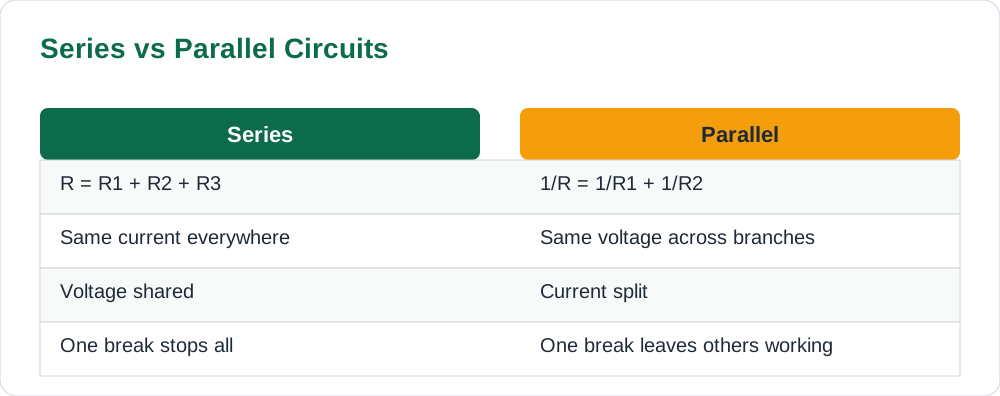
Class 10 physics series parallel circuits numericals test whether you can tell the two combinations apart and apply the right rule for equivalent resistance. In series, resistances add directly. In parallel, reciprocals add, and the equivalent resistance is always smaller than the smallest individual resistor. Students lose marks mainly by using the series rule for a parallel circuit, by forgetting to invert the final reciprocal, and by mixing up how current and voltage behave in each combination. This guide teaches both combinations side by side with original worked examples, so the contrast itself becomes your memory aid. In a series circuit there is only one path for current, so the same current flows through every component, while the voltage is shared between components. In a parallel circuit there are branches, so the voltage across every branch is the same, while the current splits between branches. These two sentences are the key to almost every question: series means same current, shared voltage; parallel means same voltage, shared current. Household wiring uses parallel circuits precisely because every appliance then gets the full supply voltage, while old-style decorative lights in series dimmed or failed together because one break stopped the whole loop.
Series Circuits: Add the Resistances
For resistors in series, the equivalent resistance is the sum: R = R1 + R2 + R3, and so on. The current is the same through every resistor, and the total voltage divides in proportion to resistance: the larger resistor gets the larger share of voltage. Example: resistors of 2 ohms, 3 ohms, and 5 ohms in series have an equivalent resistance of 10 ohms. Connected to a 20 V battery, the current is 20 / 10 = 2 A through every resistor. The voltages are 2 times 2 = 4 V, 2 times 3 = 6 V, and 2 times 5 = 10 V, which add up to 20 V, confirming the calculation. Checking that branch voltages add to the battery voltage is a powerful verification step for series questions.
Series circuits have a practical weakness: if one component breaks, the whole circuit stops, because there is only one path. That is why series wiring is avoided for household lights but used where a single current through every component is wanted, such as in some decorative strings and in simple experimental circuits. In exam questions, a diagram with one loop and no branches is series, even if the components are drawn in different positions around the loop. Trace the path: if the current has no choice of route, it is series.
- Series: R = R1 + R2 + R3.
- Same current through every resistor.
- Voltage shared in proportion to resistance.
- One break stops the whole circuit.
Parallel Circuits: Add the Reciprocals
For resistors in parallel, the rule is 1/R = 1/R1 + 1/R2 + 1/R3. The voltage across every branch is the same, and the total current splits between branches in inverse proportion to resistance: the smaller resistor carries the larger current. Example: resistors of 6 ohms and 3 ohms in parallel have 1/R = 1/6 + 1/3 = 1/6 + 2/6 = 3/6 = 1/2, so R = 2 ohms. Notice that the equivalent resistance, 2 ohms, is smaller than both 6 and 3. This is always true for parallel combinations and is your best sense check: if your parallel answer is larger than the smallest resistor, you have made an error.
For two resistors only, a shortcut exists: R = (R1 times R2) / (R1 + R2). For 6 ohms and 3 ohms, that gives 18 / 9 = 2 ohms, matching the reciprocal method. The shortcut works only for two resistors, so do not use it for three or more. The final and most common error is forgetting the last step: after finding 1/R, you must invert it to get R. A student who stops at 1/R = 1/2 and writes 0.5 ohms has the reciprocal of the right answer. Circle the inversion step in your working until it is automatic.
Worked Example 1: Series Numericals
Example: Resistors of 4 ohms and 6 ohms are connected in series to a 20 V battery. Find the total resistance, the current, and the voltage across each resistor. Solution: total resistance = 4 + 6 = 10 ohms. Current = 20 / 10 = 2 A, the same through both resistors. Voltage across 4 ohms = 2 times 4 = 8 V. Voltage across 6 ohms = 2 times 6 = 12 V. Check: 8 + 12 = 20 V, the battery voltage, so the answer is consistent. Writing the check line takes seconds and confirms all three answers at once.
Example: Three resistors, 2 ohms, 2 ohms, and 2 ohms, are connected in series to a 12 V battery. Find the current. Solution: total resistance = 6 ohms. Current = 12 / 6 = 2 A. Equal resistors share the voltage equally, so each gets 4 V. Equal-resistor questions are quick if you spot the pattern, but still write the total-resistance step, because examiners award marks for method even on short questions. For more solved material, see the solved notes and the books section.
Worked Example 2: Parallel Numericals
Example: Resistors of 4 ohms and 4 ohms are connected in parallel to a 12 V battery. Find the equivalent resistance and the total current. Solution: 1/R = 1/4 + 1/4 = 2/4 = 1/2, so R = 2 ohms. Total current = 12 / 2 = 6 A. Each branch carries 12 / 4 = 3 A, and 3 + 3 = 6 A, confirming the total. Equal resistors in parallel halve the resistance, which is a useful pattern to recognise: two equal resistors in parallel give half of one resistor's value.
Example: Resistors of 10 ohms and 15 ohms are connected in parallel. Find the equivalent resistance. Solution: 1/R = 1/10 + 1/15 = 3/30 + 2/30 = 5/30 = 1/6, so R = 6 ohms. The answer is smaller than 10, as it must be. A common alternative is the product-over-sum shortcut for two resistors: (10 times 15) / (10 + 15) = 150 / 25 = 6 ohms. Both methods agree, so use whichever you find more reliable, but always finish with the sense check that the result is smaller than the smallest resistor.
Common Mistakes and Exam Tips
The most damaging mistakes are applying the series rule to a parallel circuit, forgetting to invert the final reciprocal, and using the battery voltage as the voltage across one resistor in a series circuit. A fourth mistake is misreading the diagram: resistors drawn side by side are not automatically parallel, and resistors drawn in a line are not automatically series. What matters is the wiring: branches mean parallel, a single path means series. Trace the current path with your finger on the diagram before choosing a rule, and label each branch or loop as you go.
For combined circuits, where some resistors are in series and some in parallel, work in stages: first reduce each parallel group to its equivalent resistance, then add the series parts. Write each reduction as its own line with a small diagram note, such as parallel pair equals 2 ohms, so the examiner can follow the stages. The examples here are original practice problems for teaching the method. More guidance is on the blog and the about page.
- Trace the current path before choosing series or parallel.
- Parallel: invert the final reciprocal to get R.
- Parallel equivalent resistance is always smaller than the smallest resistor.
- Reduce parallel groups first in combined circuits.
AI Help: Muse AI
Muse AI is Meta's personal AI assistant, and it can help you master series and parallel circuits by generating mixed combination problems, checking your equivalent resistance calculations, and explaining current and voltage sharing with simple diagrams described in words. Ask it to quiz you on telling series from parallel diagrams until the distinction is instant. Join Muse with invite code LTGSWD — in the Muse app, go to Settings > Redeem token and enter the code. Disclosure: LTGSWD is the author's Muse invite code. Muse AI does not give official STBB answers — always verify against your STBB book and your teacher. Always verify against your Sindh Textbook Board book and your teacher before using anything in classwork.
5 key points you must know
- Series: R = R1 + R2 + R3; same current, shared voltage.
- Parallel: 1/R = 1/R1 + 1/R2; same voltage, split current.
- Parallel equivalent resistance is always smaller than the smallest resistor.
- For two resistors in parallel, R = (R1 x R2) / (R1 + R2).
- Always invert the final reciprocal in parallel calculations.
Frequently asked questions
How do I know if resistors are in series or parallel?
Trace the current path. If there is only one path through all resistors, they are in series. If the current splits into branches that rejoin, the resistors on different branches are in parallel.
Why is parallel resistance smaller than each resistor?
Parallel branches give current extra paths, so more total current flows for the same voltage. By Ohm's law, more current at the same voltage means lower equivalent resistance.
What is the shortcut for two resistors in parallel?
R = (R1 times R2) / (R1 + R2). It works only for two resistors. For three or more, use the reciprocal rule 1/R = 1/R1 + 1/R2 + 1/R3.
Why are household appliances wired in parallel?
In parallel, every appliance gets the full supply voltage, and switching one off does not affect the others. In series, voltage would be shared and one failure would stop everything.
In series, does the larger resistor get more voltage?
Yes. Voltage divides in proportion to resistance, so V = IR with the same current gives a larger voltage across the larger resistor. The branch voltages add up to the battery voltage.
Solved notes — preview free
These guides work best with the solved exercises. Preview the solved notes free on this website — 119 solved notes for Classes 6–10 in Sindhi, Urdu, English and Arabic medium. Or browse the full solved notes catalogue for your class and medium. New solved notes are added regularly — check the catalogue for coming-soon books.