Class 10 Physics: Pressure Numericals

Class 10 physics pressure numericals are built on one short formula, pressure equals force divided by area, P = F / A, but they test whether you can apply it to very different situations: a person standing on one foot, a sharp knife, a dam wall, or a diver under water. The unit of pressure is the pascal, where one pascal is one newton per square metre, and the most common student errors are using area in square centimetres instead of square metres, and confusing pressure with force itself. This guide teaches the formula, the unit conversions, liquid pressure, and original worked examples for both solids and liquids. Pressure tells you how concentrated a force is. The same force spread over a large area gives low pressure, which is why tractors have wide tyres and why lying on a bed of nails does not hurt: the force is shared across many points. The same force concentrated on a tiny area gives high pressure, which is why a sharp knife cuts and a nail pierces. Whenever a question asks why something is wide, flat, sharp, or pointed, the answer almost always involves pressure, and the numerical part is simply P = F / A with careful units.
Pressure in Solids: P = F / A
Pressure is force per unit area: P = F / A, where F is force in newtons and A is area in square metres. The SI unit is the pascal (Pa), where 1 Pa = 1 N/m squared. Force here is usually weight, mass times gravity, when an object rests on a surface. A 60 kg person standing on both feet exerts a force of about 600 N on the ground. If the total contact area of both shoes is 0.03 m squared, the pressure is 600 / 0.03 = 20,000 Pa, or 20 kPa. Standing on one foot halves the area and doubles the pressure to 40,000 Pa, which is why balancing on one foot on soft ground sinks deeper.
Area conversion is the critical skill. One square metre equals 10,000 square centimetres, so an area given as 50 cm squared must be divided by 10,000 to give 0.005 m squared. Students who divide by 100 instead, confusing length conversion with area conversion, get answers 100 times wrong. If the area is given as length times width, for example a rectangular block 0.2 m by 0.1 m, multiply first to get 0.02 m squared, then divide the force by it. Always convert area to square metres before using the formula, and write the conversion as its own step.
- P = F / A, in pascals (Pa = N/m squared).
- Force on a surface is usually weight: mass times gravity.
- Convert cm squared to m squared by dividing by 10,000.
- Smaller area means larger pressure for the same force.
Liquid Pressure: Depth Matters, Not Volume
Pressure in a liquid at a depth h is given by P = rho times g times h, where rho is the density of the liquid in kg/m cubed, g is about 10 m/s squared, and h is depth in metres. This pressure acts in all directions and increases with depth, which is why dams are thicker at the bottom and why divers feel more pressure deeper down. A surprising result students must remember is that liquid pressure depends on depth and density only, not on the shape of the container or the total volume of liquid. Two containers with the same depth but different shapes have the same pressure at the bottom.
Total pressure at a depth under water is the liquid pressure plus atmospheric pressure acting on the surface, but many Class 10 questions ask only for the pressure due to the liquid, so read the wording carefully. If the question says pressure due to water at a depth, use rho times g times h alone. If it says total pressure, add atmospheric pressure, about 100,000 Pa. Density of water is 1000 kg/m cubed, which makes water calculations tidy: at 10 m depth, water pressure is 1000 times 10 times 10 = 100,000 Pa, exactly one atmosphere. That tidy result is a useful memory anchor.
Worked Example 1: Pressure Under a Block and a Person
Example: A block of mass 20 kg rests on a face of area 0.1 m squared. Find the pressure it exerts. Solution: force = 20 times 10 = 200 N. Pressure = 200 / 0.1 = 2000 Pa. If the block is turned onto a smaller face of area 0.05 m squared, the pressure becomes 200 / 0.05 = 4000 Pa. The force did not change, but the pressure doubled because the area halved. This is the classic exam pattern: same object, different face, compare the pressures. Always state which face you used, and show the area for each case.
Example: A girl of mass 50 kg stands on one heel of area 1 cm squared. Find the pressure. Solution: force = 50 times 10 = 500 N. Area = 1 cm squared = 1 / 10,000 = 0.0001 m squared. Pressure = 500 / 0.0001 = 5,000,000 Pa, or 5 MPa. This huge pressure explains why a heel dents soft floors. The area conversion is the whole question: a student who uses 1 cm squared as 0.01 m squared gets 50,000 Pa, which is 100 times too small. For more solved material, visit the solved notes and the books section.
Worked Example 2: Liquid Pressure Problems
Example: Find the water pressure at a depth of 5 m. Solution: P = rho times g times h = 1000 times 10 times 5 = 50,000 Pa. Example: A tank holds oil of density 800 kg/m cubed to a depth of 2 m. Find the pressure at the bottom due to the oil. Solution: P = 800 times 10 times 2 = 16,000 Pa. Notice that the oil gives lower pressure than water at the same depth because its density is lower. Density is the only liquid property in the formula, so questions often give two liquids at the same depth and ask which gives higher pressure: the denser liquid always wins.
Example: A diver experiences water pressure of 200,000 Pa. How deep is the diver? Solution: rearrange to h = P / (rho times g) = 200,000 / (1000 times 10) = 20 m. Rearranging the liquid pressure formula is a common question type, so practise all three forms: P = rho g h, h = P / (rho g), and rho = P / (g h). As always, check units: density in kg/m cubed, depth in metres, pressure in pascals. A depth answer in metres for a diver should be a sensible number, not thousands of metres.
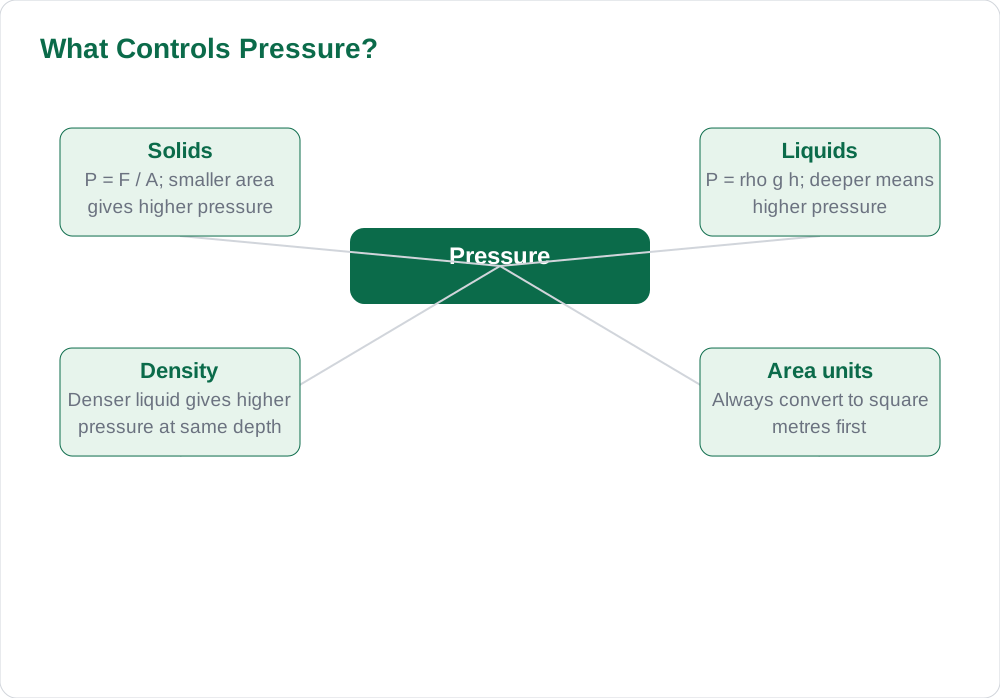
Common Mistakes and Exam Tips
The biggest mistakes are using area in cm squared without converting, confusing pressure with force by forgetting to divide by area, and using mass instead of weight for the force. A second trap is liquid pressure questions that give the volume of the container or its shape: both are irrelevant, and only depth and density matter. A third trap is forgetting atmospheric pressure when total pressure is asked, or adding it when only liquid pressure is asked. Underline the words due to and total in the question to decide which one is wanted.
Follow a fixed routine: decide whether the question is about a solid or a liquid, pick the matching formula, convert area or depth to SI units, substitute, and finish with pascals. For comparison questions, calculate both pressures and state which is larger and why. The examples in this guide are original practice problems for teaching the method. More study guidance is available on the blog and the about page.
- Convert cm squared to m squared by dividing by 10,000.
- Force on a surface is usually weight, not mass.
- Liquid pressure depends on depth and density, not container shape.
- Check whether total pressure or liquid pressure alone is asked.
AI Help: Muse AI
Muse AI is Meta's personal AI assistant, and it can help you practise pressure numericals by generating solid and liquid pressure problems, checking your area conversions, and explaining why sharp objects exert high pressure with everyday examples. Ask it to quiz you on both P = F / A and P = rho g h until you can pick the right formula instantly. Join Muse with invite code LTGSWD — in the Muse app, go to Settings > Redeem token and enter the code. Disclosure: LTGSWD is the author's Muse invite code. Muse AI does not give official STBB answers — always verify against your STBB book and your teacher. Always verify against your Sindh Textbook Board book and your teacher before using anything in classwork.
5 key points you must know
- Pressure P = F / A, measured in pascals (N/m squared).
- Smaller contact area gives larger pressure for the same force.
- Convert cm squared to m squared by dividing by 10,000.
- Liquid pressure P = rho g h depends on depth and density only.
- Total pressure includes atmospheric pressure; liquid pressure alone does not.
Frequently asked questions
Why does a sharp knife cut better than a blunt one?
A sharp knife has a much smaller contact area, so the same force produces much higher pressure, which cuts through material more easily. Pressure is force divided by area.
How do I convert 50 cm squared to m squared?
Divide by 10,000, because 1 m squared equals 10,000 cm squared. So 50 cm squared is 0.005 m squared. Dividing by 100 is a common error: that converts length, not area.
Does the shape of a container affect liquid pressure?
No. Liquid pressure at a depth depends only on the liquid density and the depth, not on the container shape or the total volume. Two containers with the same depth have the same bottom pressure.
Why are dams thicker at the bottom?
Water pressure increases with depth, so the bottom of a dam faces much higher pressure than the top. The extra thickness at the bottom withstands that higher pressure.
What is the difference between pressure and force?
Force is a push measured in newtons. Pressure is force per unit area, measured in pascals. The same force can give very different pressures depending on the area it acts on.
Solved notes — preview free
These guides work best with the solved exercises. Preview the solved notes free on this website — 119 solved notes for Classes 6–10 in Sindhi, Urdu, English and Arabic medium. Or browse the full solved notes catalogue for your class and medium. New solved notes are added regularly — check the catalogue for coming-soon books.