Class 10 Physics: Ohm's Law Electricity Numericals

Class 10 physics ohm law electricity numericals all come from one relationship: voltage equals current times resistance, V = IR. If you can rearrange this formula confidently and keep current in amperes, voltage in volts, and resistance in ohms, you can solve the majority of electricity questions in this chapter. The traps are unit conversions, especially milliamperes to amperes and kilo-ohms to ohms, and questions that give two quantities in a different order than you expect. This guide teaches a fixed method with original worked examples and explains how to read simple circuit diagrams so you know what each question is really asking. Ohm's law states that the current through a conductor is directly proportional to the voltage across it, provided the temperature stays constant. In practical terms, doubling the voltage across a fixed resistor doubles the current, and doubling the resistance halves the current for a fixed voltage. Resistance is the opposition to current flow, measured in ohms, and it depends on the material, length, and thickness of the conductor. A long thin wire has more resistance than a short thick wire of the same material, which is why household wiring uses thick copper and why heating elements use thin high-resistance wire.
Ohm's Law and Its Three Forms
Ohm's law is V = IR, where V is potential difference in volts, I is current in amperes, and R is resistance in ohms. Rearranged, it gives I = V / R when current is unknown, and R = V / I when resistance is unknown. Practise all three forms until rearranging is instant, because exam questions rotate which quantity is missing. A quick check after every answer is to substitute back: if you found R = 10 ohms from V = 20 V and I = 2 A, check that 2 times 10 equals 20, which confirms the answer. This five-second check catches most rearrangement slips.
The condition for Ohm's law matters for theory questions: it holds when temperature is constant. A filament bulb does not obey Ohm's law strictly because its filament heats up and its resistance rises as current increases, so its current-voltage graph curves instead of staying straight. Metal wires at steady temperature do obey it, and their graphs are straight lines through the origin. When a question asks whether a component obeys Ohm's law, look for a straight-line graph or a constant resistance value across different voltages.
- V = IR: volts, amperes, ohms.
- Rearranged: I = V / R and R = V / I.
- Ohm's law needs constant temperature.
- Filament bulbs do not obey it strictly; metal wires do.
Units: Milliamperes and Kilo-ohms
Current is often given in milliamperes in exam questions, and 1 A equals 1000 mA, so 500 mA is 0.5 A and 250 mA is 0.25 A. Resistance is often given in kilo-ohms, and 1 kilo-ohm equals 1000 ohms, so 2 kilo-ohms is 2000 ohms. Forgetting either conversion throws the answer off by a factor of 1000, which is easy to spot if you sense-check: household circuits carry currents of a few amperes, and a small torch bulb may carry 0.3 A, not 300 A. If your answer is 300 A for a torch bulb, you forgot to convert milliamperes.
Work through a conversion example: a resistor of 2 kilo-ohms carries a current of 5 mA. Find the voltage. Convert first: R = 2000 ohms, I = 0.005 A. Voltage = 0.005 times 2000 = 10 V. The large resistance and tiny current combine into an ordinary voltage, which is a good sense check. Students who skip the conversions and multiply 5 times 2 get 10 as well by accident here, but with the wrong reasoning, and in most questions the accident does not happen. Convert first, every time, and write the conversion as its own step.
Worked Example 1: Finding Voltage and Current
Example: A current of 2 A flows through a resistor of 15 ohms. Find the voltage across it. Solution: V = IR = 2 times 15 = 30 V. Example: A 12 V battery is connected across a 4 ohm resistor. Find the current. Solution: I = V / R = 12 / 4 = 3 A. These are the two simplest question types, and they should each take under a minute. The skill is recognising which quantity is missing and picking the matching rearrangement without hesitation, then writing the substitution with units before calculating.
Example: A bulb connected to a 6 V battery draws 0.5 A. Find its resistance. Solution: R = V / I = 6 / 0.5 = 12 ohms. Example: A resistor of 20 ohms is connected to a battery, and the current is 250 mA. Find the voltage. Solution: I = 250 / 1000 = 0.25 A. Voltage = 0.25 times 20 = 5 V. Notice how the conversion step is written before the formula step in both examples. That ordering is the habit that protects your marks. For more solved study material, see the solved notes and the books section.
Worked Example 2: Circuit Diagrams and Two-Stage Problems
Example: In a simple circuit, a 9 V battery drives a current of 0.3 A through a resistor. The resistor is then replaced by one of double the resistance. Find the new current. Solution: original resistance = 9 / 0.3 = 30 ohms. New resistance = 60 ohms. New current = 9 / 60 = 0.15 A. Doubling the resistance halves the current, exactly as Ohm's law predicts, and this reasoning check confirms the calculation. Two-stage questions like this are common: first find a hidden quantity, then use it in a second step. Write each stage separately and label it.
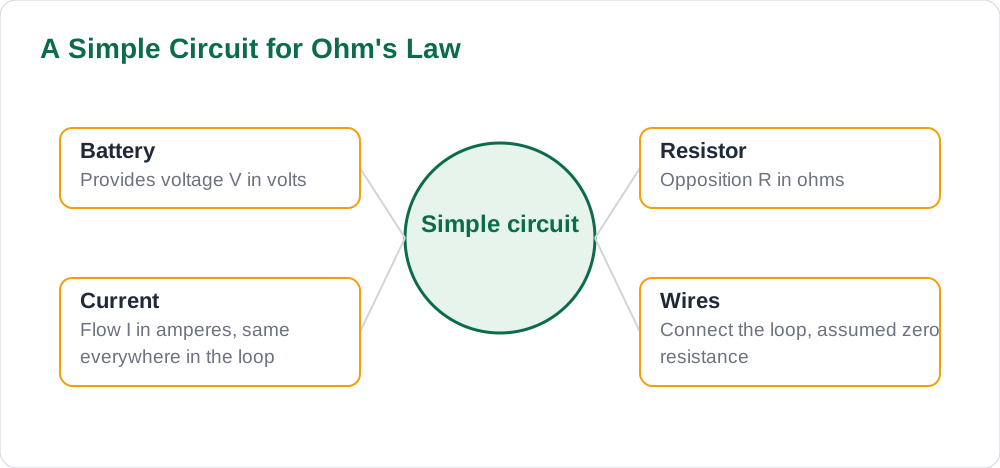
Example: A circuit has a 12 V battery and two resistors in series, 2 ohms and 4 ohms. Find the current. Solution: total resistance in series = 2 + 4 = 6 ohms. Current = 12 / 6 = 2 A. This question previews the series rule covered in the next guide, but the Ohm's law step is the same: find total resistance first, then apply V = IR to the whole circuit. When reading a circuit diagram, trace the single loop for series circuits and confirm there is only one path for the current. A diagram that shows the battery, the resistors, and the connecting wires with no branches is a series circuit.
Common Mistakes and Exam Tips
The top mistakes are forgetting milliampere and kilo-ohm conversions, rearranging the formula incorrectly, and confusing voltage across a component with the battery voltage in a circuit with several components. In a series circuit, the battery voltage is shared between components, so the voltage across one resistor is only part of the total. Always check whether the question gives the voltage across the resistor itself or the whole battery, and if it gives the battery voltage for a multi-resistor circuit, find the total resistance first. A second trap is writing the answer without a unit: 30 is not an answer, 30 V is.
Build this routine: list V, I, and R with their units, convert mA and kilo-ohms, pick the rearrangement for the missing quantity, substitute with units, calculate, and back-substitute to check. Practise mixed questions where each of the three quantities is missing in turn, and include conversion questions deliberately, because they are the ones that separate full marks from partial marks. The examples here are original practice problems for teaching the method. More guidance is on the blog and the about page.
- Convert mA to A by dividing by 1000.
- Convert kilo-ohms to ohms by multiplying by 1000.
- In series circuits, battery voltage is shared between resistors.
- Back-substitute your answer into V = IR to check it.
AI Help: Muse AI
Muse AI is Meta's personal AI assistant, and it can help you practise Ohm's law numericals by generating mixed V, I, and R problems, checking your milliampere and kilo-ohm conversions, and explaining circuit diagrams in simple words. Ask it to quiz you on all three rearrangements of V = IR until each one is instant. Join Muse with invite code LTGSWD — in the Muse app, go to Settings > Redeem token and enter the code. Disclosure: LTGSWD is the author's Muse invite code. Muse AI does not give official STBB answers — always verify against your STBB book and your teacher. Always verify against your Sindh Textbook Board book and your teacher before using anything in classwork.
5 key points you must know
- Ohm's law: V = IR, with volts, amperes, and ohms.
- Rearranged forms: I = V / R and R = V / I.
- Convert mA to A by dividing by 1000; kilo-ohms to ohms by multiplying by 1000.
- Ohm's law holds at constant temperature.
- Back-substitute your answer to check every calculation.
Frequently asked questions
What is Ohm's law?
Ohm's law states that current through a conductor is directly proportional to the voltage across it at constant temperature. In symbols, V = IR, where V is voltage, I is current, and R is resistance.
How do I convert 250 mA to amperes?
Divide by 1000. So 250 mA is 0.25 A. Similarly, 2 kilo-ohms is 2000 ohms, found by multiplying by 1000.
Does a filament bulb obey Ohm's law?
Not strictly. As current increases, the filament heats up and its resistance rises, so the current-voltage graph curves. Metal wires at steady temperature do obey Ohm's law.
How do I find resistance if I know voltage and current?
Use R = V / I. For example, 12 V divided by 3 A gives 4 ohms. Always check the answer by multiplying current times resistance to recover the voltage.
What happens to current if resistance doubles at fixed voltage?
The current halves, because I = V / R. Doubling the denominator halves the result when voltage stays the same.
Solved notes — preview free
These guides work best with the solved exercises. Preview the solved notes free on this website — 119 solved notes for Classes 6–10 in Sindhi, Urdu, English and Arabic medium. Or browse the full solved notes catalogue for your class and medium. New solved notes are added regularly — check the catalogue for coming-soon books.