Class 10 Physics: Light Reflection Numericals

Class 10 physics light reflection numericals centre on the mirror formula, 1/f = 1/v + 1/u, and magnification, m = negative v/u, together with the sign convention that makes them work. Students find this chapter hard not because the algebra is difficult, but because sign errors flip answers and because image nature, real or virtual, upright or inverted, magnified or diminished, must be read from the signs. This guide teaches the sign convention first, then the formulas, then original worked examples for concave and convex mirrors, so you can answer both the number and the description of the image. Reflection is the bouncing back of light when it strikes a smooth surface, and the laws of reflection state that the angle of incidence equals the angle of reflection, with both angles measured from the normal, the line perpendicular to the surface. Mirrors form images by reflection: a plane mirror gives a virtual, upright, same-size image as far behind the mirror as the object is in front, while spherical mirrors, concave and convex, can magnify, diminish, and invert images depending on where the object stands. The mirror formula connects object distance, image distance, and focal length, and magnification tells you how large the image is compared with the object.
The Sign Convention You Must Memorise
The sign convention used here is the standard one for Class 10: all distances are measured from the pole of the mirror. Distances measured in the direction of incident light, that is, in front of a mirror, are taken as negative, while distances behind the mirror are positive. Object distance u is therefore almost always negative, because the object stands in front of the mirror. Focal length f is negative for a concave mirror and positive for a convex mirror. Image distance v is negative for a real image formed in front of the mirror, and positive for a virtual image formed behind it. Height of the object is positive above the axis, and image height is positive if upright and negative if inverted.
This convention feels backwards at first, because the object distance you measure with a ruler is positive, but you must enter it as negative in the formula. The most reliable habit is to write u = negative value as the first line of every solution, before touching the mirror formula. If you skip that line, sign errors follow. A second habit is to interpret the sign of your answer at the end: a negative v means a real image in front of the mirror, a positive v means a virtual image behind it, and the sign of magnification tells you upright (positive) or inverted (negative). The number alone is only half the answer; the description completes it.
- Object distance u is negative (object in front of mirror).
- Concave f is negative; convex f is positive.
- Negative v means real image; positive v means virtual image.
- Magnification sign: positive upright, negative inverted.
Mirror Formula and Magnification
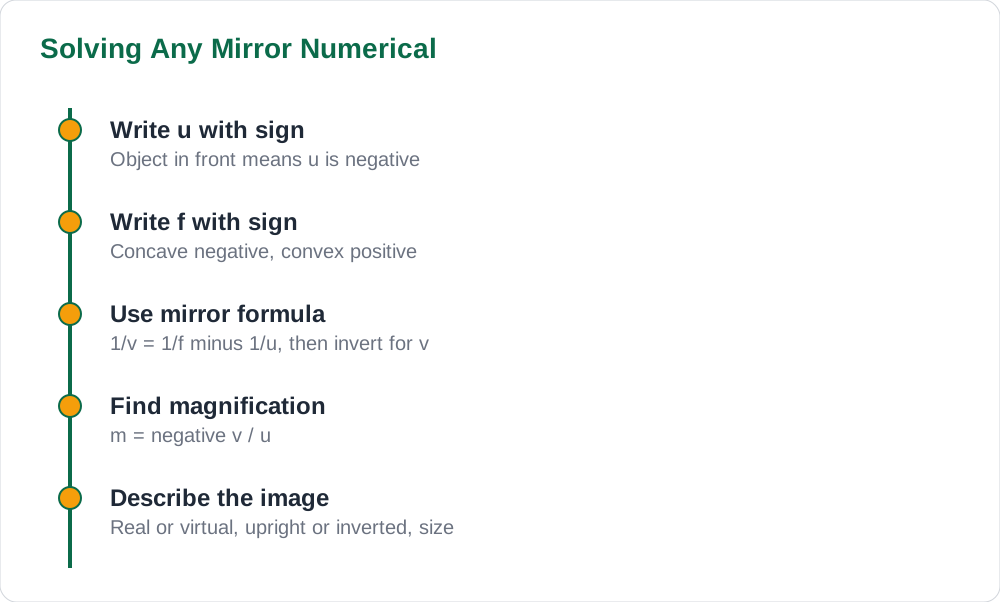
The mirror formula is 1/f = 1/v + 1/u, where f is focal length, v is image distance, and u is object distance, all in the same unit, usually centimetres. Focal length is half the radius of curvature: f = R / 2. Magnification is m = negative v / u, and it also equals image height divided by object height, m = h image / h object. The magnitude of m tells you size: m larger than 1 means magnified, m smaller than 1 means diminished, and m equal to 1 means same size. To find an unknown, rearrange the formula: 1/v = 1/f minus 1/u, then invert to get v. The inversion step is where many students stop early, so circle it in your working.
A worked pattern helps: for a concave mirror with f = negative 20 cm and an object at u = negative 30 cm, 1/v = 1/(negative 20) minus 1/(negative 30) = negative 1/20 + 1/30 = negative 3/60 + 2/60 = negative 1/60, so v = negative 60 cm. The negative sign means a real image 60 cm in front of the mirror. Magnification = negative (negative 60) / (negative 30) = negative 2, so the image is inverted and magnified twice. Every mirror question follows this same pattern: substitute with signs, solve for v, invert, then find m and describe the image.
Worked Example 1: Concave Mirror
Example: An object is placed 15 cm in front of a concave mirror of focal length 10 cm. Find the image distance and magnification, and describe the image. Solution: f = negative 10 cm, u = negative 15 cm. 1/v = 1/f minus 1/u = 1/(negative 10) minus 1/(negative 15) = negative 1/10 + 1/15 = negative 3/30 + 2/30 = negative 1/30. So v = negative 30 cm. Magnification = negative (negative 30) / (negative 15) = negative 2. The image is real (negative v), inverted (negative m), and magnified 2 times, formed 30 cm in front of the mirror. This matches the known behaviour of a concave mirror when the object is between the focal point and the centre of curvature.
Example: An object 4 cm tall is placed 30 cm in front of a concave mirror of focal length 20 cm. Find the image height. Solution: f = negative 20 cm, u = negative 30 cm. 1/v = 1/(negative 20) minus 1/(negative 30) = negative 1/20 + 1/30 = negative 1/60, so v = negative 60 cm. Magnification = negative (negative 60) / (negative 30) = negative 2. Image height = m times object height = negative 2 times 4 = negative 8 cm. The negative sign means inverted, and the height is 8 cm. Always include the sign in the image height, because it carries the upright or inverted information.
Worked Example 2: Convex Mirror
Example: An object is placed 20 cm in front of a convex mirror of focal length 10 cm. Find the image distance and magnification, and describe the image. Solution: f = positive 10 cm, u = negative 20 cm. 1/v = 1/10 minus 1/(negative 20) = 1/10 + 1/20 = 3/20, so v = positive 6.67 cm. Magnification = negative (positive 6.67) / (negative 20) = positive 0.33. The image is virtual (positive v), upright (positive m), and diminished (m less than 1), formed 6.67 cm behind the mirror. Convex mirrors always give this kind of image, whatever the object distance, which is why they are used as rear-view mirrors: they show a wide, upright, if smaller, view.
Example: A convex mirror has a radius of curvature of 40 cm. Find its focal length. Solution: f = R / 2 = 40 / 2 = 20 cm, and because the mirror is convex, f = positive 20 cm. Radius questions are easy marks, but remember the sign: concave mirrors take negative f, convex mirrors positive f, and the radius sign follows the same rule. For more solved study material, see the solved notes and the books section.
Common Mistakes and Exam Tips
The dominant mistakes are entering u as positive, using the wrong sign for f, forgetting to invert after finding 1/v, and describing the image from the number alone without reading the signs. A second group of errors comes from mixing up magnification formulas: m = negative v / u uses distances, while m = image height / object height uses heights, and both give the same value. A third trap is unit mixing: object distance in metres and focal length in centimetres must be converted to the same unit before substituting. Convert everything to centimetres first, since mirror questions almost always use centimetres.
Exam technique: write the sign convention line first, substitute with signs visible, show the inversion step, and finish with a full image description in words, not just numbers. A complete answer reads: v = negative 30 cm, m = negative 2, so the image is real, inverted, and magnified 2 times, formed 30 cm in front of the mirror. That sentence earns the description marks that a bare number cannot. The examples here are original practice problems for teaching the method. More guidance is on the blog and the about page.
- Always write u as negative for an object in front of the mirror.
- Concave f negative, convex f positive.
- Invert 1/v to get v; do not stop at the reciprocal.
- Describe the image fully: real or virtual, upright or inverted, size.
AI Help: Muse AI
Muse AI is Meta's personal AI assistant, and it can help you practise mirror numericals by generating concave and convex mirror problems, checking your sign convention step by step, and explaining image descriptions in simple words. Ask it to quiz you on reading image nature from the signs of v and m. Join Muse with invite code LTGSWD — in the Muse app, go to Settings > Redeem token and enter the code. Disclosure: LTGSWD is the author's Muse invite code. Muse AI does not give official STBB answers — always verify against your STBB book and your teacher. Always verify against your Sindh Textbook Board book and your teacher before using anything in classwork.
5 key points you must know
- Mirror formula: 1/f = 1/v + 1/u, all distances in the same unit.
- Object distance u is negative; concave f negative, convex f positive.
- Magnification m = negative v / u = image height / object height.
- Negative v means real image; positive v means virtual image.
- Always describe the image: real or virtual, upright or inverted, size.
Frequently asked questions
Why is object distance negative in the mirror formula?
By the sign convention, distances measured in front of the mirror, in the direction of incident light, are negative. Since the object stands in front of the mirror, u is entered as negative.
How do I know if an image is real or virtual?
Look at the sign of v. A negative v means the image forms in front of the mirror and is real. A positive v means it forms behind the mirror and is virtual.
What does a magnification of negative 2 mean?
The negative sign means inverted, and the magnitude 2 means the image is twice the size of the object. So the image is inverted and magnified 2 times.
Do convex mirrors ever give real images?
No, for a real object a convex mirror always gives a virtual, upright, diminished image behind the mirror, whatever the object distance.
How is focal length related to radius of curvature?
Focal length is half the radius of curvature: f = R / 2. Remember the sign: negative for concave mirrors, positive for convex mirrors.
Solved notes — preview free
These guides work best with the solved exercises. Preview the solved notes free on this website — 119 solved notes for Classes 6–10 in Sindhi, Urdu, English and Arabic medium. Or browse the full solved notes catalogue for your class and medium. New solved notes are added regularly — check the catalogue for coming-soon books.